







Quick answer
App user acquisition for an AI product works in one order: make the promise legible, define in data the moment a new user first gets value, then buy attention against a payback period rather than a cost per signup. Most AI companies run that sequence backwards and pay for accounts that log in once. The repair is usually in the copy and the first ten minutes of the product, not in the budget.
I have run growth for software and app businesses where the product was good and the market walked past it anyway. Traffic arrives, the signup chart looks healthy, revenue does not move. If you would rather have this run with you than read about it, that is what my B2B digital marketing consulting covers.
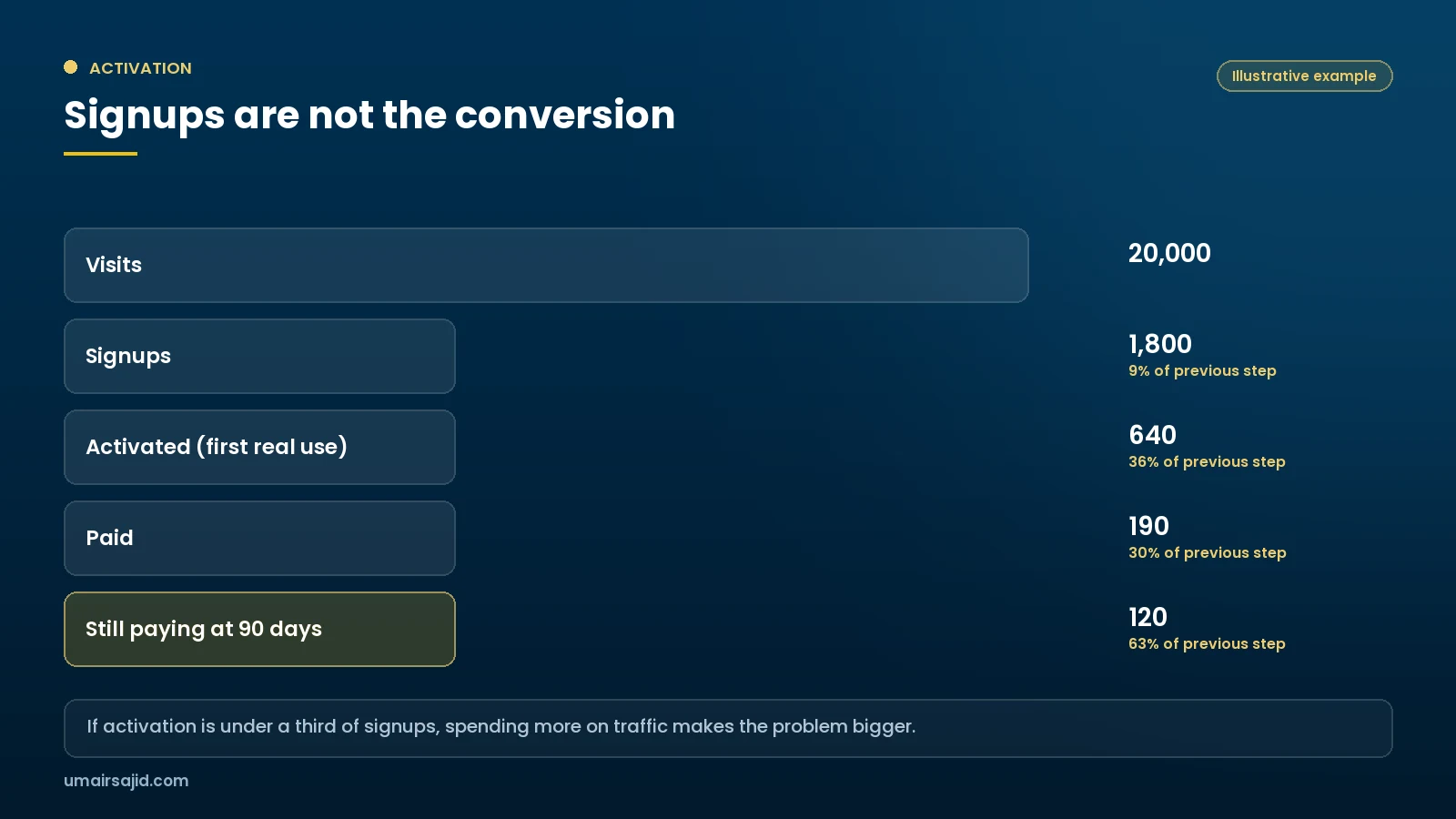
That funnel is illustrative, drawn rather than taken from an account, because the shape matters more than anyone’s numbers. Visits are fine. Signups are fine. The floor falls out between signing up and the first useful result.
So this is the playbook: the first call, the fixes that come before any ads, the channels that earn a place, and the first ninety days.
Who this is for: founders and growth leads at AI app and AI-assisted software companies with a product already in real users’ hands, who want demand that does not depend on a launch going well.
Start with the goal, not the channel
Signups are the cheapest number in your business to move and the one least connected to revenue.
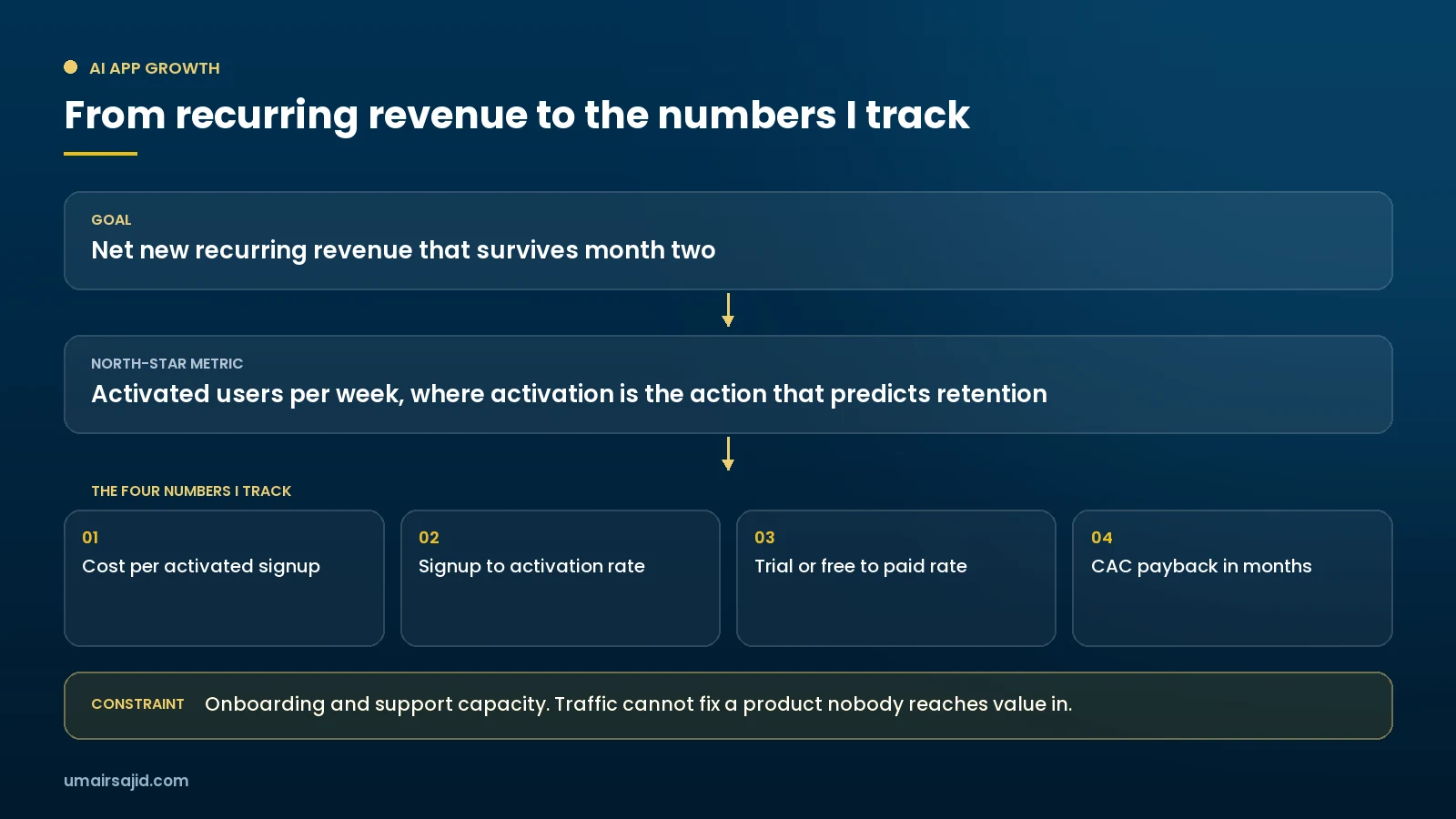
Every engagement starts with the same argument. The dashboard shows signups climbing and nobody can say how many of those people came back on day seven. So the number we steer by is activated users per week: people who reached the point where the product is actually useful, inside a window you can measure.
Defining that point is data work, not a whiteboard session. Pull the cohorts, find the action that separates people still around after thirty days from the ones who vanished, and set a threshold. For a writing product it may be three documents finished in week one; for a support product, one connected inbox and one ticket answered. That becomes the conversion everything optimizes toward.
Four numbers sit under it, and I report them weekly:
- Cost per activated signup. Spend divided by people who reached the value moment, not by accounts created.
- Signup to activation rate. When this is low, more traffic makes the problem more expensive rather than smaller.
- Trial to paid rate. When this is low, the problem is packaging, pricing, or the gap between what the page promised and what the product did.
- CAC payback in months. How long a customer takes to repay what it cost to win them, counted in gross margin and not revenue.
One constraint decides the ceiling, and it is rarely money: onboarding and support capacity. An AI product that wins a thousand accounts in a week and answers none of their questions has bought a churn cohort and a pile of one-star reviews.
A signup is only a promise to try. Activation is the first evidence anyone believed you.
What I need to understand before I touch anything
The first two weeks have nothing to show for them. No campaigns, no redesign. I am working out what the product is to the person paying for it.
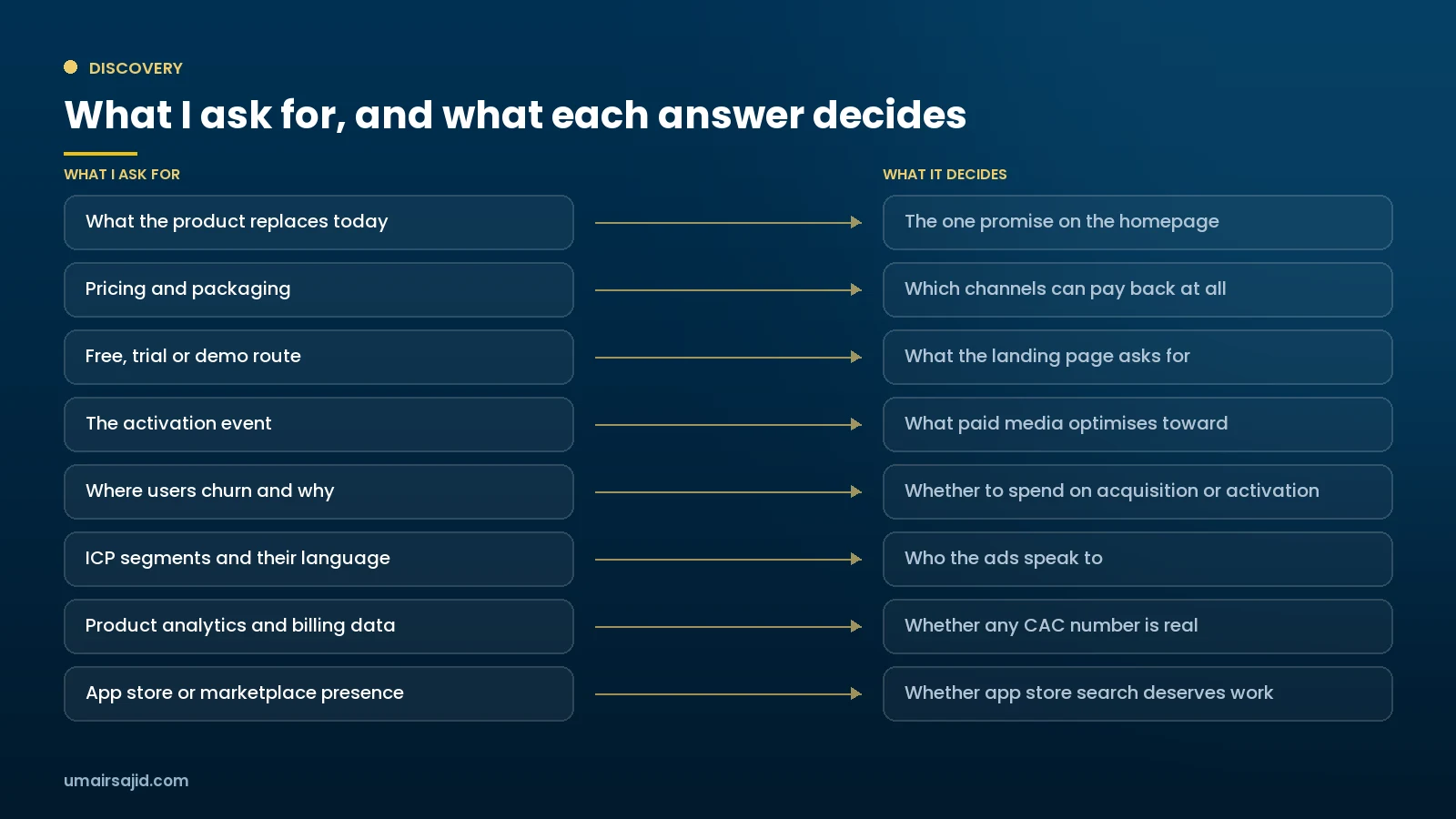
These are the questions, and why each one exists:
- What does this replace? A spreadsheet, an agency, a junior hire, a competitor, or nothing at all. The alternative sets the message and the price, and “nothing at all” is the hardest market to sell into.
- Who felt the pain first? Usually one job title in one kind of company. That is the ideal customer profile until the data says otherwise.
- How is it priced and packaged? Per seat, per usage, per workspace, flat. Packaging decides whether growth comes from new logos or from accounts that grow themselves.
- Free, trial or demo? Each moves acquisition cost and sales load in a different direction, and I cover that further down.
- What is the activation event, and what is the rate today? If nobody can answer this, it is job one.
- Where do people churn, and when? Week one churn is an onboarding problem. Month six churn is a value problem.
- What does product analytics already record? Half the teams I meet have the tool installed and three events firing, none useful.
- What does a paying account pay over twelve months, including expansion? This is the ceiling on acquisition spend.
- What is app user acquisition cost today, blended and by channel? Blended alone hides the channel quietly subsidizing the others.
- Who sells, and how much load can they carry? A demo-led model with one founder taking calls has a hard weekly limit.
- Is there an app store or marketplace listing, and who controls it? Store search sends buyers who have already decided to install something.
- What access can I have? Analytics, Search Console, ad accounts, product analytics, billing, CRM and the site admin.
That last one is a gate, not a request. If billing and product events are not visible, every report I write later is the ad platform’s opinion of itself.
Two things stop a paid campaign before it starts. The first is conversions that carry no revenue: if the platform cannot see which signups became paying accounts and what they were worth, it optimizes toward the cheapest email address in the country. The second is a broken activation rate. Buying traffic into a product where nine of ten users never reach the value moment is paying to fill a bucket with a hole in it.
Demand and competitor research
The research for this market gives an uncomfortable answer: the words AI companies use about themselves are not the words anyone searches.
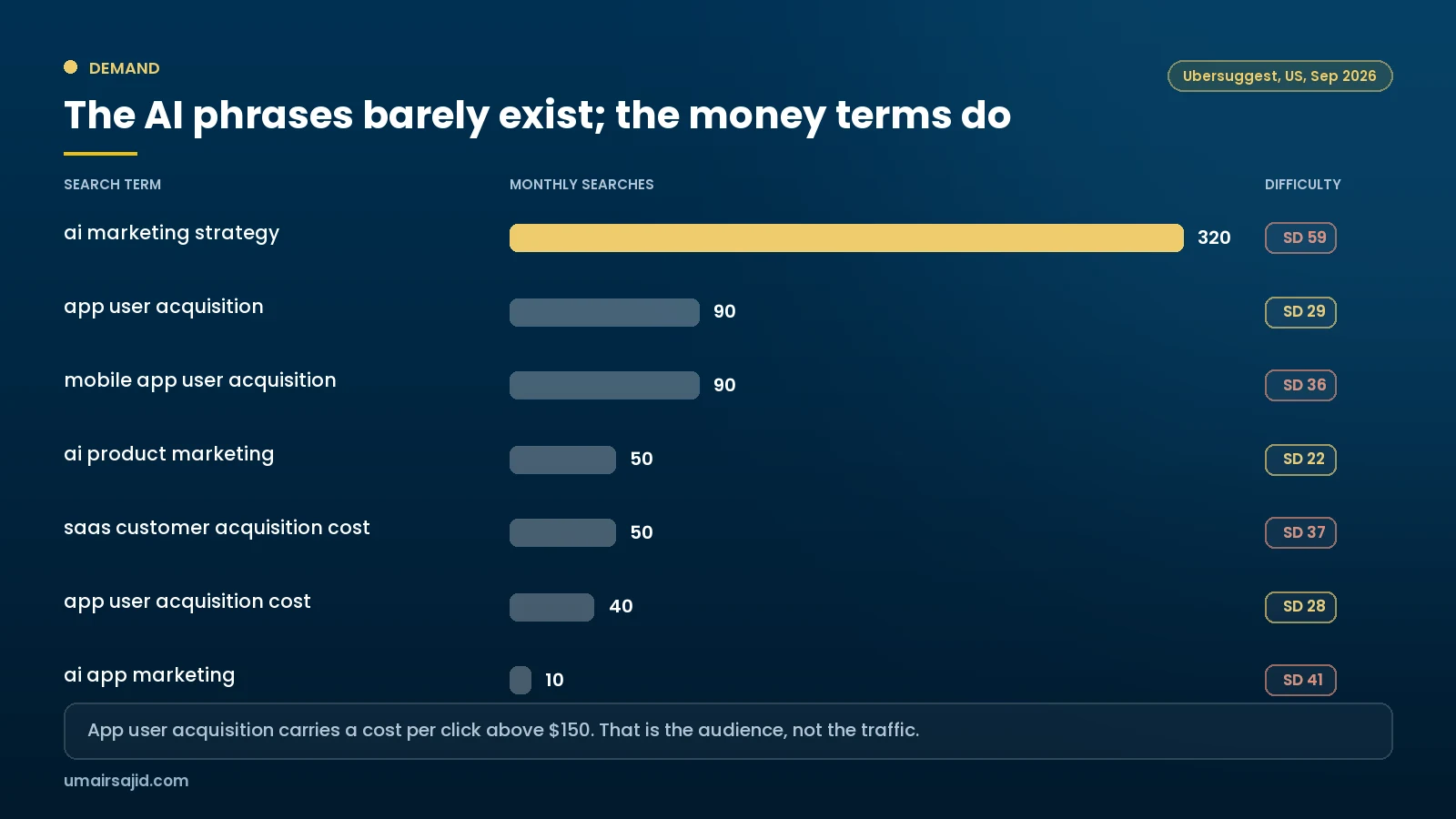
Those are real figures from Ubersuggest for the US in September 2026, not illustrations. The exact-match phrases are close to empty: “ai app marketing” returns about 10 searches a month at a difficulty of 41, “ai saas marketing” the same 10 at difficulty 42, and “ai startup marketing” returns zero.
The acquisition language carries the money instead. “app user acquisition” sits at 90 searches with a cost per click around $150, “mobile app user acquisition” the same, “ai product marketing” at 50 with a difficulty of only 22, and “saas customer acquisition cost” at 50. The broad “ai marketing strategy” term has 320 searches at difficulty 59, which means competing with business school publishers.
So do not build a content program on your category label. Almost nobody types “ai app marketing” into Google, and the few who do are marketers shopping for tools rather than buyers shopping for your product. Demand lives in two other places: the language of the job your product does, and the language of money.
Write for the task (“summarize support tickets automatically”, “reconcile invoices without a bookkeeper”) and for the commercial decision. Publish the category page anyway if it helps in a sales conversation, but plan it as a sales asset rather than a traffic source.
The second demand pool is comparison. People search competitors’ names with “alternatives”, “vs” and “pricing” attached, and that traffic converts far better than top-of-funnel visits, because the buyer has decided to buy something. The same demand sits on review sites and inside app stores, where the search box is a purchase queue.
Reading the results page honestly. For most software queries, page one is review aggregators, listicles and a competitor’s comparison page. If the whole page is aggregators, a better blog post will not change your week. Getting reviewed there will.
Looking at the ads, not just the pages. Ad libraries show which competitor creative has run for months rather than days, and a four-month-old ad is a working ad. Their pricing pages tell you what they cap and which objection they answer first.
The positioning gap is the last thing I look for and the most useful. Read twenty competitor homepages in any AI category and they claim the same adjectives: intelligent, powerful, automated, enterprise-ready. Almost none say who it is for, what it replaces, or what it will not do. Specific beats superior, and here specific is also rare.
The growth roadmap
The sequencing rule I do not bend for an AI product: positioning before traffic, activation before scale.
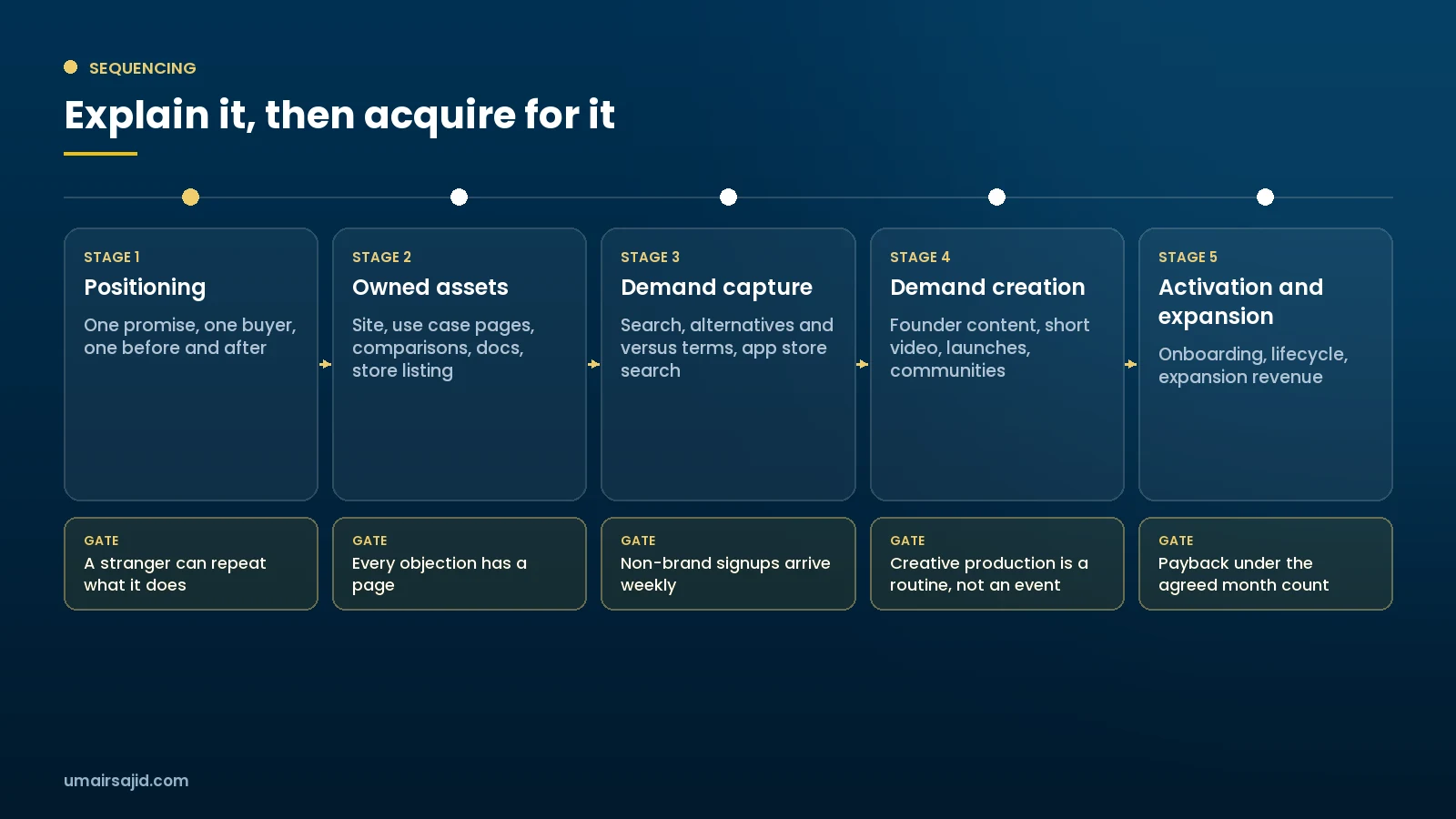
Paid traffic pointed at an unclear promise is a tax you pay twice: once to the platform, and again in the visitors who understood nothing and left. Most AI apps I audit do not have a traffic problem. They have an explanation problem, and more visits make it louder rather than smaller.
Each stage has a gate, so nobody has to argue about readiness:
| Stage | What gets built | The gate before moving on |
|---|---|---|
| Positioning | One promise, the ICP, what it replaces, pricing clarity | Five customers repeat the promise back in their own words |
| Owned assets | Homepage, use-case pages, comparison pages, docs, store listing | Activation is defined, tracked and reported weekly |
| Demand capture | Search on problem and alternative terms, review sites, retargeting | Cost per activated signup is known by channel |
| Demand creation | Founder content, short video, communities, paid social | Creative volume holds without a launch behind it |
| Activation and expansion | Onboarding, lifecycle, usage-based upgrades | Payback sits inside the target window |
One exception. If the promise is already sharp and activation already holds, I will run Search on competitor and alternative terms in week one, because those competitors bid on your brand name whether or not your roadmap is finished.
Owned media: the assets you keep
Owned media is everything that still exists if every ad account closed tomorrow: the positioning, the site, the docs, the store listing, the onboarding, and your customer list.
Positioning is the first marketing asset
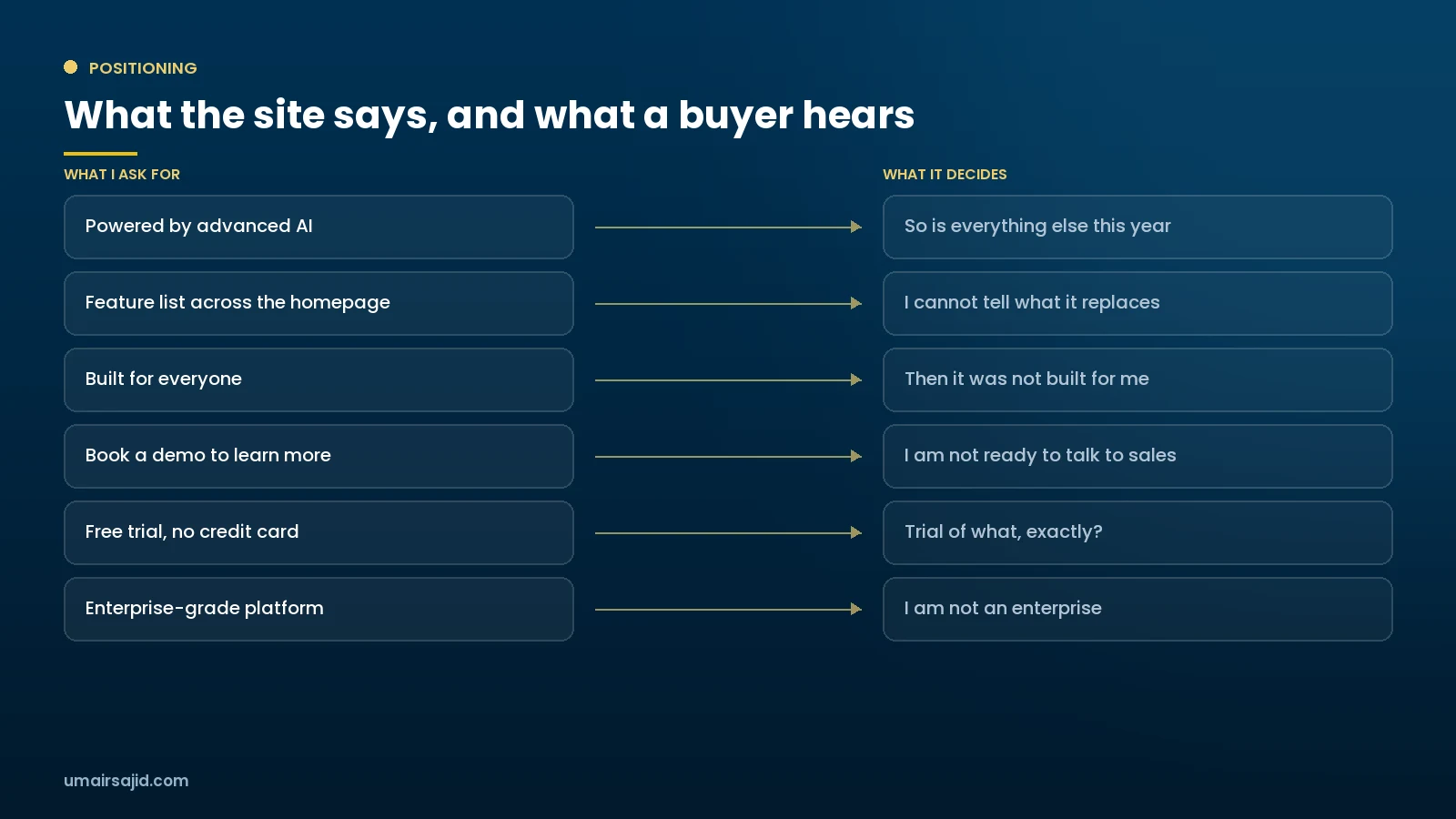
The gap in that image is the whole problem. The site says “AI-powered workflow intelligence”. The buyer hears “I do not know what this is or whether it is for me”, closes the tab, and goes back to the spreadsheet that at least does something.
A promise that works names four things: who it is for, the job it does, what it replaces, and the evidence. “Turn a week of support tickets into a tagged report, for support leads at companies without a data team, instead of the two days someone spends in a spreadsheet.” The test is whether five customers, asked what the product does, come back with the same sentence.
The page map comes before the design
For an AI app it is usually: home, one page per use case written as a job rather than a feature, one per ICP segment if the segments buy differently, a comparison page for each serious competitor, an alternatives page, pricing, docs, a security and data page, case studies and a start page. If your buyers are enterprise, the data page is a sales requirement, because the first question about any AI product is where the data goes.
What each page has to contain

The homepage carries one promise in the buyer’s own words, above the fold, with proof beneath it and an honest description of how the thing works. People buying AI products want the mechanism, because they have been sold vapor before. Saying what the product does not do buys more trust than another adjective.
Use-case pages take a single job end to end: the situation, the old way, what changes, what setup takes, and one way to start. Screenshots of real output beat any paragraph about it.
Comparison and alternatives pages are the highest converting content type in software, and they take the effort that would otherwise go into category blogging. Write the fair version. State where the competitor is better, because the buyer has their tab open next to yours and a page that pretends otherwise loses the sale and the trust together.
Pricing and packaging as a conversion lever
Hiding the price costs more deals than it protects. If the model is complicated, publish the shape of it: what you charge for, what the entry point covers, what happens at the limit.
Then the decision that shapes your acquisition model. Free brings volume and the lowest cost per signup, while raising support load and making the paid signal noisy, so ad platforms learn from people who will never pay.
A time-boxed trial keeps that signal clean and forces activation inside a window. A demo lifts lead quality and puts a human cost on every enquiry, so it works only when contract value carries the sales hours. Copying a company with a different price point is how teams end up with a thousand free users and no pipeline.
Docs, templates and the SEO assets nobody bothers to copy
Documentation ranks for the long tail of task searches, and almost no marketing team treats it as marketing. Add templates, prompt libraries, a calculator for acquisition cost or payback, and a glossary of your category’s terms. These pull the links an AI product usually lacks.
App store and marketplace listings
If there is a mobile or desktop app, store search is a demand channel with its own rules. Title and subtitle carry most of the ranking weight, the first two screenshots do the converting, and review volume decides whether anyone believes either. Integration directories matter as much for B2B, reaching buyers while they extend their stack. Store policies change often, particularly around AI features and data use, so check the current App Store review guidelines and the equivalent for your other platforms before planning around them.
Onboarding and lifecycle: the cheapest growth available
A ten point lift in activation is worth more than a ten percent cut in cost per click, and it is easier to get. The work is unglamorous. A first-run checklist with three steps rather than nine. Sample data so the empty state is never empty. Prompts that appear when someone stalls rather than when they arrive.
Around it sit the lifecycle emails: a first-day nudge toward the missing step, a mid-trial message that depends on what the person did, a last-day message built on the result they produced, and a reactivation for quiet accounts. Then expansion, where the economics of an AI product are won. Seats, usage tiers and team upgrades let a customer pay you more without you paying again to win them, and that buys a payback period competitors cannot afford.
Social and the content engine
Two platforms done properly beat five done occasionally. For most B2B AI products that means LinkedIn and one video surface. The mix is product demonstrations, the problem behind the product, and opinions worth disagreeing with. Anything a competitor could have posted is wasted effort. If you want it planned and run rather than explained, social media marketing strategy covers that.
Earned media: the proof other people create
Earned media is what other people say, list and link to. It is the research your buyer does before reaching your site.
Launch platforms. A launch gives you one day of attention, a page that keeps ranking, and a link. Plan it as an event inside the pipeline, not a strategy. Companies that treat a launch as the plan spend the next quarter wondering where everybody went.
Review sites. For B2B software, review volume and recency on the major aggregators decide who appears in comparison searches at all. Ask at the activation moment, when the product has just done something useful, never with a reward attached.
Communities are the slow half. Slack groups, subreddits, forums and niche newsletters all work on one rule: answer the question in a way that helps even if the person never buys, and say who you are. A newsletter with four thousand of the right readers outperforms a podcast with four hundred thousand of the wrong ones.
The founder’s own account. Founder-led content on LinkedIn is the most under-priced channel in B2B software at the moment. Posts about the problem, the build decisions and the things that did not work outperform any company page, because people follow people. Twenty minutes a day from a founder beats a content retainer. Every integration you ship adds to the same pile: a listing, a link and a search surface.
What I never do: buy reviews, incentivize ratings, run a review gate that only asks happy customers, buy links, or post in communities from accounts pretending to be customers. For a product that asks people to trust it with their data, getting caught is expensive in a way no campaign repays.
Paid media: buying demand once the promise holds
Now we buy traffic, and the number we judge it by is not cost per signup.

Cost per signup flatters free products and punishes demo-led ones, which makes it useless for comparing channels. I judge on CAC payback: how many months of gross margin a channel’s customers take to repay what it cost to win them. A channel with double the cost per signup and half the payback is the better one, and only this metric shows it.
Google Search. Three intent groups, in three campaigns. Problem terms, where somebody describes the job without knowing your category exists. Alternative and competitor terms, small in volume and high in intent. Your own brand, which you defend because competitors bid on it. Keep match types tight and run a serious negative list: jobs, courses, free, tutorial, github, api docs. Clicks here are among the most expensive anywhere, so loose broad match is a fast way to lose a quarter’s budget.
LinkedIn for B2B ICPs. Expensive per click and worth it when contract value carries it. Target by job title and company size, run the offer that matches the sales model, and accept that the first useful read takes longer than on Search. What works is a specific claim with a screenshot, not a stock photo with a slogan across it. This is where lead generation work pays for itself, because a LinkedIn lead is only as good as what you asked for on the form.
Meta and TikTok come later, and only once creative volume exists. If the team cannot produce five to ten pieces a month, mostly product demonstrations filmed on a phone, do not start. Broad targeting with a clean conversion signal beats stacked interests, provided the signal you send back is activation rather than a page view.
Retargeting is split by funnel stage, never pooled: visited pricing, started the signup and stopped, signed up and never activated, trial ending, churned. Five audiences, five messages. Most accounts I inherit show one ad to all of them.
Budget logic. Budgets come from payback, not a percentage of revenue. Scale when payback holds at the higher volume, and write the stopping rule before launch so nobody negotiates with a losing campaign in week three. Google Ads management covers this work when you want it run rather than described.
The measurement stack
If the ad platforms cannot see revenue, they optimize toward whatever is cheapest, and cheapest is never your best customer.
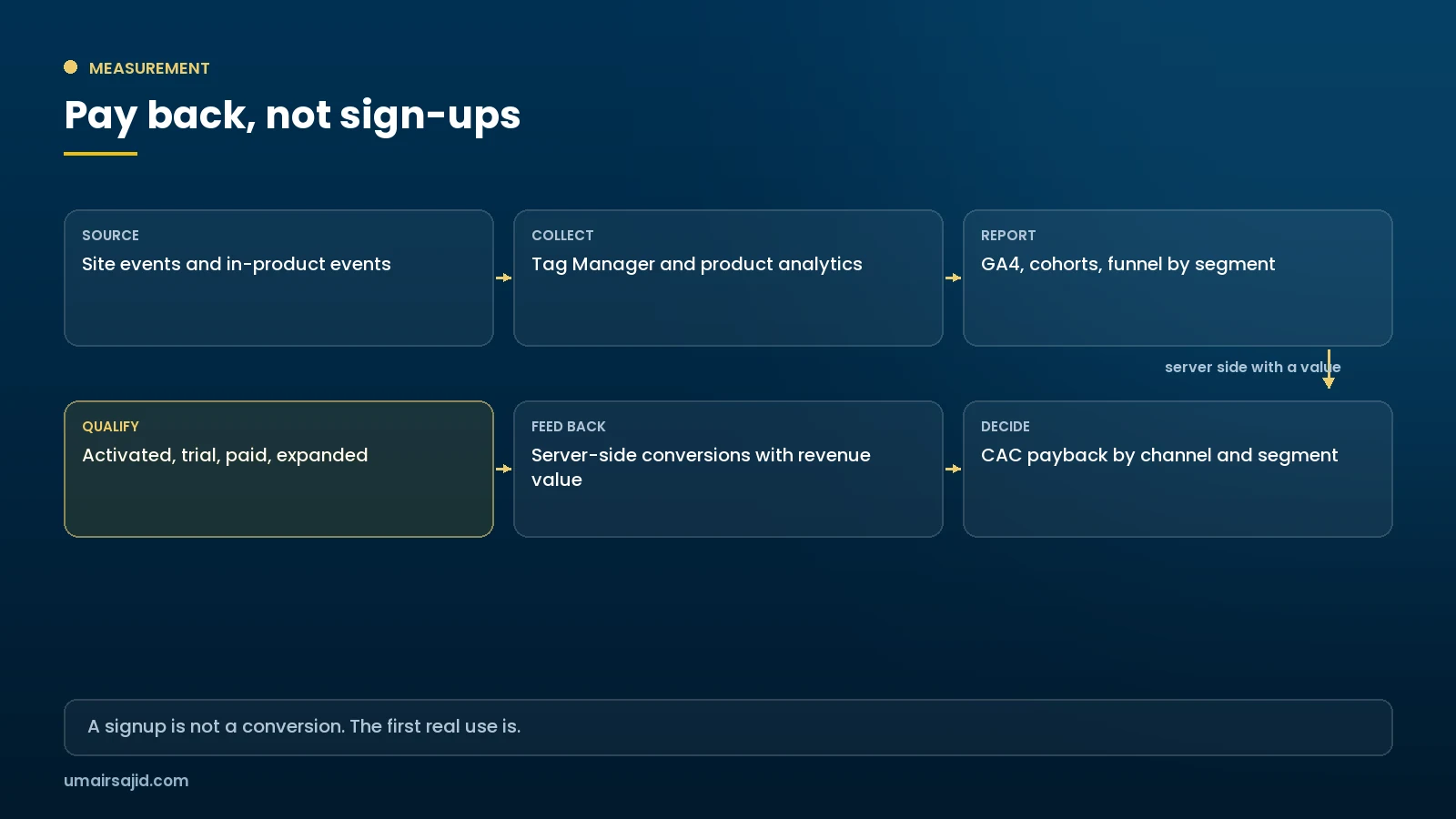
What counts as a conversion. Activation, trial start where the model has one, paid conversion with its real value attached, and expansion. Not signups, not installs, not “engaged sessions”.
The stack. Tag Manager on the marketing site, GA4 for acquisition, product analytics for in-product behavior, billing for what was actually paid, and a CRM if there is a sales motion. Then the step almost nobody takes: joining billing back to the ad platforms through server-side conversions that carry the revenue value. When a platform learns that one campaign produces accounts worth four times another’s, it changes what it buys, and that has moved more revenue for me than any creative refresh.
Consent belongs in the same build, not after it. Consent mode configured properly, identifiers hashed, customer data kept in systems you control. For an AI product this is not paperwork. Your buyer is already nervous about where data goes, and a careless site answers that question before a salesperson gets a chance.
The one report. A single page: spend, activated users, cost per activated signup, trial to paid, new recurring revenue by source, and payback by monthly cohort. If a report takes longer to read than to act on, it is the wrong report.
Last click is wrong in software, where somebody hears about you on a podcast, reads three comparison pages, and signs up from a branded search six weeks later. Three cheap correctives: a “how did you hear about us” field at signup, cohort views that ignore touchpoints, and holdout tests where a channel is paused and the effect on signups is measured. A defensible view beats a perfect one that does not exist.
Where AI and automation carry the load
This section carries a warning as well as a method.
The useful, boring parts first. Clustering thousands of search terms and support tickets into themes in minutes. Generating ad and landing section variants for a human to cut down. Deflecting repeat support questions so the team answers the hard ones. Scoring signups by fit. Flagging churn risk from usage drops. Pulling the weekly numbers into one sheet, so my time goes on the decision.
Now the warning. Using a model to write the marketing for an AI product at volume is how these companies end up sounding identical. The models learned from the same corpus of software marketing pages, so what comes back is the average of it, and the average is “intelligent, powerful, automated, built for modern teams”.
If your whole argument is that the product does something nobody else does, the copy cannot be the mean of everybody else’s copy. I use models for drafts and variants, then cut every adjective that survived the first pass and put back the specifics only the team knows: the number, the customer’s exact phrase, the thing the product refuses to do.
What I do not automate: the positioning, the customer interviews, the pricing decision, and the message that goes out when something breaks. Those are the business.
How the work actually runs
A plan nobody can run is a document. The engagement has a shape:
- Kickoff, where access is granted, activation is defined, and the stop list is written.
- A weekly call, thirty minutes, same time, same six numbers.
- A monthly review of payback by channel, which decides what moves.
- A quarterly reset on positioning, pricing and the channel mix.
Who does what: I own positioning, the site, search, ads, tracking and reporting. Product owns the onboarding changes and gets specifications from me rather than opinions. The founder owns their own content, which cannot be handed over without losing what makes it work. This is how I run every engagement as a freelance digital marketing consultant: one board, one document of decisions, one dashboard, and you keep all of it at the end.
The first 90 days
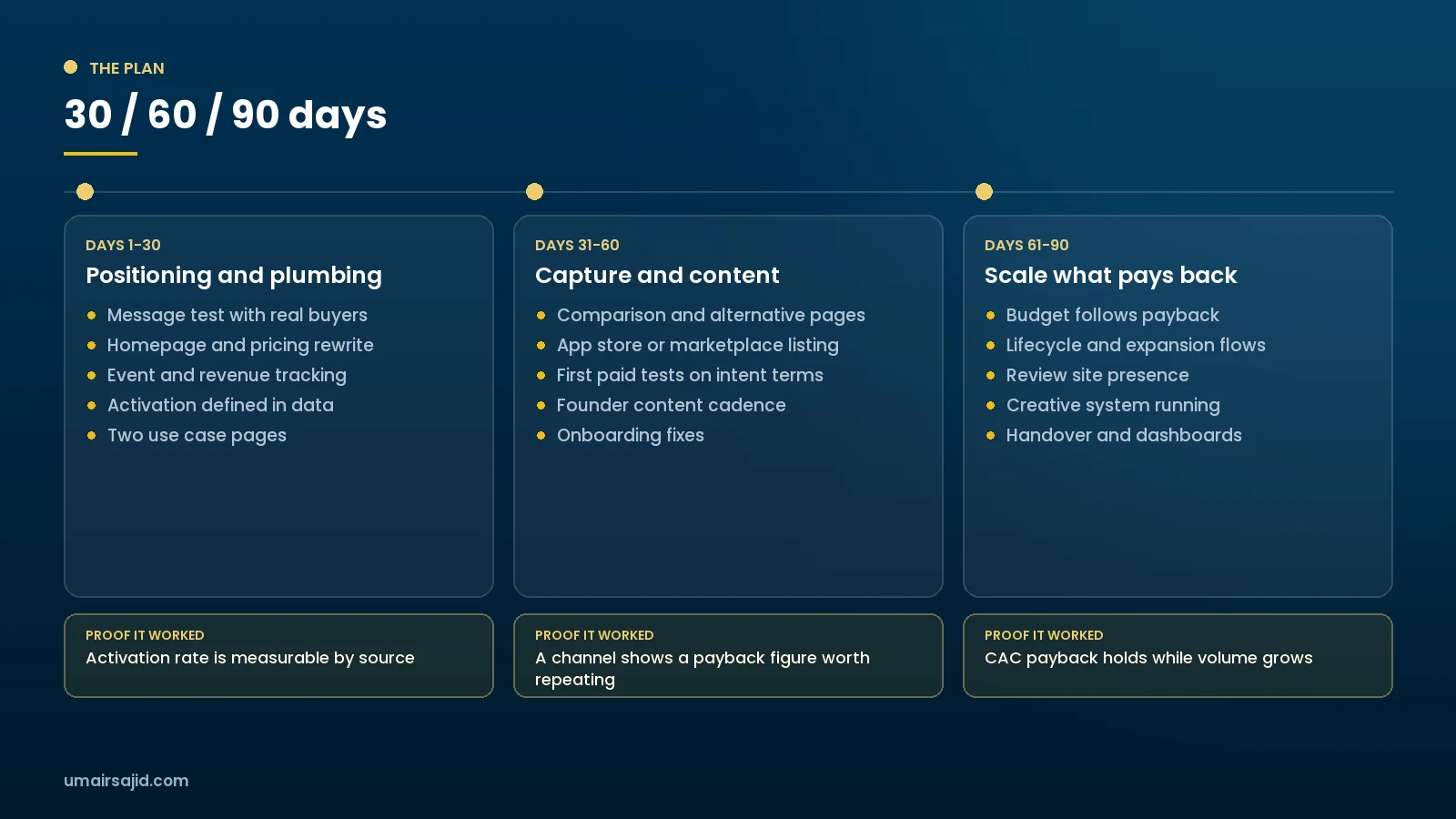
Days 1 to 30: positioning and plumbing. Customer interviews and the promise rewritten. Activation defined in the data and instrumented. Tracking rebuilt end to end, including server-side conversions carrying revenue. Homepage and the two strongest use-case pages rewritten. Onboarding cut to three steps. Search live on brand and alternative terms. Proof it worked: you can state your activation rate to one decimal place and see it by traffic source.
Days 31 to 60: assets and first tests. Comparison and alternatives pages published for the competitors that come up on sales calls. Docs and one template asset live. Review profiles completed and a review request running at the activation moment. The first LinkedIn or Search test at a real budget, with a written stopping rule. Lifecycle emails live. Proof it worked: cost per activated signup is stable enough to forecast against.
Days 61 to 90: scale what pays back. Budget moves to whichever channel has the shortest payback. Creative production becomes a weekly habit. Retargeting split by funnel stage. Expansion triggers built into the product and the emails. A first holdout test. Handover written. Proof it worked: payback sits inside the target window and new recurring revenue by source is a number the board can read.
What this looks like after 90 days
An honest picture, because the promises in this market are silly.
Landing page and onboarding changes show up in days. Paid search gives a readable signal in two to three weeks and a trend you can trust by week six. LinkedIn takes longer, because the audience is smaller and the sales cycle is not short. Comparison and use-case pages take three to six months to rank. Content built on AI category terms may never repay the effort in traffic, which is why I treat it as sales material.
Two results for context, from businesses in adjacent markets. An advisory firm I worked with lifted qualified B2B enquiries by 65 percent and cut cost per lead by 25 percent through LinkedIn work. A payments product raised conversions by 50 percent and cut cost per acquisition by 30 percent through PPC and landing-page changes. Those were their outcomes, in their markets, with their offers and margins. Yours will depend on your price point, your activation rate and how clearly you can say what you do.
I have written the same playbook for landscaping companies, remittance companies, appliance repair businesses and small businesses, and the framework applied to live accounts sits in the case studies.
The mistakes I stop first in AI products
- A feature list where a promise should be. Nine capabilities on a homepage means the visitor picks none and remembers nothing.
- Optimizing for signups. The vanity conversion of this industry. A free signup costs the user nothing, which is what it tells you about their intent.
- Launching on five channels at once. Five half-fed channels produce five inconclusive results and one exhausted team. Two, resourced properly, produce an answer.
- Discounting before activation is fixed. A discount on a product people cannot get working buys you cheaper churn.
- No comparison or alternatives pages. The buyer makes that comparison anyway, on somebody else’s page, with somebody else writing your column.
- Ignoring store and marketplace search. People searching inside an app store or an integration directory have decided to install something.
- Reporting acquisition cost with no payback number. Cost per acquisition without gross margin and retention beside it is unusable.
- Letting a model write the product’s own marketing. Competent copy that sounds like every competitor is the one outcome a company selling differentiation cannot afford.
FAQ
How do you market an AI app?
Start with the promise rather than the channel. Say what the product replaces, for whom, with proof, then define the moment a new user first gets value and measure how many reach it. Only then does channel work pay, judged on payback rather than signups.
SEO or paid first for a new AI product?
Paid first in most cases, because it tells you within weeks which message and which audience respond, and that answer feeds the SEO work. The exception is comparison and alternatives content, which I publish early because it converts immediately.
What is a realistic CAC payback period?
Work it out rather than adopt someone else’s. Take gross margin per customer per month, divide acquisition cost by it, then compare the answer with how long accounts survive. If the average customer stays eighteen months and payback lands at fourteen, the model does not work however good the growth chart looks.
Do comparison pages actually work?
They are consistently the best converting pages I build for software companies, because the reader has decided to buy something and is choosing between options. They work when they are fair: a page that pretends the competitor has no advantages reads as marketing, and the reader goes elsewhere.
How important is ASO for an AI app?
It matters when the product lives in a store or a marketplace, because that search box is full of people ready to install. Title and subtitle drive the ranking, the screenshots drive the install, and reviews decide whether either gets a chance. If your product is web only, integration directories are the equivalent.
Free trial or demo?
Contract value decides. A low price and fast time to value point to a free tier or a trial, because a human cannot afford to touch every deal. High contract value with real setup points to a demo. Running both without deciding which is primary splits your messaging and your sales time.
How do I stand out when every tool claims AI?
By naming the specific job, the specific person and the specific thing you replace, and by publishing what competitors avoid: price, setup time, limits, data handling. The adjectives are taken. The details are still available, and they are what buyers wanted anyway.
When is it too early for paid?
When the promise is not settled, when activation is not measured, or when conversions reaching the ad platform carry no revenue value. Any of the three turns paid spend into an expensive way to collect anecdotes. Fix them first, then start small with a written stopping rule.
Where to start
Take the order, if nothing else. Positioning before traffic, activation before scale, payback before budget. It is slower than launching on Monday, and it is why growth still holds in month nine.
The first move costs nothing. Open your product analytics and answer one question: what share of last month’s signups reached the point where your product became useful? If you cannot answer it, that is the first job, and the rest waits.
Free 30-minute AI product growth review. I will look at your positioning, your activation data, your tracking and your ad accounts, and tell you the two things to fix first and the one thing to stop paying for. No pitch, and the notes are yours whether we work together or not. Book the call.