







Quick answer
Appliance repair marketing is a speed problem before it is a traffic problem. The freezer is thawing right now, the homeowner will call two or three numbers in the next ten minutes, and whoever picks up and puts a time in the diary takes the job. Everything below exists to put your number in front of that person and make sure a human is on the other end of it.
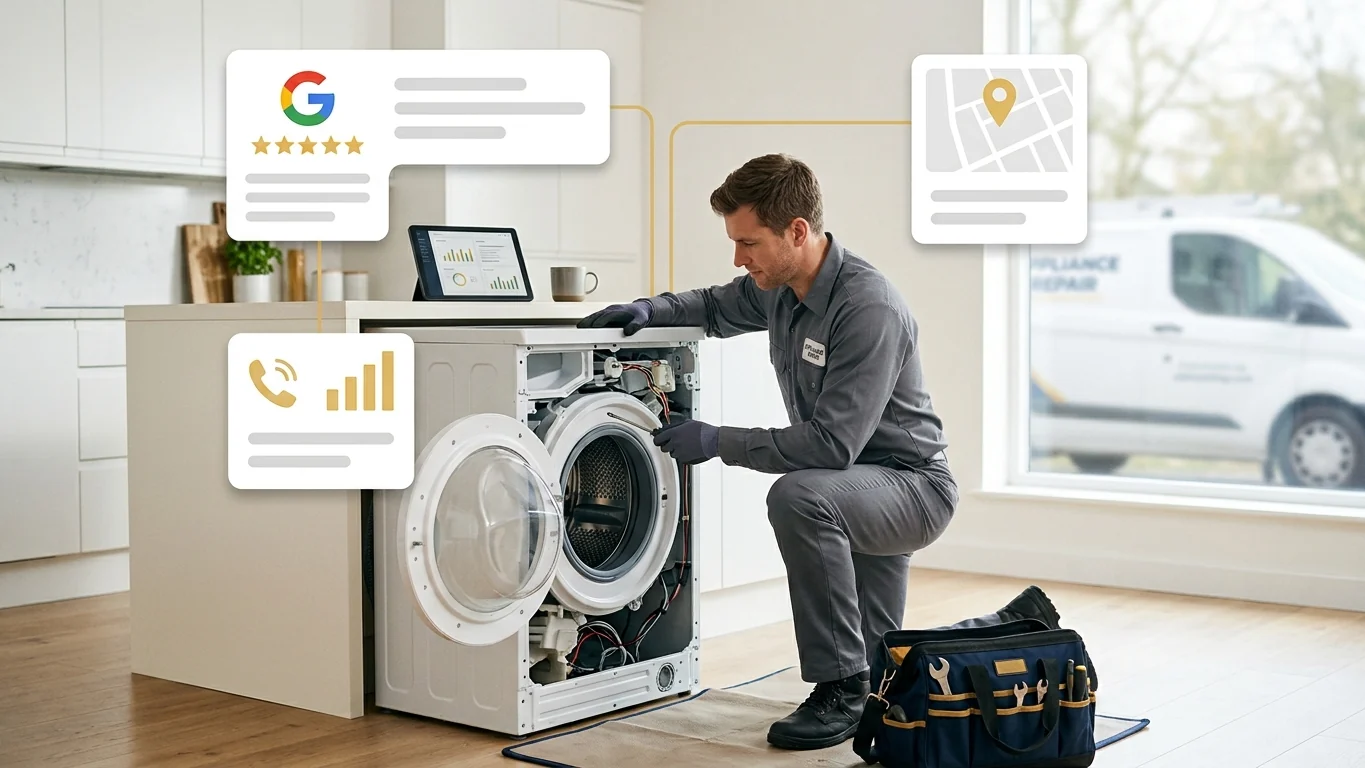
I build this system for local service businesses where the phone is the cash register, and the order matters more than the tactics. Answer and track first, get visible second, buy calls third. If you want the calls handled rather than explained, that is what my lead generation service does.
Below is the sequence: what I ask before touching an account, how the site and the profile are built for an emergency buyer, how the ads are run, what gets measured, and the first ninety days.
Who this is for: owners running one to ten vans on refrigeration, laundry, cooking or dishwasher work, who are tired of paying a directory for leads three competitors received at the same moment.
Start with the goal, not the channel
The owner asks for more calls. More calls is not the goal, and in a business with a fixed number of vans it can be the opposite of it.
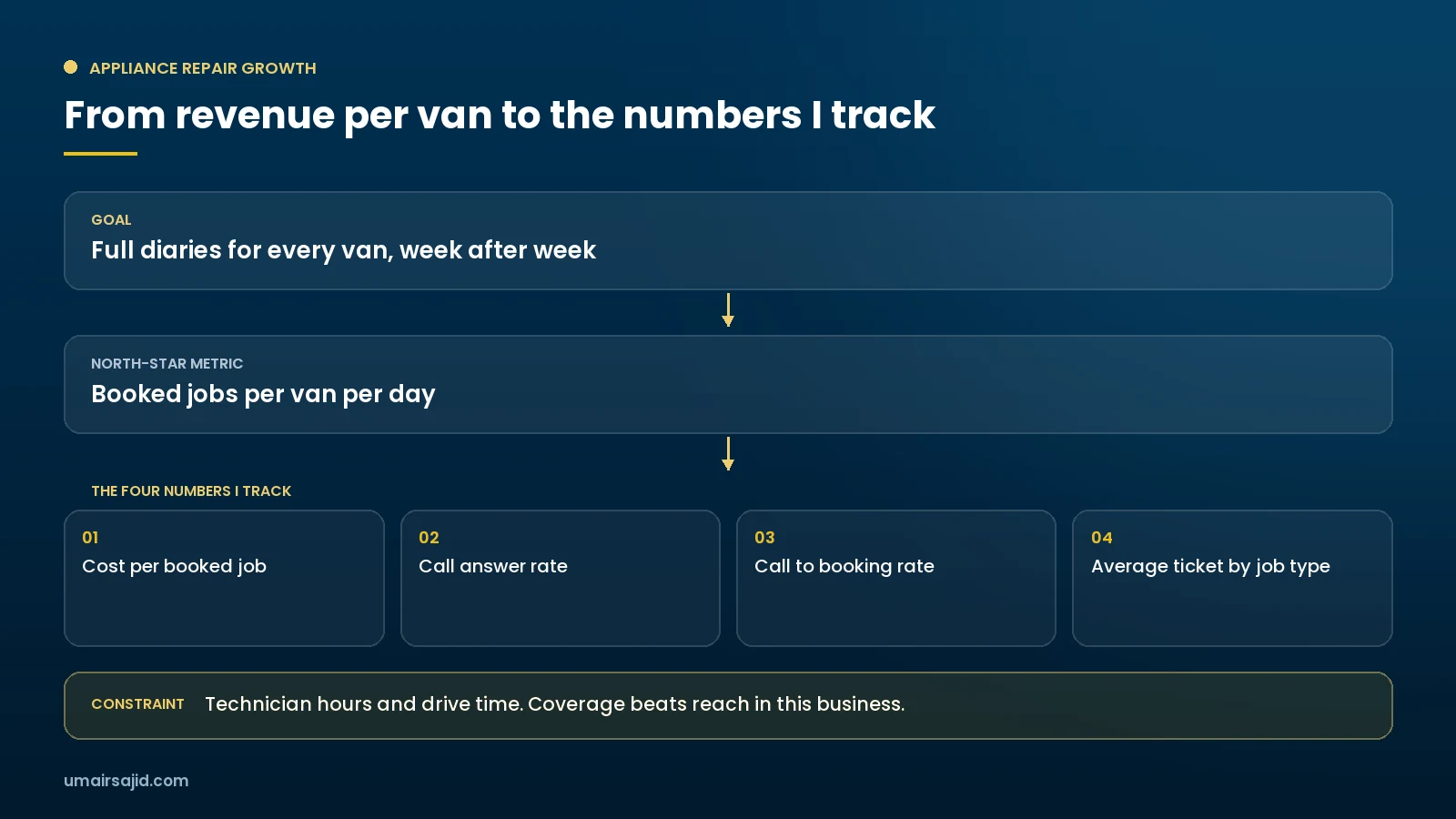
So the number we steer by is booked jobs per van per day at a healthy average ticket. That metric settles three arguments before they start. It stops us celebrating a cheap lead that turns into a no-access visit. It stops us filling a schedule with twenty-minute jobs on the far side of the county when a sealed-system refrigerator pays several times more. And it caps spend, because four vans can only be in four places at once.
Four numbers sit underneath it:
- Cost per booked job. Not cost per lead. A lead that rings out at 6pm cost money and produced nothing.
- Call answer rate. The share of calls a human picks up during the hours you advertise. Usually the biggest lever in the account, and it costs nothing to move.
- Call to booking rate. If calls are answered and jobs are not booked, the problem is the phone script, the fee explanation or the next open slot.
- Average ticket and gross margin by job type. A compressor job and a dryer belt are the same phone call and completely different businesses.
Then the number that is not a marketing metric and sets the budget anyway: capacity, measured as dispatch density. A van does a finite number of jobs in a day, and every extra mile between two of them deletes one. Calls from a town where you have one customer a month look fine in the ad account and lose money on the road.
There is a second ceiling: technicians. If you cannot hire, more spend only buys longer waits and worse reviews, and a bad week of reviews takes a quarter to repair.
What I need to understand before I touch anything
The first two weeks produce no campaigns and no new website. They produce answers, because the answers decide everything after.
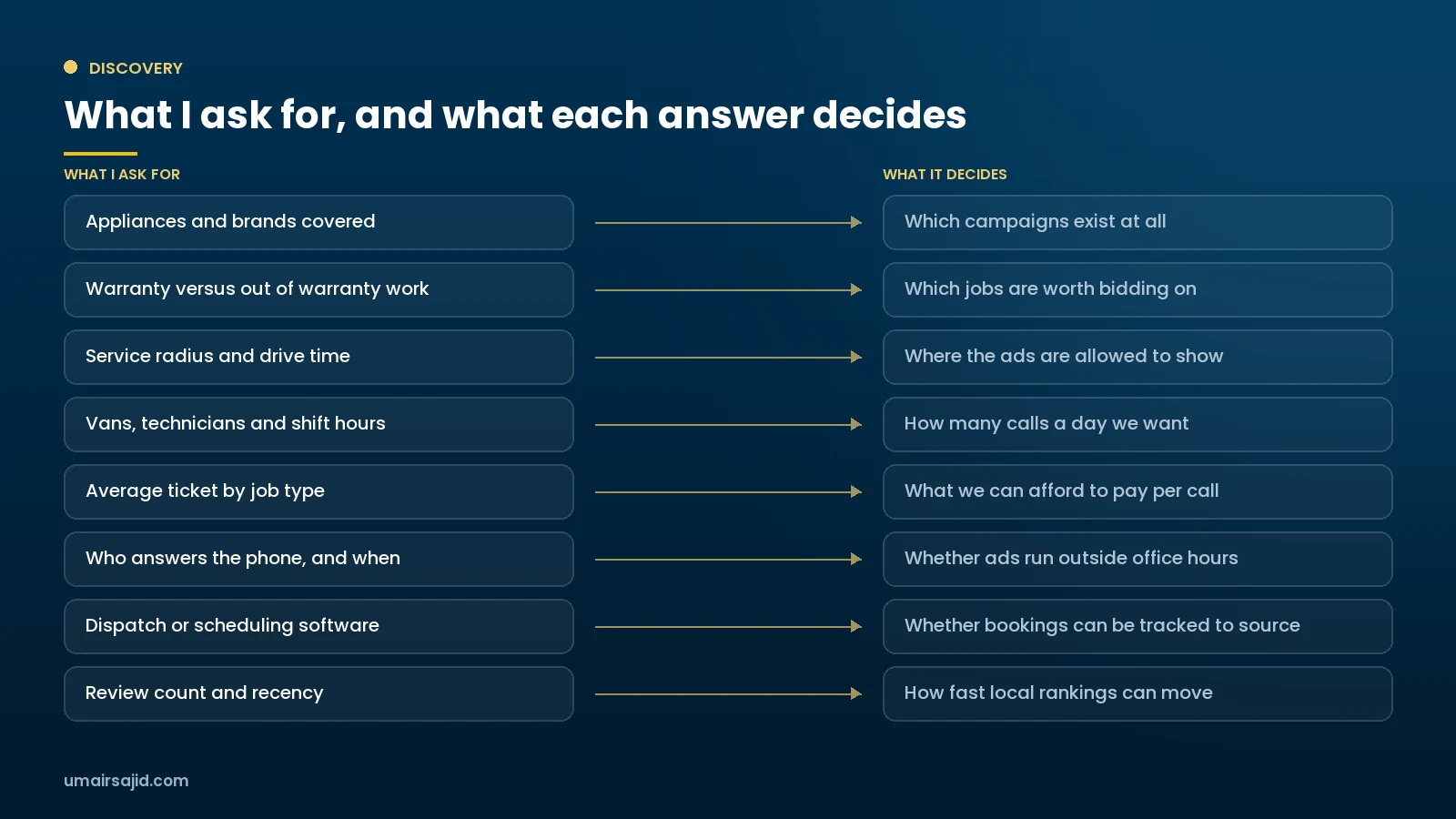
These are the questions I ask on the first call, and why each one is there:
- Which appliances and which brands do you actually work on? Advertising a brand your technicians avoid produces calls you have to refuse.
- Warranty work, out-of-warranty work, or both? Authorized work arrives through the manufacturer at rates you do not set. Out-of-warranty work is where marketing changes the outcome.
- What does each job type earn after parts, drive time and the technician’s hour? This becomes the bidding table later.
- What is the diagnostic fee, and is it credited against the repair? That one line of copy moves booking rates more than any headline I could write.
- How many vans and technicians, and how booked are they this week? The ceiling we plan against.
- Where is your work concentrated, and where does drive time eat the margin? I want the map of jobs done, not the map of towns you would like.
- Who answers the phone, in which hours, and what happens at 7pm on a Saturday? Emergency demand ignores office hours, so either you have a path for it or you are paying to send buyers to a competitor.
- How many calls went unanswered last month? If nobody knows, that is the first thing we instrument.
- What parts live on the van, and what takes two visits? First-visit fix rate behaves like a marketing asset.
- Where do jobs come from today, and what does each source really cost? Shared-lead platforms, a warranty network, repeat customers, the sign on the van.
- What do you refuse? Appliances over a certain age, brands with impossible parts lead times, jobs under a certain value. All of it goes into the negative keyword list.
- What access can I have? The profile, the dispatch system, call logs and recordings, ad accounts, analytics, Search Console.
That last one is a gate. If calls and jobs are not visible in the same place, nothing I report afterwards is worth reading.
Two things stop a paid campaign before it starts. The first is no call tracking, because most of the money arrives by phone and an untracked call is a donation to the ad platform. The second is a business whose calls ring out during advertised hours. I would rather spend a week fixing who picks up than a month buying voicemail.
Demand and competitor research
Now I find out what demand looks like in your towns, appliance by appliance.
Four moods, four kinds of page. There is the emergency, typed in fragments from a laundry room floor: “fridge not cooling repair near me”. There is the brand search, where somebody reads the badge on the door and types it. There is the money question, “how much does it cost to fix a dryer”, which is the moment a customer decides between you and a delivery van from a retailer. Answer that one in public and you are the business they believe on the phone. And there is the error code search, which is mostly not your customer at all.
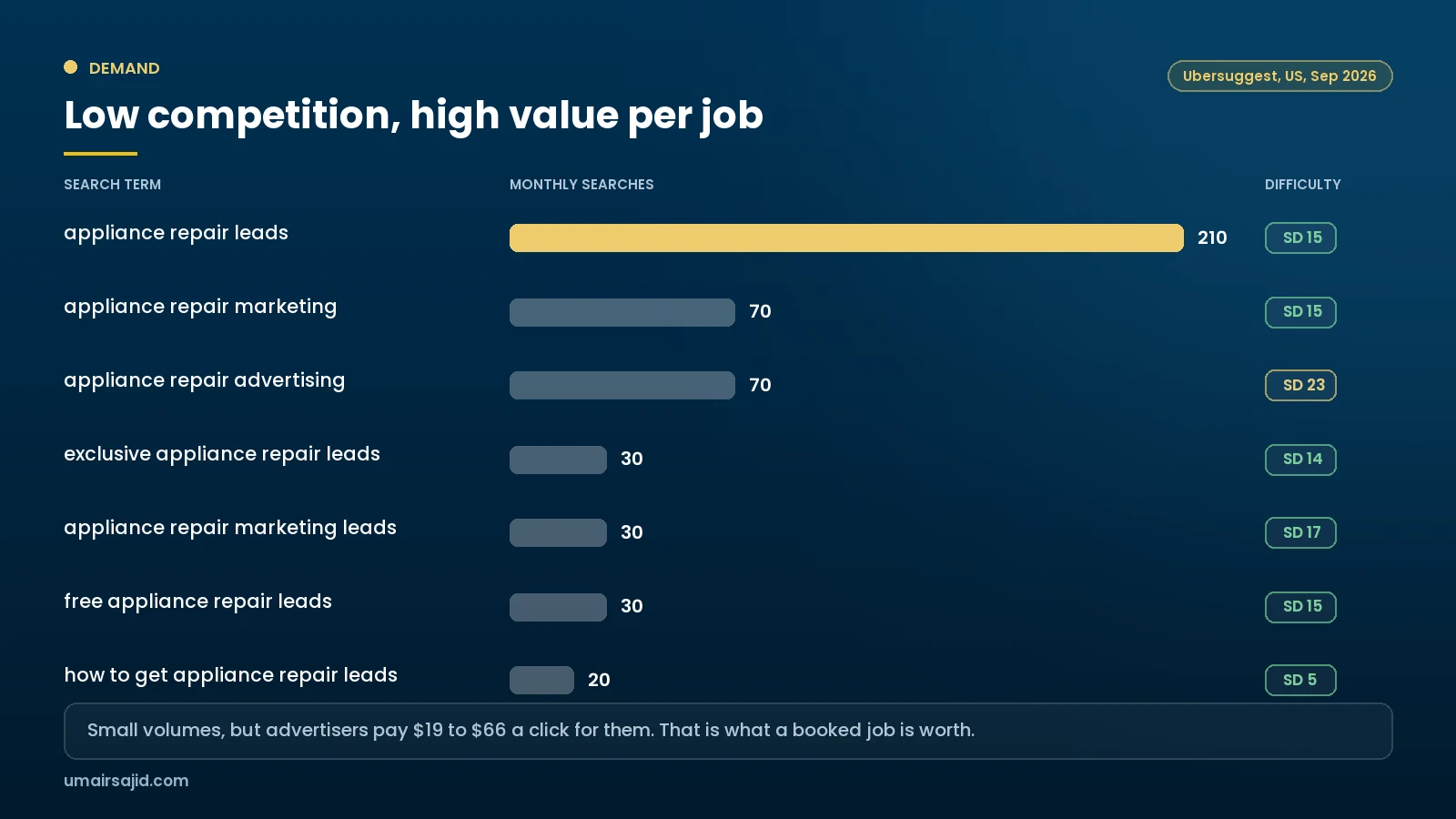
The chart above carries real Ubersuggest figures pulled in September 2026 for the US market, and the interesting part is the cost per click rather than the volume. Terms here run into the tens of dollars per click, with “appliance repair advertising” above sixty. Nobody pays that for fun. It is the market pricing one booked repair and the repeat work behind it.
Reading the results page honestly. For an emergency query the screen is stacked against a normal website. Local Services Ads sit at the top, then Search ads, then the map pack, and the first organic result is often below the fold on a phone. Effort goes to the profile, the reviews and the placements long before a blog post.
Competitors: read dates, not totals. A rival with four hundred reviews collected over nine years is beatable. A rival adding reviews every week is not, at least not this quarter. So I count what arrived in the last ninety days. The same logic applies to ads: the Ads Transparency Center and the Meta Ad Library show how long a creative has run, and longevity is the only free performance data you get.
Seasonality, which here is a set of spikes rather than a curve. Refrigeration calls jump in a heat wave. Ovens and dishwashers spike in the ten days before a holiday, when somebody is cooking for twelve. Laundry breaks in a cold snap. These arrive with days of warning, so the campaigns and the extra Saturday cover have to exist before the weather does.
The positioning gap. Twenty competitor sites in one service area say the same four things: fast, reliable, same-day, family owned. Almost none publish the diagnostic fee, the brands their technicians are trained on, or whether the van carries common parts. Specificity is free here, and it is the gap I write into.
The growth roadmap
The rule I do not bend in this industry: answer before you advertise, track before you scale.
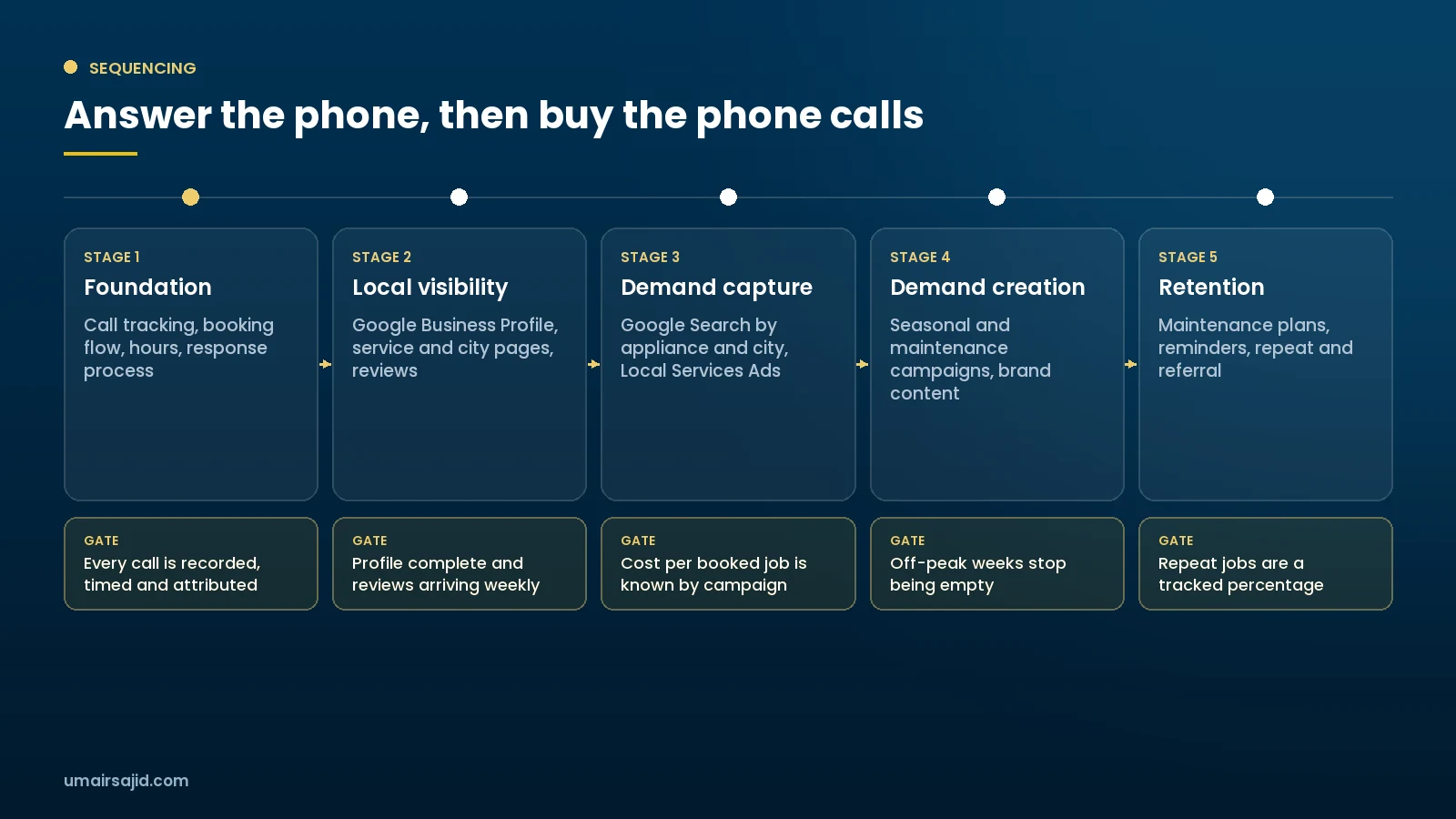
Paid traffic into an unanswered phone is the most expensive mistake in home services marketing, and it is common because ads are easy to switch on while the answering problem belongs to somebody else in the building.
Every stage has a gate, so nobody has to argue about whether we are ready:
| Stage | What gets built | The gate before moving on |
|---|---|---|
| Foundation | Call tracking, booking form, answered hours, after-hours path | Every call has a source and an answered status |
| Local visibility | Google Business Profile, appliance pages, review engine | Profile complete, reviews arriving weekly |
| Demand capture | Search by appliance, Local Services Ads, call-only in answered hours | Cost per booked job is known by source |
| Demand creation | Maintenance offers, seasonal campaigns, paid social, content | Non-emergency bookings appear in the schedule |
| Retention | Reminder flows, second-appliance offers, referrals | Repeat work is a reported line, not a feeling |
One exception. If a heat wave or a holiday week is about to land and the phone is answered, I will run Search in week one while the foundation is built, because a spike you miss does not come back. That is a trade taken with the owner, not a shortcut.
Owned media
Owned media is what you would still have if every ad account closed tonight: the site, the profile, the reviews, and a customer list with five more appliances behind every name on it.
The page map: appliance, brand and city without the clones
Three variables multiply here, and that is the trap. Appliance times brand times city runs to hundreds of URLs, and a tool will happily generate all of them. Google’s spam policies on scaled content describe that pattern precisely, and the damage lands on the whole domain.
So I use a proof rule. A combination earns its own page when it carries three things the parent page cannot: a job you have actually done, a detail specific to that brand or model family, and something local such as your same-day cutoff. Otherwise it is a section on the appliance page.
In practice: home, one page per appliance, brand pages where your technicians are trained and demand exists, city pages where you have dispatch density, then a booking page, a page explaining how the visit and the fee work, and an about page with real faces.
What a repair page has to answer
The buyer has one appliance, one symptom and no patience. In order: do you cover my brand and model, can somebody come today and by when, what does the visit cost and is it credited against the repair, do you carry the part or is this two trips, and how to book in under a minute.
The diagnostic fee. Publishing it is uncomfortable and it works. The calls you lose by naming it are the ones you would have lost on the doorstep anyway, after paying for the click and the drive. Saying whether it comes off the repair removes the main reason a homeowner keeps dialing.
Parts. If your vans stock the common failures for the brands you advertise, say so on the page and in the ad. “Most repairs finished on the first visit” beats any adjective, provided it is true. If not, stop advertising that brand until the parts supply is fixed.
On-page and technical work, in the order I do it
On-page first, because it is quick. Titles and H1s use the words people type, which are symptoms rather than service names: not cooling, will not drain, no heat. The first paragraph answers the query, internal links run appliance to brand to city to the booking page, and the schema is filled in.
Technical second, and the realistic test is a phone on cellular data in a utility room with one bar. Page weight matters more than any lab score, the number is tappable above the fold everywhere, and indexation gets checked in Search Console before anything else is believed.
The booking flow and the call bar
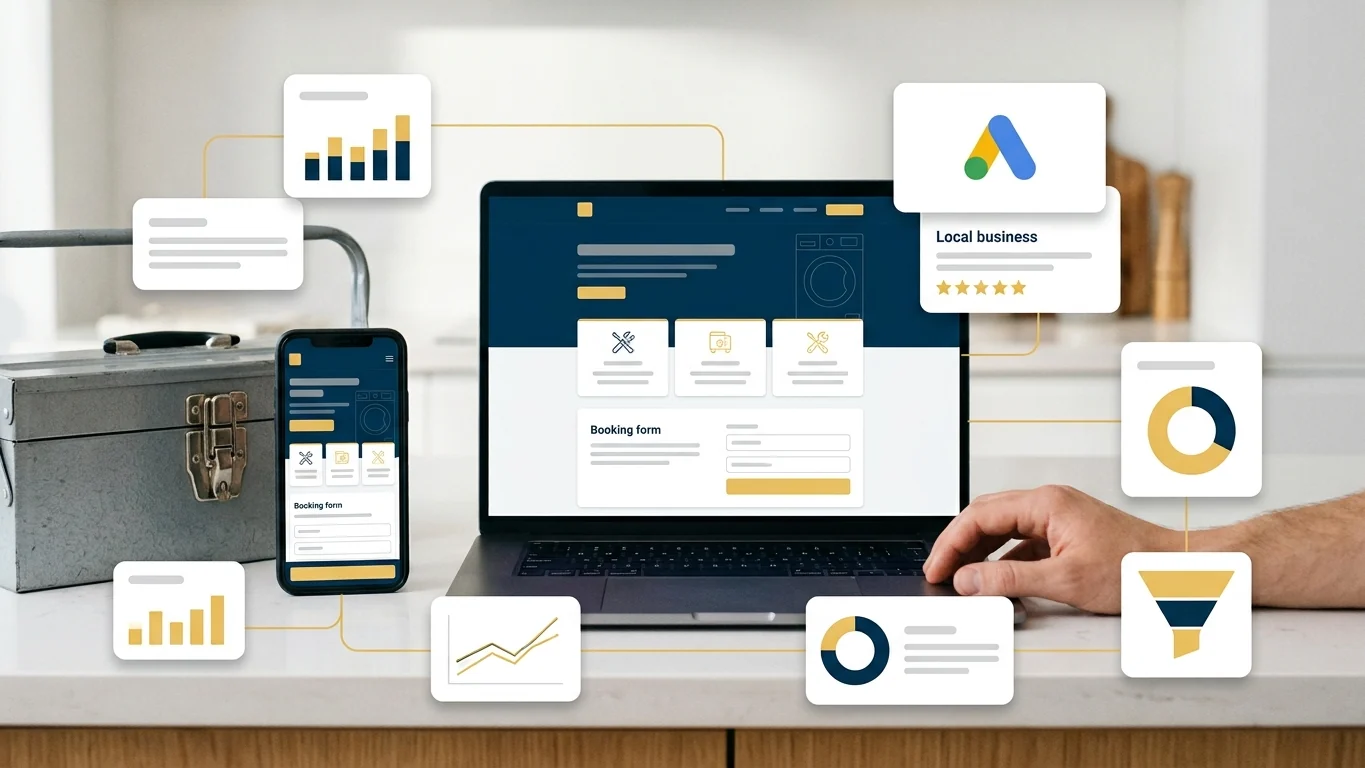
Most repair sites lose money in the same three places: a phone number rendered as an image, a form asking for fourteen fields, and no promise about when anybody replies.
The form I use has four fields plus two optional extras: name, phone, address, what is wrong, then appliance and brand from a dropdown, and a photo of the model plate. That photo is the whole trick. It gives the dispatcher the exact model before anyone drives anywhere, which decides whether the part is already on the van.
A sticky call bar on mobile carries the number with the real hours beside it. After hours it swaps to a booking promise with a time in it. Near the form go the things a nervous person checks: licensing, the brands covered, and three recent reviews.
The Google Business Profile is your dispatch window
For a business that travels to the customer, the profile produces more enquiries per hour of work than the website.
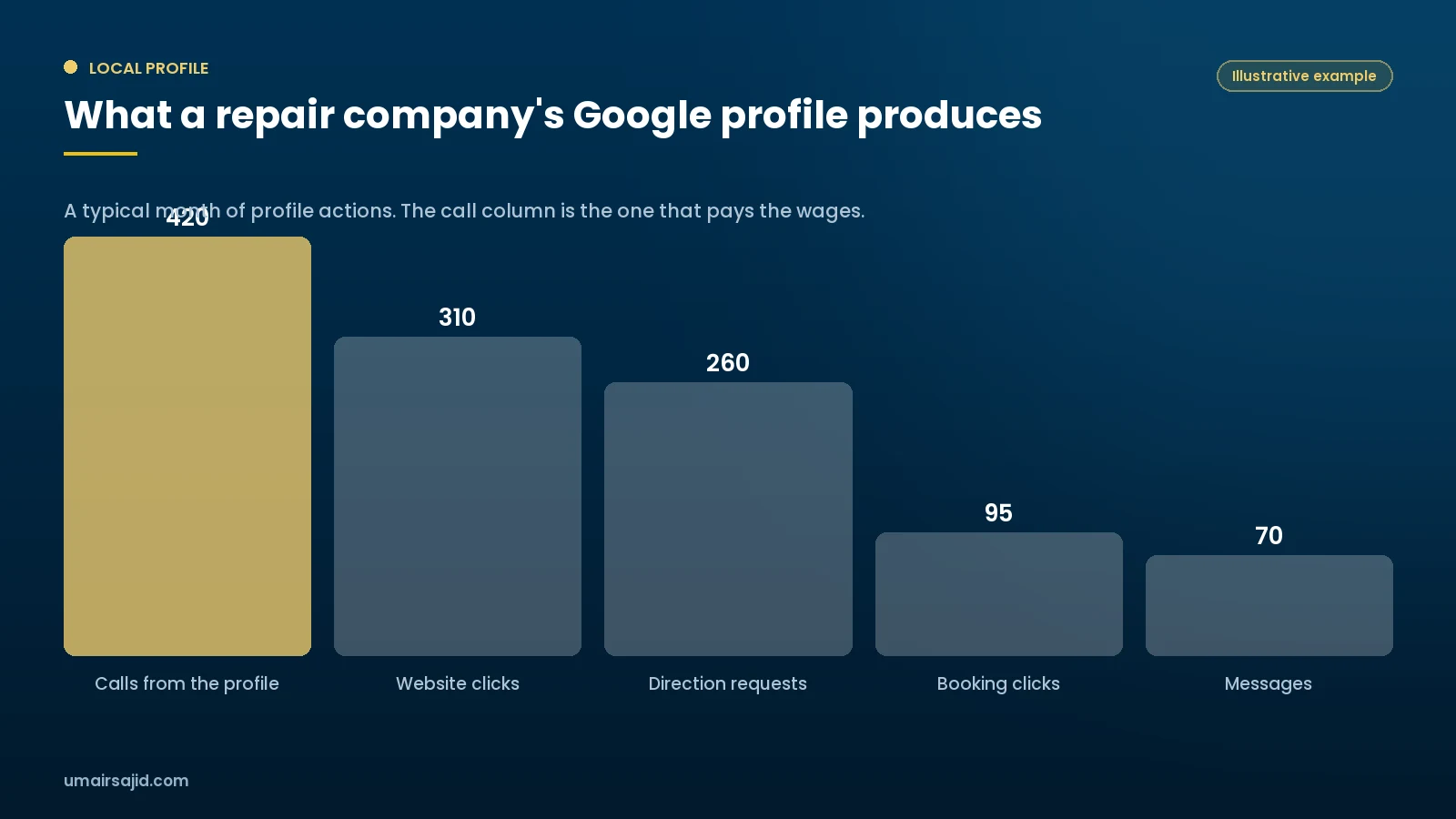
The chart above is an illustrative example rather than one company’s data, and it makes a point I repeat on kickoff calls: read the actions, not the views. For a repair company the calls line is the business. Direction requests barely matter, because nobody drives to you. Website clicks are people who want the fee and the brands before they dial.
The profile needs the right primary category, secondary categories for the appliances you service, every service listed and described, a service area drawn around real dispatch density, hours that match when somebody answers, and the questions section seeded with the fee and the brands.
Social and content that fits a repair business
Nobody scrolls Instagram looking for an emergency technician. Social does three other jobs here: it puts you in the neighborhood’s memory before the breakdown, it sells the work that is not urgent, and it gives retargeting something to show the person who called and did not book.
The content writes itself from the van: the five-minute check to do before calling anybody, why a dryer suddenly takes three cycles, the repair-or-replace question answered honestly. If you want that run rather than explained, social media management and social media marketing cover it.
Reminders, email and SMS: the part everyone skips
Every address you have visited holds five or six more appliances, and you know roughly how old they are and which brands, because your technician stood in front of them.
Four flows cover most of the opportunity. A review request sent while the technician is still on the drive. A maintenance reminder timed to the appliance, such as a dryer vent clean before winter. A second-appliance offer a few months later. And a yearly reactivation to every customer who has gone quiet. This is the cheapest revenue in the business, and most shops spend the budget buying strangers instead.
Earned media
Earned media is what other people say about you, and in appliance repair it is a ranking factor, a conversion factor and a sales argument at once.
Review velocity is the lever. Local ranking and the ad placements both respond to recent reviews, and so does the homeowner comparing three listings on a phone. A pile of five-star reviews with nothing since spring reads as a business gone quiet. So the request belongs in the job rather than in a monthly campaign: the technician sends a text with a link before leaving the drive, while the appliance is running again. Replies get written for every review, including the angry ones, because the next customer reads the replies more carefully than the reviews.
Partnerships that bring repeat volume. Property managers and landlords are the best of them, because one relationship produces work every week and the invoice gets paid without a conversation about the fee. Realtors need pre-sale fixes on a deadline. Retailers and parts counters send the jobs they cannot take. Home warranty networks give steady volume at rates somebody else sets, which makes them useful as filler and dangerous as a foundation.
Being brand-authorized also changes which terms you may use in your marketing, so check the current agreement rather than assume. Authorized work arrives on its own, so the budget chases the work that does not.
What I never do. Buy reviews, offer anything in exchange for one, or run a review gate that filters unhappy customers to a private form. Regulators in the US and UK have moved on that behavior, and for a business whose reputation is its main asset the risk is absurd.
Paid media
Now, with the phone answered and every call sourced, we buy demand.
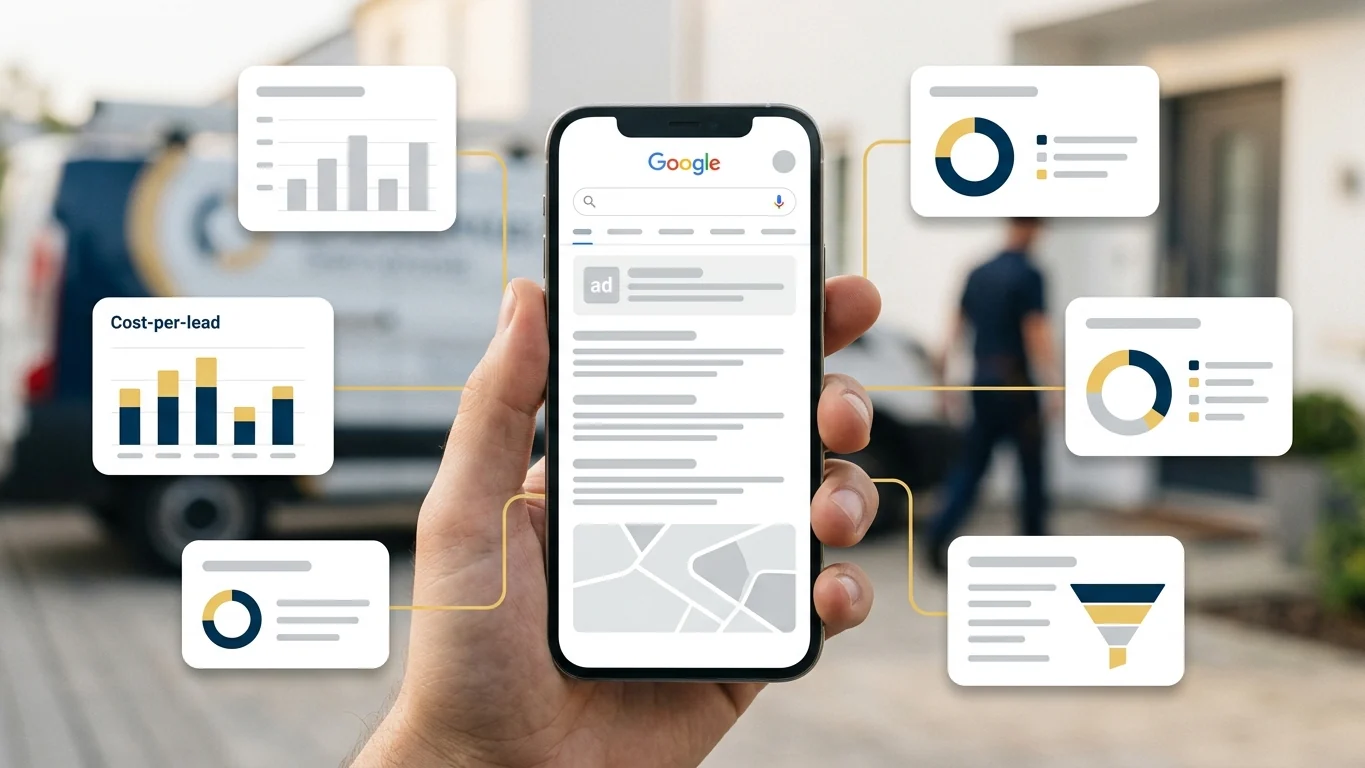
Local Services Ads first, where the category is eligible. They sit above the Search ads, you pay per lead rather than per click, and the verification badge carries weight with a nervous homeowner. Eligibility, categories and screening requirements differ by country and change without much notice, so check Google’s current Local Services Ads documentation rather than a blog post from last year, including this one. The checks take time, so the application starts in week one. And the dispute process only works if a human uses it: out-of-area and wrong-service calls get disputed weekly, or the budget quietly leaks.
Google Search second, structured by margin. Campaigns or ad groups split by appliance, because a sealed-system refrigerator job and a microwave are not worth the same bid. The bidding table comes from the discovery answers: gross margin per job type, minus drive time, times the booking rate for that type. That is the ceiling on what a click there is worth, and the spread from top to bottom is usually several times over.
The negative list does more work here than in most industries. Out go parts, manual, how to fix, used, scrap, courses, jobs, and the model number searches from somebody with a screwdriver already in hand. Location targeting is presence rather than interest, drawn around dispatch density, with the outer ring you can technically reach excluded until it pays.
Call-only, scheduled to reality. Call-only campaigns run in the hours a human answers and not one hour longer. If nobody picks up at 8pm, buying 8pm clicks funds a competitor’s evening. When the answering window is short, concentrating the budget inside it beats spreading it across a day.
Meta, for everything that is not an emergency. Nobody picks a technician from a feed while water spreads across a kitchen floor. Paid social sells maintenance work, retargets people who called without booking, and keeps you present in the neighborhoods you serve. It has a fourth use that marketing decks miss: hiring technicians. When capacity is the ceiling, recruitment advertising is growth advertising.
Budget logic. Spend follows answered capacity and the calendar of spikes. I lift budgets a week ahead of a holiday or a forecast heat wave rather than during it, because everybody raises theirs once the calls start and the auction gets expensive. Budget rises only while the call-to-booking and completion rates hold.
Buying appliance repair leads from a reseller fills a gap and builds nothing, and the ones sold as exclusive appliance repair leads are exclusive only until renewal. The lead is sold to three competitors at the same moment, the price only rises, and you never own the customer. I keep them running while the owned channels are built, measure them on cost per completed job, and cut the spend as the profile and the ads take over. Google Ads management and lead generation cover this work when you would rather it was run for you.
The measurement stack
If you cannot see which jobs came from where, everything above is expensive guesswork.
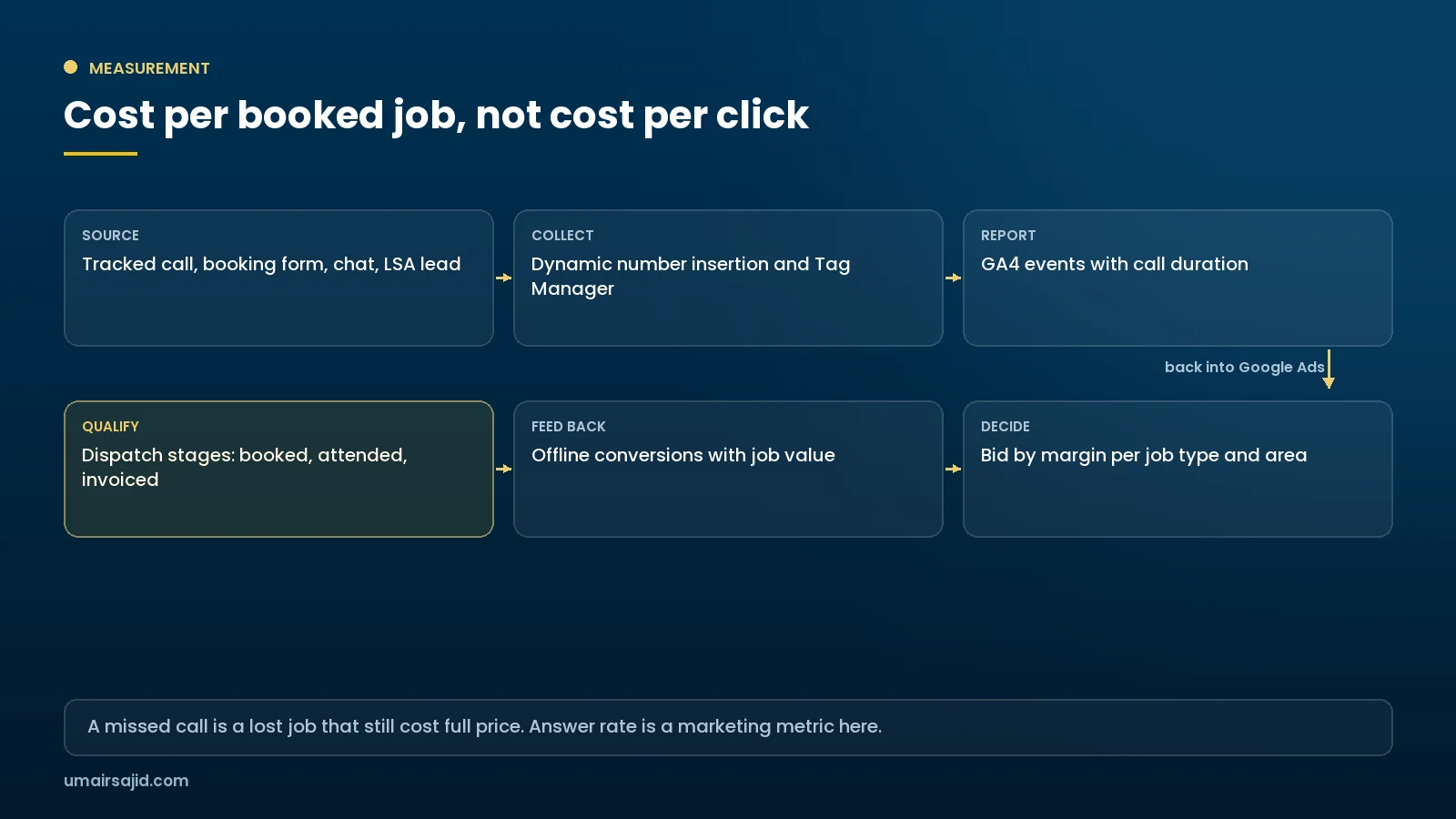
What counts as a conversion. A booked job on the schedule. Below that, a call over sixty seconds and a completed booking form. Sixty seconds is the threshold because shorter calls are wrong numbers, parts questions and sales pitches, and counting them teaches the platform to find more.
The stack. Tag Manager, GA4 receiving named events, and call tracking with dynamic number insertion so a session carries its source into the phone call. The dispatch system records the stages: call, booked, completed, invoiced value. Then the step most repair companies skip, importing completed jobs back into Google as offline conversions with their values. That moves the bidding from cheap calls to profitable repairs.
One number changes owner behavior faster than any report about impressions: missed calls in advertised hours, multiplied by your booking rate and your average ticket. It is written in money the business already had in its hand.
The report itself is one page: spend, calls, answered calls, booked jobs, completed jobs, revenue by source, cost per booked job, and this week against the same week last year.
Attribution honesty. Last click lies in local services. A neighbor recommends you, the van is parked in the street, the homeowner searches your name and calls from the profile, and the ad that started it gets nothing. Three cheap correctives: a “how did you hear about us” question at booking, call recordings sampled weekly, and an occasional geographic holdout.
Where AI and automation carry the load
AI earns its place in this business in one obvious spot and several boring ones.
The obvious spot is the call nobody answers. An AI receptionist or a trained answering service that captures the appliance, brand, symptom and address, then books the next real slot, pays for itself quickly. Two conditions. It hands off to a human the moment the caller asks something it cannot answer, and it never quotes a price the business will not honor. A confident wrong answer at 10pm becomes an argument on the doorstep tomorrow.
The boring ones add up. Clustering symptom and error-code searches into page briefs. Summarizing a competitor’s recent reviews to find what their customers complain about, usually late arrivals and second visits. Routing jobs by type and area to cut drive time. Firing review requests and reminders off the job status.
What I do not automate: the diagnosis, the conversation about whether a repair is worth doing, the apology when a technician is late, and the reply to a bad review. Those are the business.
How the work actually runs
A plan nobody can run is a document. The engagement has a shape.
Kickoff, where access is granted, the capacity ceiling agreed and the stop list written. A weekly thirty-minute call with the same six numbers on screen. A monthly review of cost per booked job by source. A reset before each seasonal spike rather than after it.
Who does what: I own strategy, the site, local search, the ad accounts, tracking and reporting. The office owns answer rate and the review text. Technicians own two photographs per job, the model plate and the finished appliance.
At the end you own the site, the accounts, the data and the plan, whether or not we keep working together.
The first 90 days
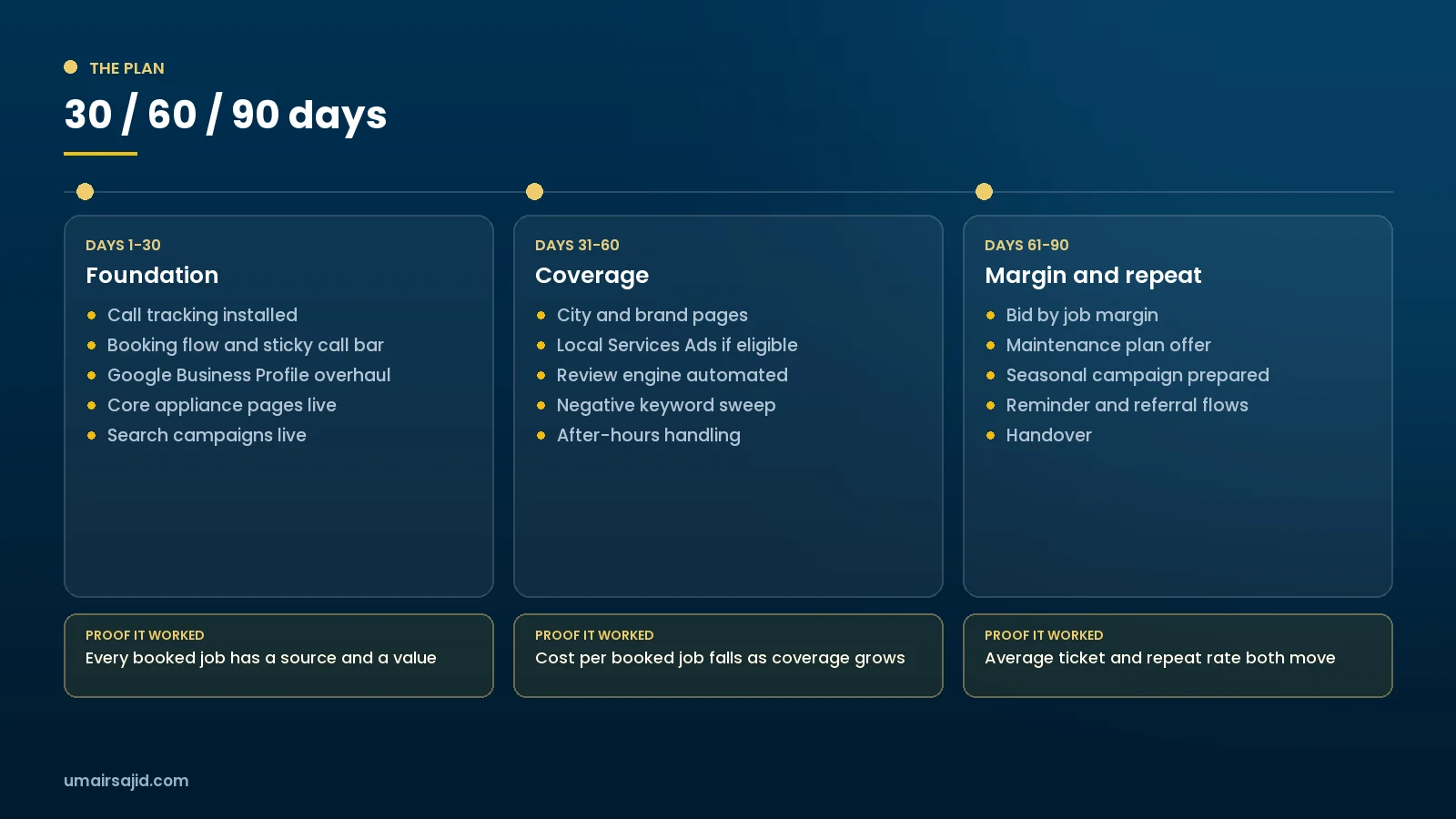
Days 1 to 30: foundation. Access and audit. Call tracking live with dynamic numbers, and answer rate measured for the first time. An after-hours path that captures rather than apologizes. Google Business Profile rebuilt. The three appliance pages carrying the most margin rewritten. The booking form cut to four fields plus the model plate photo. Review requests running from the van. The Local Services Ads application submitted, because screening takes weeks. Search live on your two best appliances. Proof it worked: every call appears with a source and an answered status.
Days 31 to 60: visibility and capture. Brand and city pages where the proof rule allows them. Local Services Ads live with disputes handled weekly. Call-only inside answered hours. Technical fixes and page weight. Offline conversions importing completed jobs with values. Proof it worked: cost per booked job is known by source and stable enough to plan against.
Days 61 to 90: scale and repeat revenue. Budget shifted toward the job types and areas that complete, away from the ones that book and cancel. Maintenance offer launched, reminder and reactivation flows live. Next season’s campaign built before the season. Proof it worked: booked jobs per van per day hold or rise while cost per booked job falls.
What this looks like after 90 days
An honest picture, because this industry is sold a lot of fantasy.
Paid search and Local Services Ads give a readable signal in two to three weeks and a reliable trend by week six, once screening is through. Fixes to the booking flow show up in days. Map pack movement takes eight to twelve weeks, faster when the profile was badly set up to begin with. Organic pages for the money questions compound over three to six months. Anyone promising quicker organic results is guessing.
For evidence from other local service businesses: a landscaping business I worked with reached three times its previous lead volume through a targeted social strategy, and a local hospitality business doubled its weekend customers through local Facebook ads. Different trades, their results rather than a forecast for yours.
I have written the same playbook for landscaping companies, remittance companies, AI app companies and small businesses generally, and the measurement framework applied to live accounts is in the case studies.
The mistakes I stop first in appliance repair
- Renting leads forever. Shared leads are a bridge. If that line grows every year, the bridge has become the business.
- No call tracking. Most of the revenue arrives by phone. Without dynamic numbers, every budget decision is a coin toss.
- Voicemail during advertised hours. The first business to answer usually takes the job, and this costs nothing to fix.
- One page called “Services”. Six appliances on one page answers none of the six questions and ranks for none of the six searches.
- Thin city clones. Swapping a town name into the same page is the scaled-content pattern Google describes, and the risk lands on the whole site.
- Letting reviews go quiet. Recency is the signal: a weekly trickle beats a pile from two summers ago.
- One bid for every job type. A dryer belt and a compressor replacement earn very different money and should never pay the same click price.
- No repeat offer. Five more appliances sit at every address you have visited, and you know how old they are.
FAQ
How do appliance repair companies get more calls?
In this order: answer the ones you already get, rebuild the Google Business Profile, get reviews arriving weekly, then buy placement through Local Services Ads and Search on the appliances with the best margin. Most shops work that list backwards, then wonder why the ads are expensive. Any appliance repair marketing agency worth paying starts at the top of it.
Is Google Ads or Local Services Ads better for appliance repair?
Run both where the category is eligible. Local Services Ads charge per lead, sit above everything else and carry a verification badge, which suits an emergency buyer. Search gives you control over which appliances and symptoms you bid on, which is where margin management happens. Rules change, so confirm the current policy first.
How much of the budget should go to local SEO?
Think in hours rather than percentages for the first quarter. The profile, the appliance pages and the review engine are mostly labor. Paid carries this month’s schedule; local search lowers next quarter’s cost per booked job.
Do I need a website if I have a Google Business Profile?
The profile produces the calls and the website closes the doubters. People who want the fee, the brand list and the warranty terms will click through, and if they land on nothing they call the next listing.
How do I compete with Angi, Yelp and the lead resellers?
Stop trying to outrank them and take the placements they cannot occupy: the map pack, Local Services Ads and your own reviews. Then out-answer them, because a directory profile cannot publish your fee, your parts stock or your same-day cutoff.
How fast do I have to answer the phone?
Live, during every hour you advertise. After hours, an answering service or a system that books the slot and confirms by text. A missed emergency call is not a delayed job, it is a job your competitor did.
How many city pages should I build?
As many towns as you can prove you work in, and no more. If a page cannot carry a job done there, a local detail and a real cutoff time, it is a heading rather than a URL.
Do maintenance plans work for appliance repair?
They work when they are specific and scheduled, sold to customers whose appliances your technician has already seen. They fail as a vague annual membership with no visit attached. Start with reminders, which cost nothing and prove the demand. If you want a second opinion on whether the numbers work, that is what a free thirty-minute review is for.
Where to start
Take the order if you take nothing else. Answer and track before you advertise, get visible before you scale, and price every job type by margin before you raise a budget.
The first move costs nothing. Pull last month’s call log and mark every call answered, missed or booked. Most owners find a week of lost revenue in that spreadsheet, money they had already paid to earn.
Free 30-minute appliance repair marketing review. I will look at your call handling, your Google Business Profile, your tracking and your ad accounts, then tell you the two things to fix first and the one thing to stop paying for. No pitch, and the notes are yours either way. Book the call.