







Quick answer
Landscaping digital marketing works when it is built in one order: capture every enquiry first, own the local search results second, and only then buy traffic. Most landscaping companies do it backwards, which is why their leads arrive in a March flood and dry up by November.

I have run this sequence for home and garden service businesses, and the pattern rarely changes. The website is not the problem. The ads are not the problem. The problem is that nobody can tell which jobs came from where, so every decision after that is a guess with a budget attached.
This is the whole playbook: what I ask for in the first call, what I fix before any money goes into ads, how the site and the Google profile are built, what the ads actually do, how it is all measured, and what the first ninety days look like week by week. If you would rather have someone run it with you, that is what my landscaping digital marketing service covers.
Who this is for: owners running maintenance, design and build, lawn care or hardscape work, with one to six crews, who already get some work from word of mouth and want a second source that does not depend on luck.
Start with the goal, not the channel
Every engagement starts with the same disagreement. The owner wants more leads. Leads are not the goal. A full calendar at a healthy margin is the goal, and those two things are only loosely related.
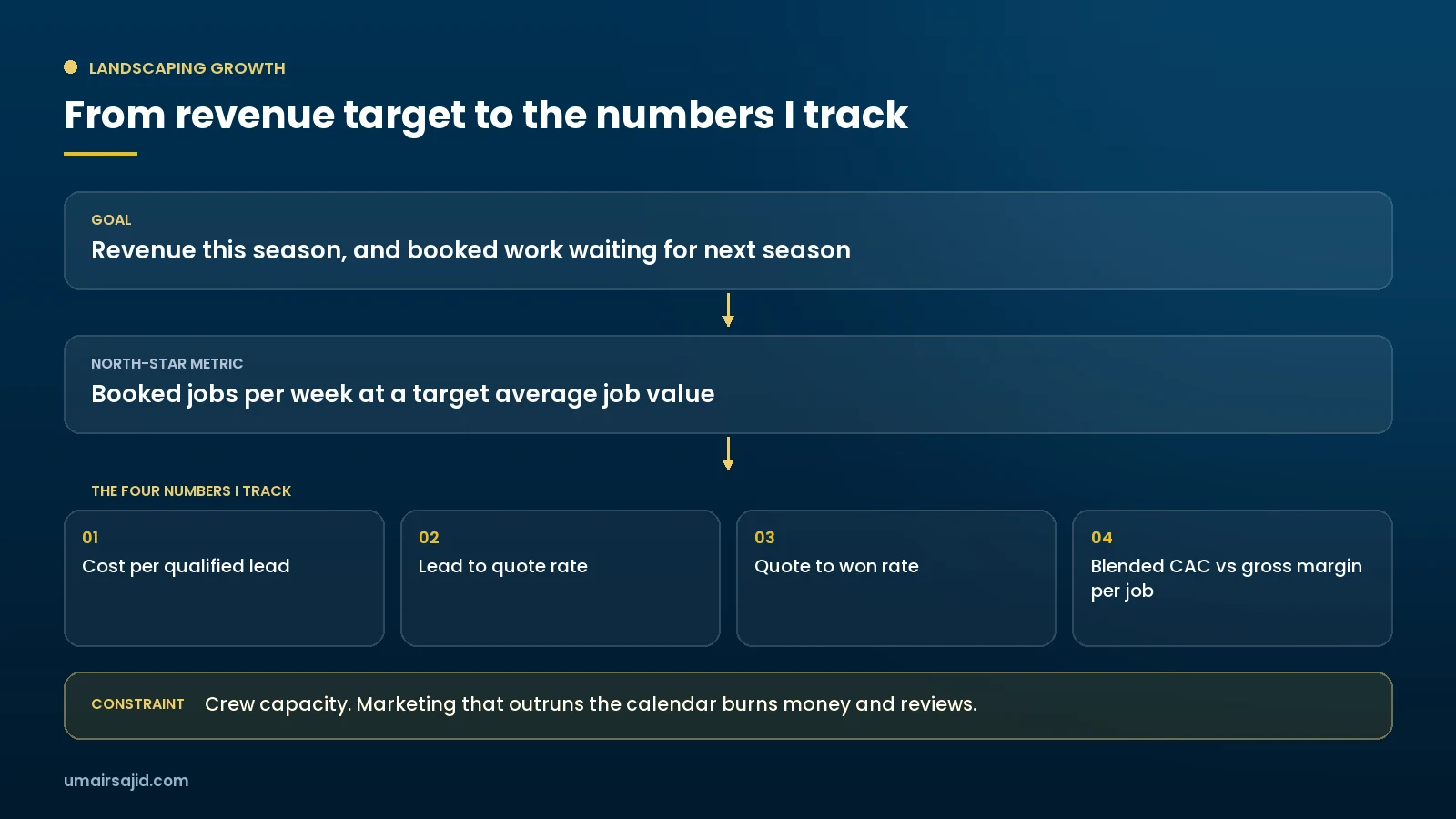
So I turn the business goal into a single number we steer by: booked jobs per week at a target average job value. That one metric keeps three arguments from happening later. It stops us celebrating cheap leads that never convert. It stops us chasing one-off small jobs when the design and build work pays four times more. And it puts a ceiling on spend, because a business with three crews cannot install forty patios in a month no matter how good the ads are.
Underneath it sit four numbers, and I report them every week:
- Cost per qualified lead. Qualified means the job is in your service area, in a service you sell, and the person wants a quote. Not a form fill.
- Lead to quote rate. If this is low, the problem is response speed or qualification, not marketing.
- Quote to won rate. If this is low, the problem is pricing, presentation or follow-up.
- Blended CAC against gross margin per job. Everything spent, divided by jobs won, compared to what a job actually earns after materials and crew hours.
There is one more number that is not a marketing metric at all, and it decides the budget: capacity. Jobs per crew per week, and how far a crew can drive before the travel eats the margin. I have seen a campaign work so well that the business stopped answering the phone for a fortnight, and the reviews from that fortnight took six months to recover from. Marketing that outruns delivery is not growth, it is damage with an invoice.
When an owner tells me “I just want more leads”, my answer is always the same question: how many jobs do you want next Tuesday, and what is each one worth to you? If we cannot answer that, we are not ready to spend anything.
What I need to understand before I touch anything
The first two weeks are unglamorous. No campaigns, no redesign. I am working out what the business actually is, because the answers change every decision after that.
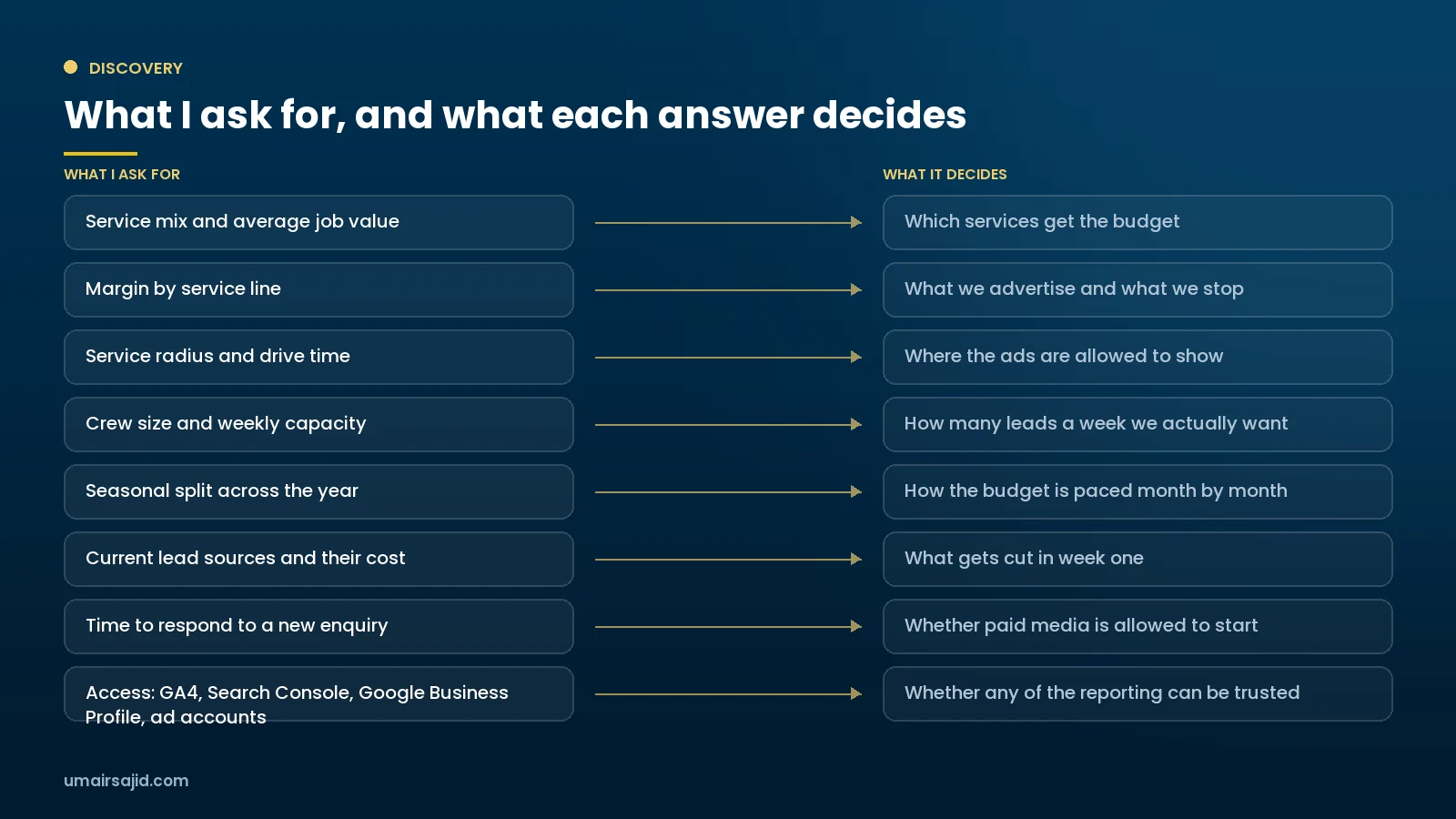
These are the questions I ask on the first call, and the reason each one exists:
- What do you actually sell, and what does each service earn? Maintenance contracts, one-off clean-ups, design and build, hardscape, irrigation, tree work, snow clearance. Most landscaping companies make the bulk of their profit on one or two of these and spread their marketing across all of them.
- What is the average job value and the margin on it? This sets what you can afford to pay for a lead. A business with a $400 average ticket and a business with a $14,000 one need different plans, not different slogans.
- How far do you travel, and where does the margin die? Drive time is a cost that never shows up in an ad account. The service radius in Google Ads should match reality, not ambition.
- How many crews, and how booked are they now? This is the ceiling we plan against.
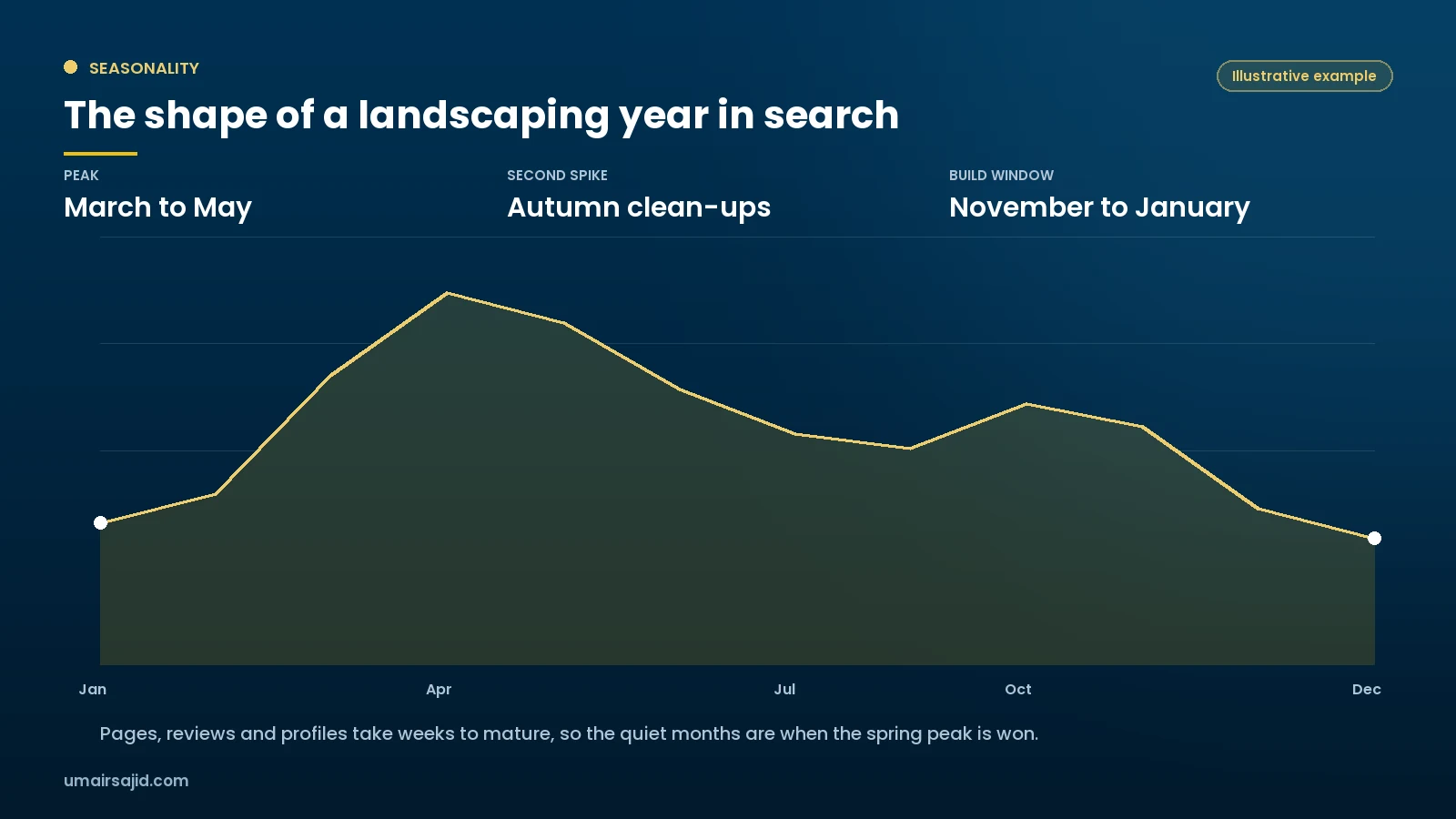
- What does the year look like month by month? The spring rush, the summer plateau, the autumn clean-up spike, the winter gap.
- Where do your jobs come from today? Word of mouth, repeat customers, directories, shared lead platforms, a sign on the van. Each with a rough cost.
- How fast does someone answer a new enquiry, and who does it? This is usually the single biggest lever in the whole engagement, and it costs nothing.
- What happens to a quote after you send it? One follow-up, three, or none.
- How many reviews do you have, and when was the last one? Recency matters more than the total.
- Who owns the website, the domain and the Google profile? More often than you would expect, it is a previous agency or a relative.
- What do you refuse to do? Every good landscaper has jobs they hate. Those should never be advertised.
- What access can I have? Analytics, Search Console, Google Business Profile, ad accounts, the website admin, call logs, and whatever the enquiries are currently written down in.
That last one is a gate, not a request. If the numbers are not visible, nothing I report later can be trusted, and we would be making decisions from feelings and screenshots.
Two things stop a paid campaign before it starts. The first is no tracked phone number, because in this industry most enquiries are calls and an untracked call is an anonymous donation to the ad platform. The second is a business where nobody answers the phone within the hour. Buying clicks that turn into voicemails is the most expensive mistake in local services, and I would rather fix the answering process for a week than spend a cent while it is broken.
Demand and competitor research that changes the plan
Now I find out what the market looks like in your towns rather than in general.
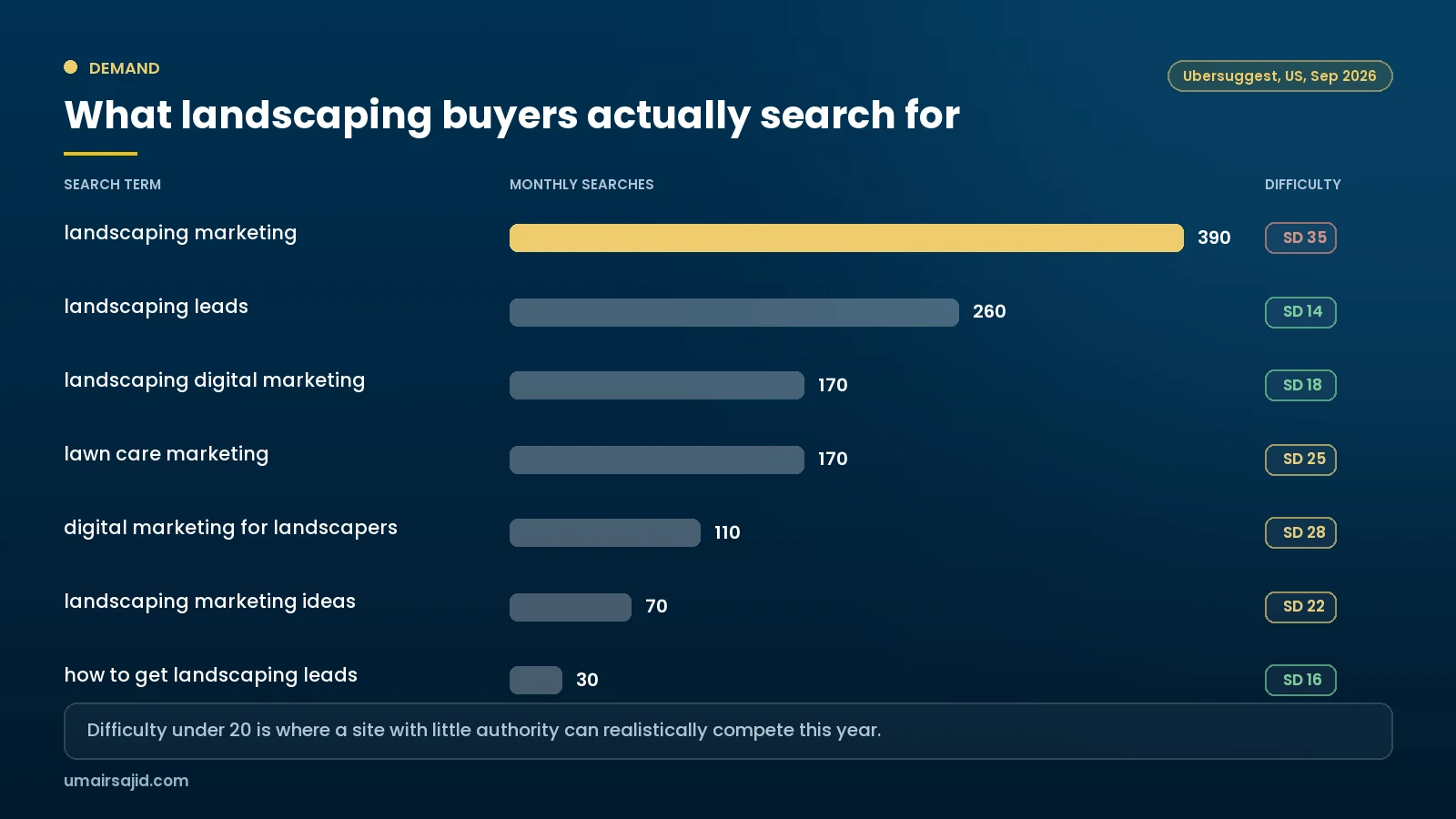
Mapping demand. People search for landscaping work in three different moods, and each needs a different page. There is the emergency (“storm damage tree removal”), the project (“garden design cost”, “patio installers near me”) and the routine (“lawn care service”, “garden maintenance”). The project searches are where the money is and where the competition thinks in terms of brochures rather than answers.
Reading the results page honestly. For most local searches the map pack takes the attention, and the organic results underneath it are the consolation prize. That tells you where the work goes: the Google Business Profile, reviews and proximity matter more than a thousand-word blog post. For the research searches, where somebody is comparing materials or budgeting a project, organic pages still win, and that is where content earns its place.
Looking at the ads, not just the pages. The Meta Ad Library and Google’s Ads Transparency Center show what competitors are running and, more usefully, how long they have run it. An ad that has been live for four months is working. An ad that appeared last week is a test. This is the cheapest competitive research available and almost nobody in this industry uses it.
Directories. Angi, Thumbtack, Houzz, Nextdoor and the rest will rent you leads that three competitors also received. They are a reasonable way to fill a gap in week one and a terrible way to build a business, because you never own the customer relationship and the price per lead only goes up. I treat them as a temporary tap, and the whole plan is designed to turn the tap down.
The positioning gap. Once I have read twenty competitor sites in a service area, the gap is usually obvious and always the same: everyone says quality, reliability and free quotes. Nobody says who they are for, how long a job takes, what it costs to start, or what happens if it rains for a week. Specific beats superior, every time.
The growth roadmap, and why the order matters
Here is the sequencing rule I do not bend: owned before earned before paid.
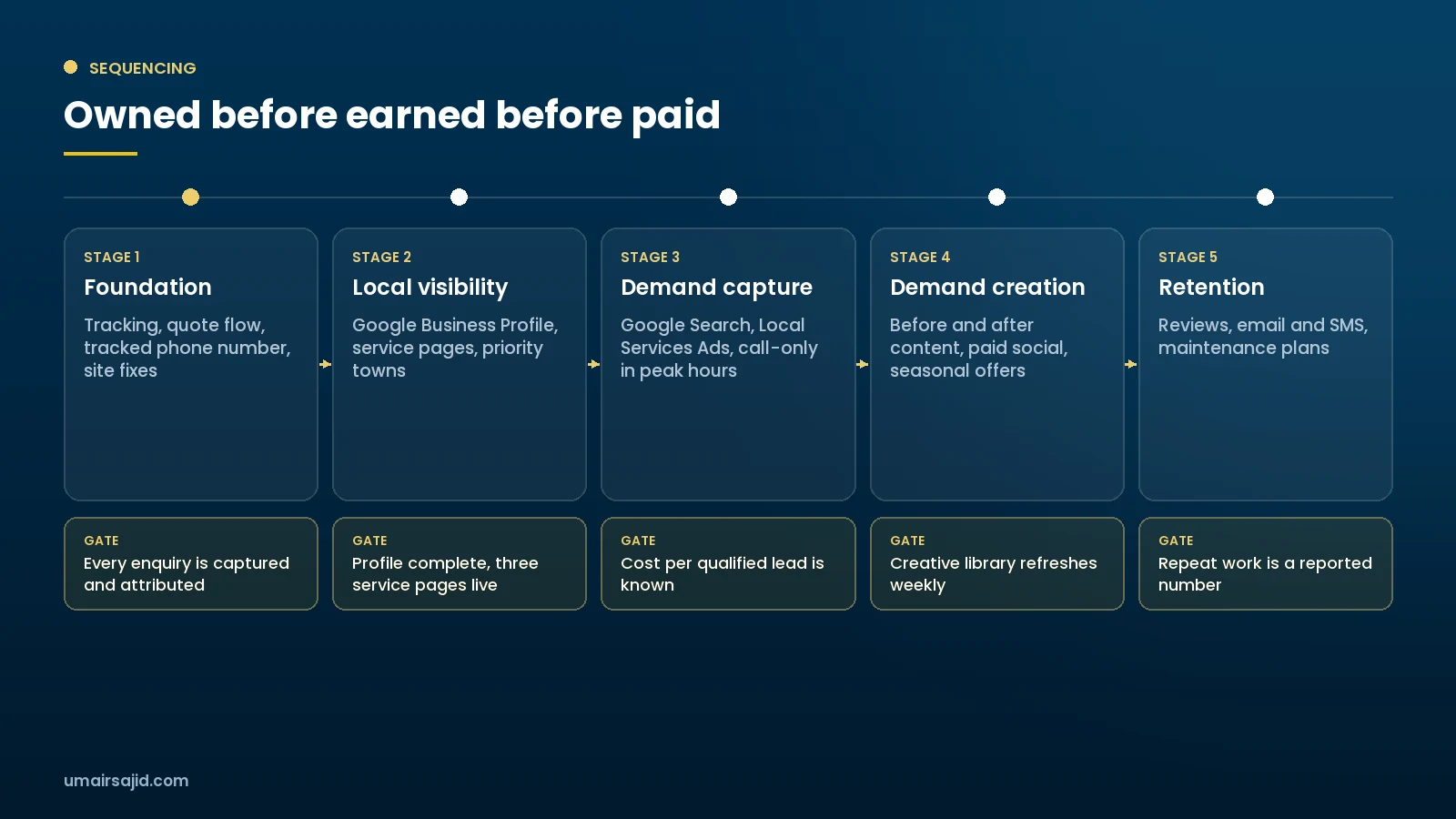
Paid traffic sent to a weak site is a tax. You pay for the click twice: once to the platform, and again in the enquiries that never arrive because the page did not answer the question. Fix capture first, then visibility, and buy traffic once you know what an enquiry is worth.
Each stage has a gate, so progress is not a matter of opinion:
| Stage | What gets built | The gate before moving on |
|---|---|---|
| Foundation | Tracking, quote flow, tracked number, core site fixes | Every enquiry is captured and attributed |
| Local visibility | Google Business Profile, service pages, priority towns | Profile complete, three service pages live |
| Demand capture | Google Search, Local Services Ads, call-only in peak hours | Cost per qualified lead is known |
| Demand creation | Before and after content, paid social, seasonal offers | The creative library refreshes weekly |
| Retention | Reviews, email and SMS, maintenance plans | Repeat work is a reported number |
There is one exception. If the season is about to break and the business already has clean tracking and real demand, I will run Search ads in week one while the rest is being built, because a spring missed is a year missed. That is a deliberate trade, taken with the owner, not a default.
Owned media: the assets you keep
Owned media is everything you would still have if every ad account was closed tomorrow. In this industry that is the site, the Google profile, the photos, the reviews and the customer list.

The page map comes before the design
I write the page map before anyone opens a design tool. For a landscaping company it is usually: home, one page per service you actually want to sell, one page per priority town, a projects or gallery page, a quote page, an about page with real faces, and a reviews page. That is it. Six services and four towns is ten pages, and ten good pages beat forty thin ones.
What every service page has to contain
Each service page answers, in this order: what the job includes, who it suits, what shapes the price, how long it takes, what the process looks like from quote to finished, proof it has been done before, and one way to start. The proof is the part most sites skip and the part buyers scroll for. Before and after photographs of your own work, with a line about the site conditions and the timescale, are worth more than any amount of copy about passion for gardens.
Town pages that are not doorway pages
Location pages work, but only if they are real. A page that is the service page with the town name swapped in is exactly what Google’s spam policies on scaled content describe, and it is a risk to the whole domain, not just that page. A real town page names the areas covered, shows jobs done there, mentions local conditions such as soil or access, and gives travel or minimum job details. If you cannot write a genuinely different page for a town, you do not need a page for that town yet.
On-page and technical SEO, in the order I do them
On-page first, because it is fast: the page title and H1 use the words a buyer types, the first paragraph answers the query, headings carry information rather than slogans, internal links join services to towns to the quote page, image filenames and alt text describe real jobs, and the schema is filled in properly (LocalBusiness, Service, and FAQ where the page has visible questions). The business name, address and phone number match everywhere they appear.
Technical second: indexation (is every page you care about actually indexed), crawl waste, a sitemap that reflects the real site, page speed on a phone on mobile data, no broken links, no duplicate near-identical pages left from an old build, and HTTPS everywhere. I check Search Console coverage before I believe anything else.
Conversion: where most landscaping sites quietly lose money
The most common fixable problem is that the phone number is not tappable, the form asks for fourteen fields, and there is no promise about when someone will reply. A quote form for this industry needs four fields and a photo upload: name, phone, postcode or area, what they need, and a picture of the space. The photo is the magic one. It gets you enough information to qualify before you drive anywhere, and it makes the form feel easier, not harder.
Add the things a nervous buyer looks for: insurance and any certifications, a line about what happens on a rainy day, a realistic response promise you can keep, and three reviews near the form rather than buried on a separate page.
The Google Business Profile is the highest-return asset you own
For a local service business, the profile usually produces more enquiries per hour of work than anything else. It needs the right primary category and the right secondary ones, every service listed with a short description, an accurate service area, photographs added regularly rather than once, the questions section seeded with the questions you are actually asked, and posts when something is worth saying. Reviews are the fuel, and I cover those in the earned media section.
Social accounts and the content engine
Landscaping is one of the few industries where the content almost makes itself, because the work is visual and the transformation is dramatic. The rule I give crews is simple: photograph the site before you start, once mid-job, and after it is finished, from the same spot. That single habit produces a year of content.
Two platforms, done properly, beat five done occasionally. Instagram and Facebook carry the before and after work and the local audience. Short video on TikTok or YouTube Shorts is worth it only if someone will actually film weekly. The content mix I use is roughly: transformations, the problem behind the job (“why this drainage failed”), the crew and the process, seasonal advice, and occasionally the price bracket for a type of job, which is the single most requested piece of information in this market and almost nobody publishes it. If you want that run for you rather than by you, social media management and social media marketing are the services that cover it.
Email and SMS, the cheapest revenue in the business
Your customer list is worth more than your ad account. Four flows cover most of it: quote follow-up over ten days, a seasonal reminder before each peak, a maintenance renewal, and a reactivation to customers who have not booked in a year. This is the part owners skip and then wonder why every spring starts from zero.
Earned media: the proof other people create
Earned media is what other people say and link to, and in local services it is a ranking factor, a conversion factor and a sales tool at the same time.
The review engine. Ask at the moment the customer is happiest, which is when they are standing in the finished garden, not three weeks later by email. The request should be a link, sent by text, from the person who did the work. Respond to every review including the difficult ones, because future customers read the replies more carefully than the reviews. Steady review flow beats a big pile of old ones, so I aim for a rhythm rather than a campaign.
The referral loop. The cheapest job you will ever win is the neighbor of the job you just finished. A card through five doors on the street you are working on, a post about the project, and a note to the customer asking who else might need it, will out-earn most paid campaigns per hour spent.
Partnerships. Garden centers, builders, architects, property managers, estate agents and holiday-let owners all send work to landscapers they trust. These relationships also produce the most useful links a local business can have.
What I never do. Buy links, buy reviews, offer discounts in exchange for reviews, or set up a “review gate” that only asks happy customers. All of it breaks platform rules and it is not worth the risk to a business whose reputation is its main asset.
Paid media: buying demand once the plumbing holds
Now, and only now, we buy traffic.

Platform selection. Google Search comes first, because people search for landscaping work at the moment the problem becomes urgent or the project becomes real. Local Services Ads sit above the normal results for eligible home-service categories, and you pay per lead rather than per click; availability varies by country and category, so check Google’s current eligibility list rather than planning around what worked for someone else last year. Meta comes next, and it is where design and build work, seasonal offers and retargeting live. TikTok and YouTube are worth it when the content engine already produces video, not before.
How I structure Google Search. Campaigns by service rather than one campaign for everything, because the value per job is so different. Tight match types for the money terms and broad kept on a short leash with a solid negative list. The negatives matter here more than most industries: jobs, apprenticeships, courses, DIY, free, cheap, wholesale, and every product search that looks like a service search. Location targeting set to presence, not interest, with the radius drawn around where crews can actually work. Call extensions on, call-only campaigns during the hours somebody answers, and bidding driven by tracked conversions rather than clicks.
Meta. Broad targeting with a clean conversion signal beats stacked interests now; the platform finds the buyer faster than we can describe them, provided it is fed a real conversion rather than a page view. What earns the result is creative volume: five to ten pieces a month, mostly from the crew’s own photographs. The strongest formats in this industry are the before and after pair, the drone shot of a finished project, the short clip of a problem being solved, and the seasonal offer with a genuine deadline. Retargeting covers site visitors and people who started a quote and stopped.
Budget logic. Budget follows the season and the capacity, not the calendar month. I keep a floor in the quiet months so the account keeps learning and the brand stays visible, then lift it ahead of each peak rather than during it, because everyone else raises theirs when the rush starts and the auction gets expensive. Budget goes up only when the lead to quote and quote to won rates hold at the higher volume. Both the scaling rule and the stopping rule are written down before launch, so nobody has to argue about them in week three. Google Ads management and Facebook advertising are the two services that cover this work when you want it run rather than explained.
The measurement stack
If you cannot see which jobs came from where, everything above is expensive guesswork.
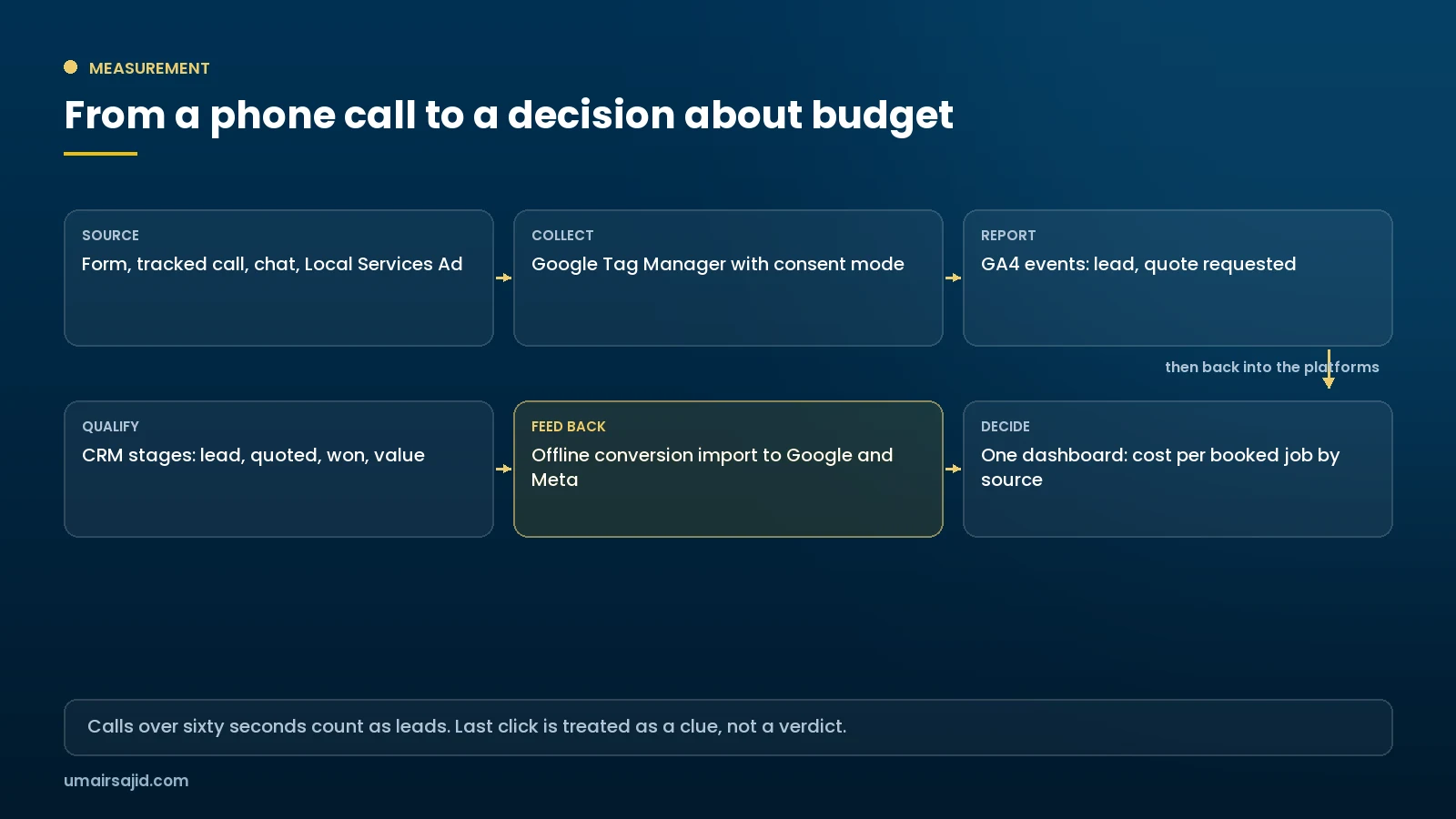
What counts as a conversion. Form submissions, calls over sixty seconds, quote requests and booked jobs. Not clicks, not impressions, not “engagements”.
The stack. Tag Manager on the site, GA4 receiving named events, call tracking with dynamic number insertion so calls carry a source, the CRM or job sheet recording the stages (lead, quoted, won, value), and then the part almost nobody does: importing the won jobs back into Google and Meta as offline conversions, with values. That last step changes what the platforms optimize for, from cheap form fills to profitable jobs.
Consent and privacy. Consent mode configured properly, and customer data staying in systems you control.
The one report the owner reads. A single page: spend, enquiries, cost per enquiry, quotes, jobs won, revenue by source, and this week against the same week last year. If a report takes longer to read than to act on, it is the wrong report.
Attribution honesty. Last click lies in local services. Somebody sees a van, searches the business name, calls from the profile, and the ad gets no credit. I use three cheap correctives: the “how did you hear about us” field, call recordings, and occasional holdout tests where a channel is paused in one area and the effect is measured. The aim is a defensible view, not a perfect one.
Where AI and automation carry the load
AI is useful here in a narrow, boring way: it removes hours from research and follow-up so the human work gets the attention.
Research and briefs. Clustering search terms, summarizing what reviews say about competitors, turning a pile of customer questions into a content plan.
Creative support. Caption variants, alt text, cutting a long job video into three short ones, drafting seasonal offers. Every piece still gets a human pass, because the tell for AI-written copy in a trade business is that it sounds like every other business.
Operations, which is where the money is. Instant reply to a new enquiry within minutes, lead routing by service and area, quote follow-up sequences, review requests after job completion, reactivation of dead leads. I build these in tools like n8n or Make so they keep running when everyone is busy.
Reporting. Automated weekly pulls into one sheet, with a written summary of what changed and what I am doing about it.
What I do not automate. The quote, the site visit, the phone call and the apology when a crew is late. Those are the business.
How the work actually runs
A plan nobody can execute is a document, not a strategy. The engagement has a shape:
- Kickoff, where access is granted, the goal and capacity are agreed, and the stop list is written.
- A weekly call, thirty minutes, same time, with the same six numbers on screen.
- A monthly review that looks at cost per booked job by source, and decides what moves.
- A quarterly reset before each seasonal change.
Who does what: I own strategy, the site, search, ads, tracking and reporting. The crew owns the photographs and the site videos, which takes five minutes a day. The office owns response speed and quote follow-up. If you have a designer or developer already, they keep the build work and I hand them specifications rather than opinions.
Everything lives in one board, one document of decisions, and one dashboard. At the end, you own the site, the accounts, the data and the plan, whether or not you keep working with me.
The first 90 days
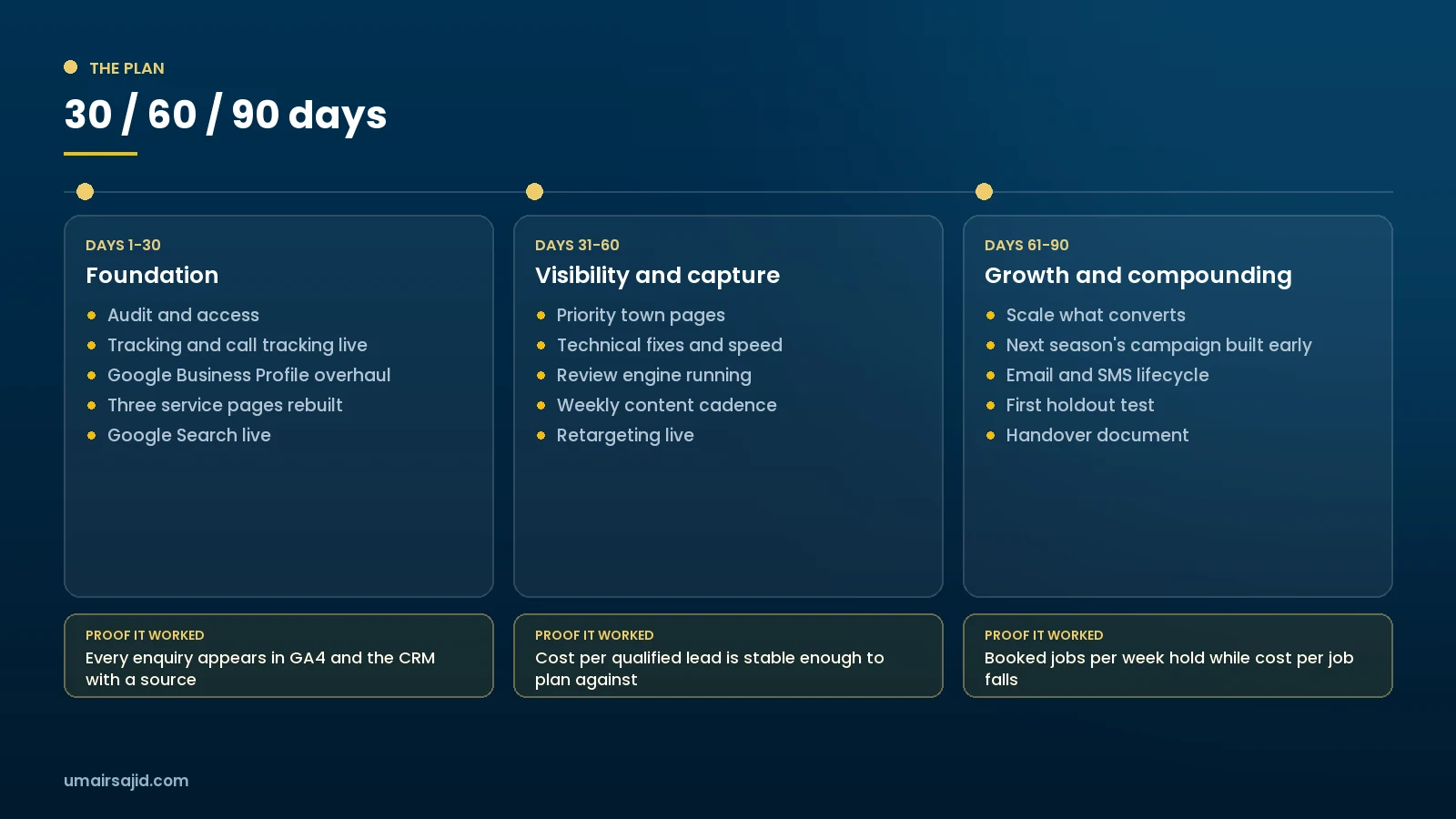
Days 1 to 30: foundation. Audit and access. Tracking and call tracking live. Google Business Profile rebuilt properly. The three service pages that matter most rewritten. The quote form cut to four fields plus a photo. Review requests started. Google Search live on your best two services with tracked conversions. Proof it worked: every enquiry appears in analytics and the job sheet with a source attached.
Days 31 to 60: visibility and capture. Priority town pages written properly. Technical fixes and speed. The content habit running weekly. Retargeting live. Response time measured and improved. Negative keyword sweeps every week. Proof it worked: cost per qualified lead is stable enough to plan against.
Days 61 to 90: growth and compounding. Scale what converts and cut what does not. Build next season’s campaign before the season arrives. Email and SMS flows live. A first holdout test. Maintenance or repeat offer launched. Handover document written. Proof it worked: booked jobs per week hold or rise while cost per booked job falls.
What this looks like after ninety days
An honest picture, because the hype in this industry is exhausting.
Paid search gives a readable signal in two to three weeks and a reliable trend by week six. Conversion fixes on the site often show within days. Local rankings and the map pack move over eight to twelve weeks, sometimes faster if the profile was badly set up to begin with. Organic pages for research terms compound over three to six months. Anyone promising faster organic results than that is guessing.
For context on the paid and social side: one landscaping business I worked with reached three times its previous lead volume through a targeted social strategy, and a local hospitality business doubled its weekend footfall through local Facebook ads. Those were their results, in their markets, with their offers. Yours will depend on your margins, your service area and how fast you answer the phone.
I have written the same playbook for remittance companies, appliance repair businesses, AI app companies and small businesses generally, and you can see the results framework applied to live accounts in the case studies.
The mistakes I stop first in landscaping
- Renting leads forever. Directories are a bridge, not a business model. Every month on them should reduce, not grow.
- One page called “Services”. Six services on one page means you rank for none of them and answer none of them properly.
- No tracked phone number. Most enquiries in this trade are calls. Untracked calls make every budget decision a coin toss.
- Answering tomorrow. The first business to reply usually wins the quote. This costs nothing to fix and changes everything.
- Spending the whole budget in April. The auction is most expensive exactly when everyone else is bidding. Build demand before the rush.
- Boosting posts instead of running campaigns. Boosted posts optimize for engagement. Engagement does not install a patio.
- Ignoring the Google profile. It is the shop window for a business with no shop.
- No repeat offer. A maintenance plan, a seasonal visit or an annual check turns a one-off customer into revenue you can forecast.
FAQ
How much should a landscaping company spend on marketing?
Work back from the numbers rather than picking a percentage. If a job earns you a certain gross margin and roughly one in three quotes is won, you can calculate what you can afford per lead, then multiply by the leads needed to fill the crews. Start at a level where a bad month is survivable, and increase only while the lead to quote and quote to won rates hold.
Is SEO or Google Ads better for a landscaping business?
They answer different problems. Ads buy you enquiries this week and stop when you stop paying. Local SEO and the Google Business Profile compound over months and keep working in the quiet season. For most landscaping companies the right answer is ads for the immediate pipeline, local SEO underneath so the cost of that pipeline falls over time.
How long before digital marketing brings jobs?
Paid search: a readable signal in two to three weeks. Site conversion fixes: days. Local map rankings: eight to twelve weeks. Organic content for research searches: three to six months. Anything faster than that on organic is someone selling you a story.
Do I need a new website, or can we fix the one I have?
Usually fix. If the site loads on a phone, can be edited, and is not built on something abandoned, then a page map, better service pages, real photographs and a simpler quote form will do more than a rebuild. I only recommend rebuilding when the platform is the constraint.
What do I do in the off-season?
Three things: sell the off-season services you do have, build the assets that take time (town pages, content, reviews, email list), and prepare the spring campaign so it launches before competitors wake up. The quiet months are when the cheap ground is available.
Are Angi, Thumbtack and similar platforms worth it?
They are worth it as a gap filler and as market research on what people ask for. They are not worth building a business on, because the lead is shared, the price rises, and you never own the customer. Use them while your own channels are being built, then reduce.
Do I need TikTok or Instagram for a landscaping business?
Instagram, yes, if someone will actually photograph the work: transformations perform and the audience is local. TikTok, only if you will post weekly video. A neglected account is worse than no account, because buyers check.
Can I run this myself, or do I need a consultant?
Plenty of owners run the local SEO, profile and content side themselves once the structure exists. The parts that usually need help are tracking, ad account structure and the quarterly decisions about where the budget goes. That is what a free thirty-minute review is for: you will get the priority list either way.
Where to start
If you take one thing from this, take the order. Capture before visibility, visibility before spend, and every stage measured before the next one begins. It is slower than launching ads on Monday and it is the reason the calendar is still full in October.
The first move costs nothing: pull last season’s enquiries and mark where each one came from. If you cannot, that is the first job.
Free 30-minute landscaping marketing review. I will look at your site, your Google Business Profile, your tracking and your ad accounts, and tell you the two things to fix first and the one thing to stop paying for. No pitch, and you keep the notes whether we work together or not. Book the call.