







Quick answer
Digital marketing for small business works by subtraction. I decide what to stop in the first week, then put the budget and the owner’s few spare hours behind two things that can be measured, usually local search and one social platform. Everything else waits until those two pay for themselves.

Small budgets do not fail because they are small. They fail because they are spread across a website refresh, an Instagram account, a boosted post, a directory subscription and a half-finished email list, and none of those five gets enough attention to produce a customer.
If you would rather have this built with you than explained to you, that is what my small business marketing strategy work covers. I have run this for local service businesses, shops and small online sellers, and the pattern repeats. Five things are done badly instead of two done properly, and nobody can say which brought the last ten customers.
Who this is for: owners of businesses with one to twenty staff, some word-of-mouth trade already, a modest monthly budget, and two or three hours a week at most.
Start with the goal, not the channel
The first thing I do is turn down the brief. Owners ask for followers, a new logo, or a presence on the platform their competitor is on. The goal is paying customers per week at a margin worth having, and none of those requests is that.
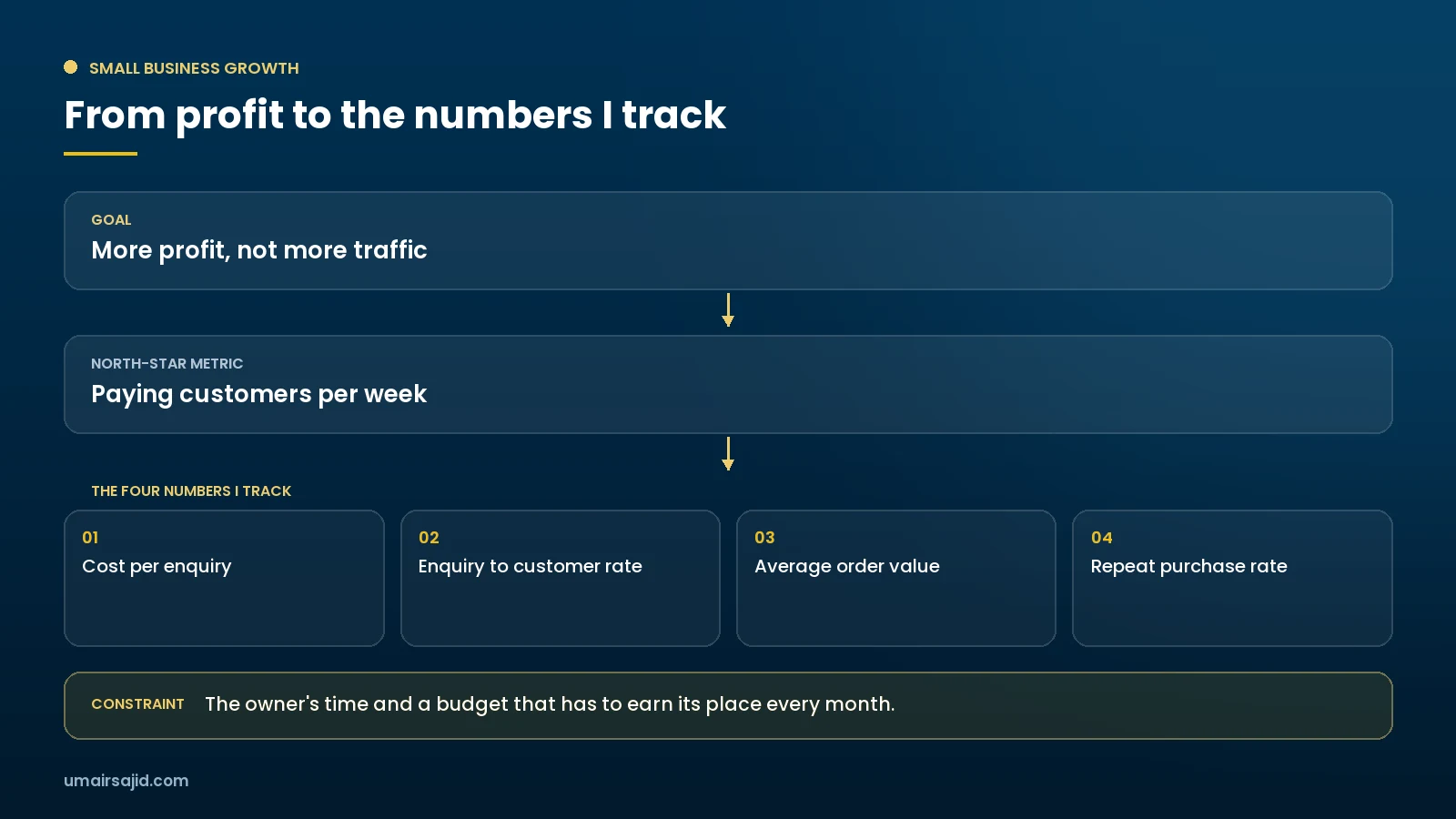
So we agree one number to steer by: paying customers per week, with the average order value beside it. It stops us celebrating reach, and it stops us pushing the cheap line when another earns four times as much.
Four numbers sit underneath it, and I report them every week:
- Cost per enquiry. Everything spent, divided by the calls, forms, messages and walk-ins that asked about buying.
- Enquiry to customer rate. If this is low, marketing is not your problem. Your offer, your price or your reply speed is.
- Average order value. The lever almost nobody pulls. Selling one more thing to someone already buying costs nothing.
- Repeat rate over ninety days. The number that decides whether you can afford to advertise at all.
Then the constraint. For a small business it is rarely money and almost always the owner’s time. A plan that needs ten hours a week from someone who has two is not ambitious, it is a plan that dies in week three and takes the owner’s confidence with it. So I ask how many hours genuinely exist, and we build for that number.
Margin decides what we promote, not revenue. I once sat with an owner whose best-selling product was his worst-earning one, and every ad he had paid for pushed it. We moved the same budget behind a service with triple the margin. Nothing got cleverer. The arithmetic stopped working against him.
What I need to understand before I touch anything
The first two weeks build nothing. I am working out what this business actually earns money from, because that changes every decision after it.
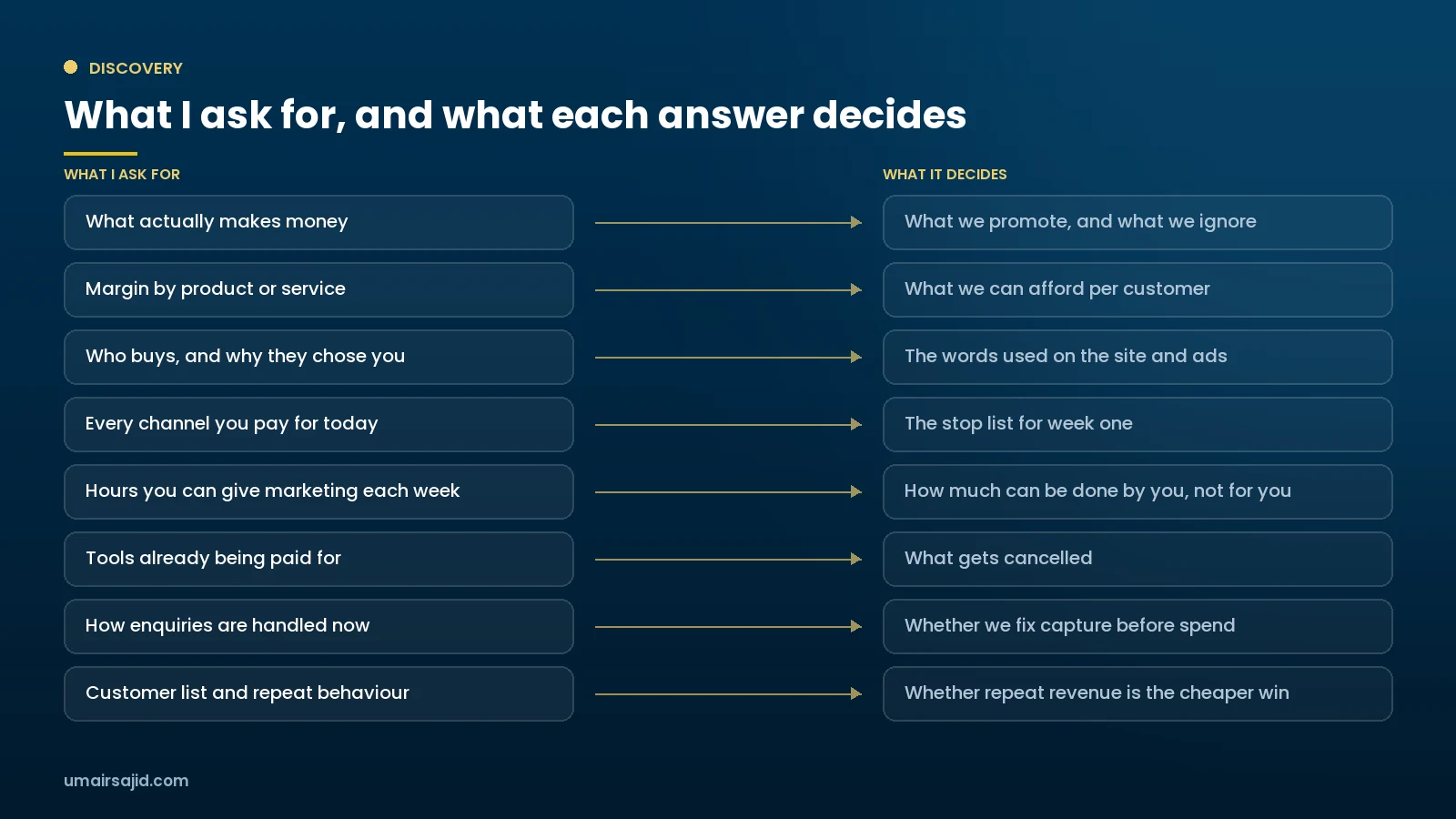
These are the questions I ask, and the reason each one exists:
- What do you sell, and what does each line earn after costs? Not the price list. What is left after materials, delivery, card fees and hours.
- Which of those do you want more of? Plenty of owners make their best margin on work they quietly hate. Advertising that work is a trap.
- Who bought in the last ninety days, and why did they pick you? Ten calls to recent customers beat any persona document.
- What does a customer spend the first time, and over a year? This decides what an enquiry is worth, and it is usually more than the owner thinks.
- What are you doing now, and what does each thing cost in money and hours? The directory subscription, the scheduling tool, the Thursday evening spent on captions. Hours are a cost even when no invoice arrives.
- How many hours a week can you really give this? Answer honestly. A two-hour plan that runs beats a ten-hour plan that gets abandoned.
- Who answers an enquiry, and how long does it take? In most small businesses this is the biggest lever, and it is free.
- What are you already paying for and not using? Almost every business I audit owns an email tool nobody has opened since January.
- What is your offer, in one sentence a stranger would understand? If we cannot write that sentence, traffic will not rescue us.
- Where do your customers come from? A radius, a city, or anywhere if you ship. This sets the targeting and half the content.
- How many reviews do you have, where, and when was the last one? Recency does more work than the total.
- What access can I have? Analytics, Search Console, the Google Business Profile, ad accounts, the website admin, and wherever enquiries are written down now.
That last one is a gate rather than a request. If I cannot see the numbers, everything I report later is a story with a chart attached.
Out of those answers comes the stop list, written in week one. It usually holds three or four items: the platform nobody has posted on since spring, the directory selling the same lead to four competitors, the second social account nobody wanted, the redesign quoted but never started. Stopping is free, immediate and unpopular, which is why owners rarely do it alone. Every hour and dollar freed here funds the work we are about to do.
Two findings stop a paid campaign before it begins. The first is no way to tell where an enquiry came from, because paying for clicks you cannot trace is a donation with extra steps. The second is an offer that has never sold without a discount. Ads do not fix a weak offer, they only buy it an audience.
Demand and competitor research
Now I find out what the market looks like in your town and your category rather than in general.
Demand comes in three moods: urgent (“emergency plumber”, “open now”), comparing (“best coffee roaster in the city”, “cost of”), and browsing, which is mostly social. Each mood wants a different page, and small businesses build for the browsing mood, then wonder why nothing converts.
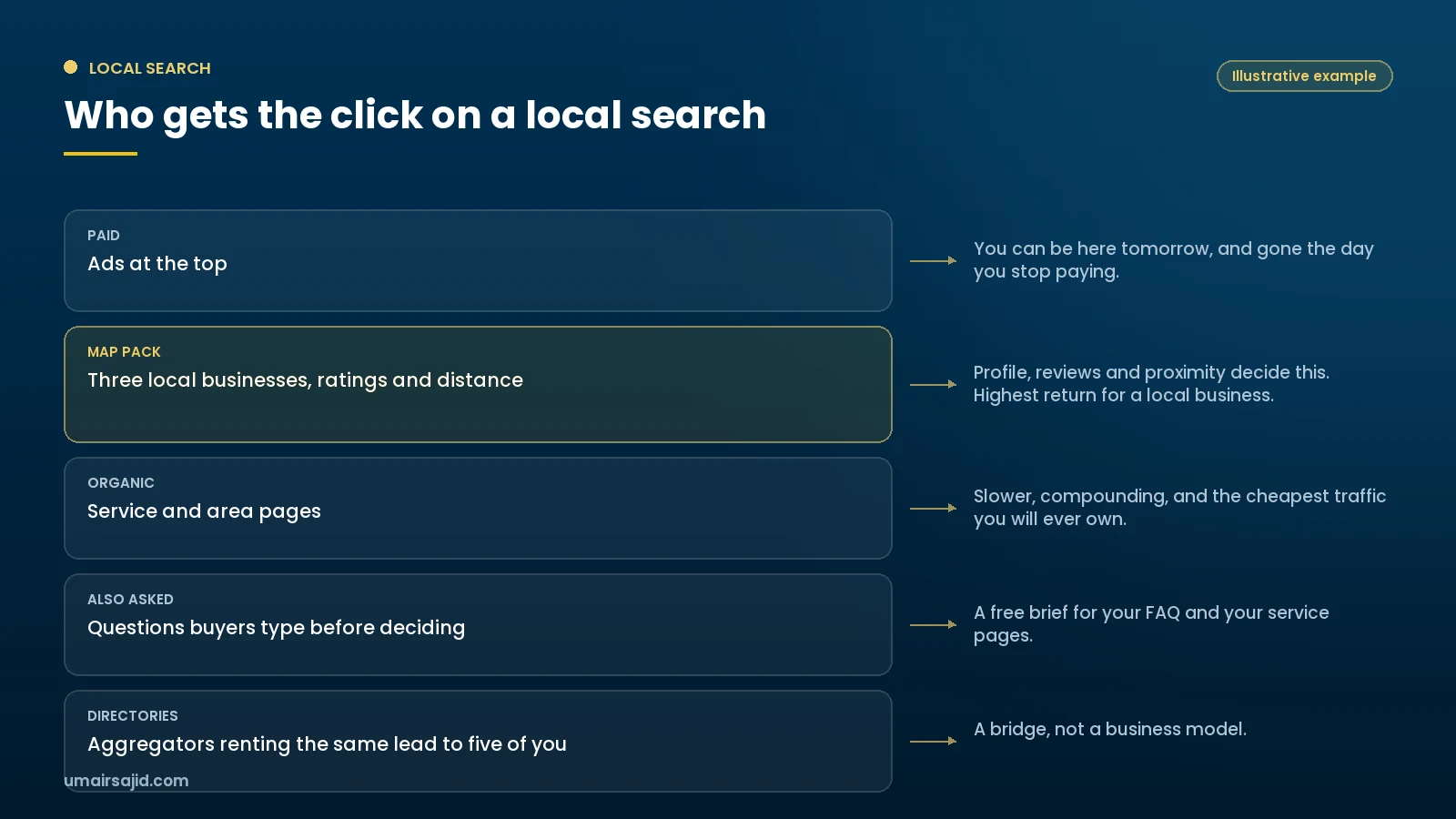
Then I read the results page honestly. For most local searches the map pack takes a large share of the clicks, with paid results above it and organic pushed down the screen. The chart above is one I drew to show that anatomy, so treat the proportions as an illustration rather than a measurement of your category. Either way the conclusion holds: the profile, the reviews and your proximity to the searcher do more than a long blog post will. Local SEO for small business is mostly profile work, not article work.
I read competitor ads rather than competitor websites. The Meta Ad Library and Google’s Ads Transparency Center show what competitors are running and how long each ad has been live. An ad running for four months is paying for itself. An ad that appeared last week is a guess. Free, twenty minutes, and almost nobody does it.
Next, where the audience already is: a local Facebook group, a WhatsApp community, a school newsletter, a supplier’s mailing list. I would rather put one offer where two thousand local people already gather than build an audience from nothing.
Last comes the positioning gap, and it is the most useful thing in the exercise. Everyone promises quality, friendly service and a free quote. Nobody says who they are for, what it costs to start, or what happens when something goes wrong. Specific beats superior. If you sell software or an app rather than a local service, the same ladder runs differently, and I wrote those versions for AI app companies and money transfer apps.
The growth roadmap
The sequencing rule I do not bend: fix what you own, then get found, then pay for attention.
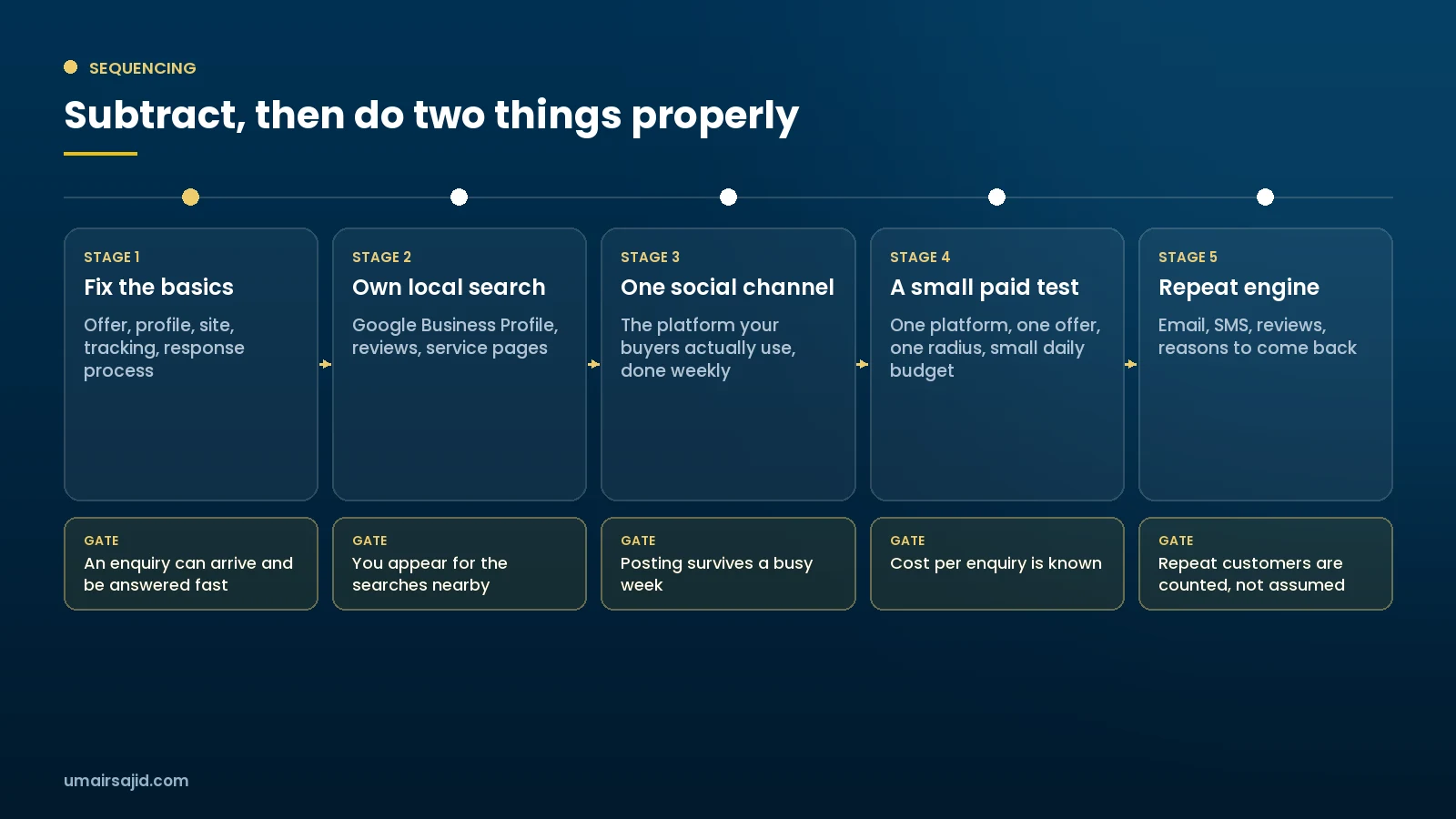
Paid traffic sent to a weak offer is a tax you pay twice, once to the platform and again in the enquiries that never arrive. The money goes in last, once we know what an enquiry is worth.
Each stage has a gate, so moving on is a fact rather than an opinion.
| Stage | What gets built | The gate before moving on |
|---|---|---|
| Fix the basics | Offer, tracking, five-page site, Google profile | Every enquiry has a source, and the offer sells without a discount |
| Own local search | Profile completed, reviews flowing, two real pages | You appear in the map results for your own category |
| One social platform | A posting rhythm the owner can actually hold | Four consecutive weeks posted without me chasing |
| A small paid test | One platform, one offer, a radius, a stop rule | Cost per enquiry is known and affordable |
| Repeat customers | A list you own, follow-up, reasons to come back | Repeat rate appears on the weekly dashboard |
There is one exception. If a season is about to break, say a florist three weeks before a holiday, and tracking is already clean, I will run a small paid test early and build the rest behind it. A missed season costs a year.
What to ignore at each stage matters as much as what to build. In stage one, ignore the logo and the TikTok account. In stage two, ignore blogging. In stage three, ignore every platform except the one you chose. The plan works because of what is missing from it.
Owned media
Owned media is everything you would still have if every ad account closed tomorrow. For a small business that is the website, the Google Business Profile, the photographs, the reviews and the customer list, and it is the only part of this that gets cheaper over time.

Five pages, and why five is enough
The page map comes before anyone opens a design tool. Home, one page per thing you most want to sell, a proof page with real work and real reviews, an about page with your face on it, and a contact page that works on a phone. Ten good pages beat forty thin ones.
What each page has to contain
A page earns its place by answering, in order: what this is, who it suits, what shapes the price, what happens after they contact you, proof you have done it before, and one way to start. Price is where owners flinch. You do not have to publish a number, but you do have to say what moves it, because the buyer is deciding whether they can afford you before they risk a call.
The about page matters more here than anywhere else, because people buying from a small business are buying a person. A real photograph and a name to ask for beat another round of copy edits.
When not to rebuild the site
Most of the rebuilds I am asked to approve should not happen. If the site loads on a phone and can be edited without a developer, a better page map, plainer copy and a shorter form beat a rebuild at a fraction of the cost. Rebuild when the platform itself is the constraint. Redesigning a site to fix a positioning problem is the most expensive form of procrastination there is.
On-page and technical SEO, in the order I do them
On-page first, because it is quick and it compounds. The title and the H1 use the words a buyer types, including your town. The first paragraph answers the question the page was opened for. Internal links join the service pages to the proof page and the contact page. Your name, address and phone number match everywhere they appear, because inconsistency between the profile, the footer and old directory listings quietly damages local rankings.
Technical second, and for a small site it is short. Is every page you care about indexed. Does it load fast on a phone on mobile data. Are there duplicate pages left from an old build. I check Search Console coverage before I believe anything anyone tells me about a website.
Conversion, where the quickest money is
Three fixes pay for themselves within days. Make the phone number tappable and put it where a thumb lands. Cut the form to four fields. Say when someone will reply, then reply in that time.
Then add what a nervous buyer looks for: a photograph of the real premises or team, two reviews beside the form, your hours, your area, and whatever licence applies. None of it is glamorous, and it routinely does more than a month of advertising.
The Google Business Profile is the highest-return asset you own
For a local business, nothing else produces as many enquiries per hour of work. It needs the right primary category, every service listed, correct hours including holidays, an accurate service area, photographs added regularly, and the questions section seeded with what you are asked. Messaging on, but only if someone answers it.
Read what the profile reports back. Calls, direction requests and website clicks tell you whether people are finding you. When an owner says nothing is working, this is the first place I look.
One social platform, chosen by what the owner can sustain
I pick the platform the owner can keep up with, not the one with the biggest audience. A restaurant owner who photographs food belongs on Instagram. A tradesperson who talks well on camera belongs on short video. The wrong answer is all of them.
Rhythm matters more than polish. Two posts a week for six months beats twenty in January and silence until June. Batch it: one hour a fortnight, photographs and captions in a block. Repeat your offer more often than feels comfortable, because nobody sees every post.
If posting keeps sliding off the owner’s week, that is a candidate for outside help rather than a reason to quit. Social media management exists for that gap, and the strategy behind it sits in social media marketing.
A list you own, and the repeat customer economics behind it
Here is the part small businesses ignore, and it is their cheapest revenue. You already know who bought from you, and reaching them costs a few minutes and a tool you may already pay for. A new customer costs a click, a campaign and a wait.
Collect an email address or a phone number at the till, and say what they will get and how often. Four messages cover most of it: a thank you that asks for a review, a reminder before they would naturally buy again, a note when something new arrives, and a reactivation at six months.
A small local list that opens your messages beats ten thousand followers who scroll past you. A customer who buys twice is worth double one who buys once, so a lift in repeat rate does the same work as a cut in cost per enquiry.
Earned media
Earned media is what other people say about you, and for a small business it is a ranking factor and a sales tool at once.
Reviews. Ask when the customer is happiest, at the counter or as the job finishes, not three weeks later by email. The ask is a text with a direct link, sent by the person who served them. Reply to every review, including the bad ones, because future customers read the replies more carefully than the reviews.
Referrals, made repeatable. Most small businesses get referrals by accident and then hope for more. Make it a habit: ask at delivery, give the customer something specific to pass on, thank them when it works. The next street, the neighbor who watched you work.
Local partnerships. The businesses that serve your customers just before or after you are the cheapest channel you will find. A nursery and a landscaper, a letting agent and a cleaner. They also produce the only links a small site needs.
What I never do. Buy reviews, buy links, offer a discount in exchange for a review, or screen customers so only the happy ones get asked. All of it breaks the platforms’ rules, some of it breaks consumer law, and for a business whose reputation is the asset it is a bad trade.
Paid media
Paid starts after the basics hold, and then it starts small and narrow on purpose.

One platform, one offer. For an urgent service that is usually Google Search, because people type the problem the moment it becomes real. For anything discovered rather than searched for, a restaurant, a salon, a class, it is usually Meta, because you are creating demand rather than catching it. Pick one. Running both on a small budget gives two underfed campaigns and no answer.
Structure it so you can read it. One campaign, two or three ad sets, a radius around where customers actually travel from, and targeting set to people in that area rather than people interested in it. On Search, a tight keyword list with a serious negative list, because half of a small account’s waste is jobs, courses and DIY searches. On Meta, broad targeting inside the radius with a real conversion event feeding it.
Creative is the budget. Three to five pieces a month, most shot on a phone in your own premises. What performs is the thing itself: the work, the food, the before and after, the offer stated plainly. Stock imagery loses to a real photograph of your shop almost every time.
Boosting a post is not running a campaign. The boost button optimizes for the cheapest engagement it can find, and engagement is not a customer. A campaign built in the ads manager lets you choose the conversion, the radius and the placement, and it reports in numbers you can act on. That change has fixed more small accounts for me than any budget increase.
Budget logic and the stop rule. Start at a daily amount you could lose for three weeks, and leave it alone for two, because changing it daily keeps the platform learning forever. Write the stop rule before launch: if cost per enquiry sits above what the margin can carry after an agreed number of enquiries, we stop, change one thing and run it again. Scale only while the enquiry to customer rate holds.
A local hospitality business I worked with doubled its weekend customers through local Facebook ads, on a small radius and one offer repeated all month. That was their result in their market, and it worked because it was narrow. If you want the account run rather than explained, that is Google Ads management, and the enquiry side is lead generation.
The measurement stack
A small business needs a deliberately small measurement stack. If it takes more than two minutes a week to read, it will not get read.
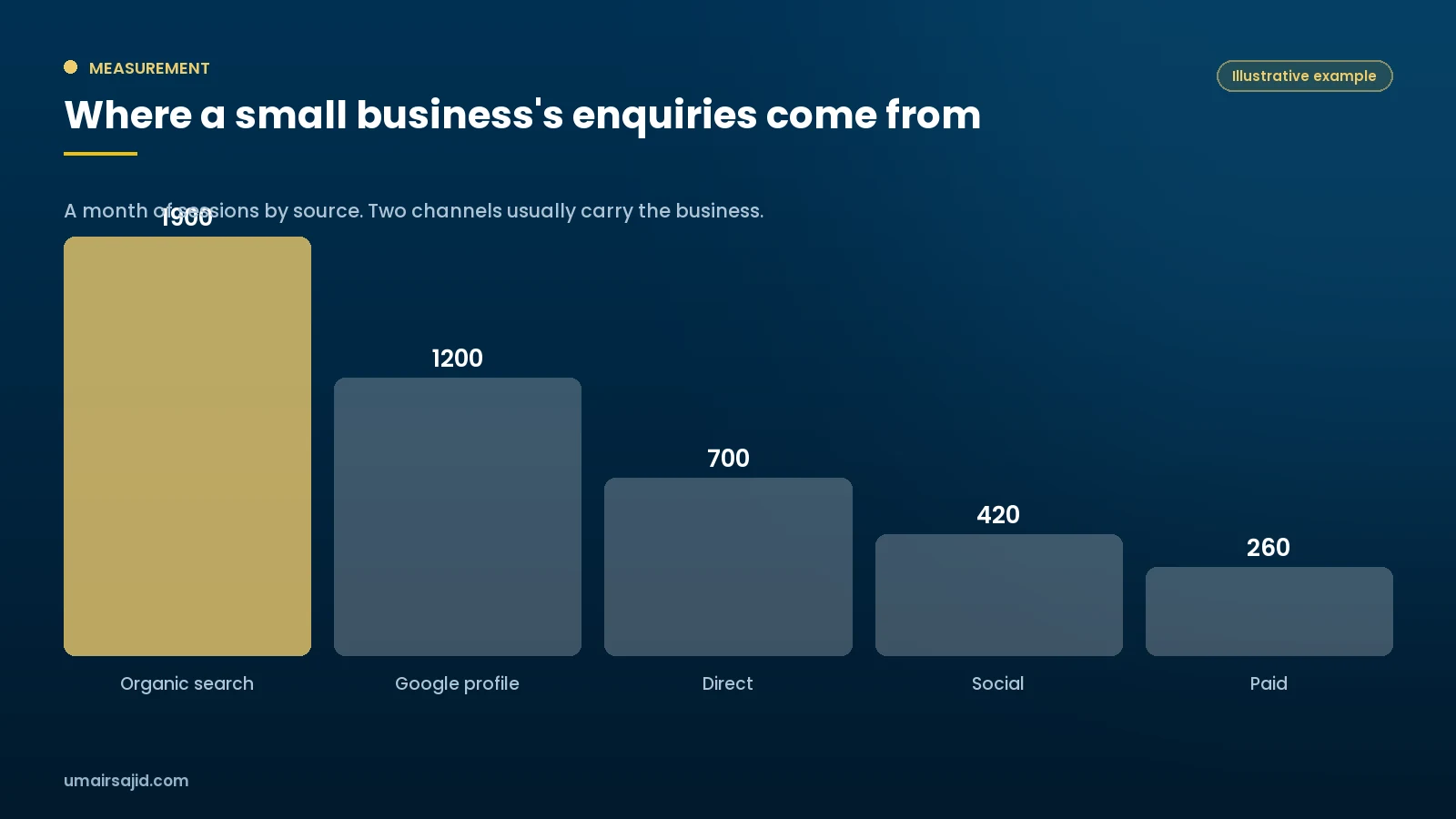
The chart above is one I drew as an example of a month once a small business finally has sources attached to its traffic. Do not read your own numbers into it. Read the shape: two channels doing the work, and a long tail that felt busy and delivered nothing.
One tracked number. A call tracking number on the website and in the Google profile, so calls carry a source. Where most enquiries arrive by phone, that is the difference between managing and guessing. Ask walk-ins how they heard about you and write it down, because that catches what analytics cannot: the van, the sign, the friend, the market stall.
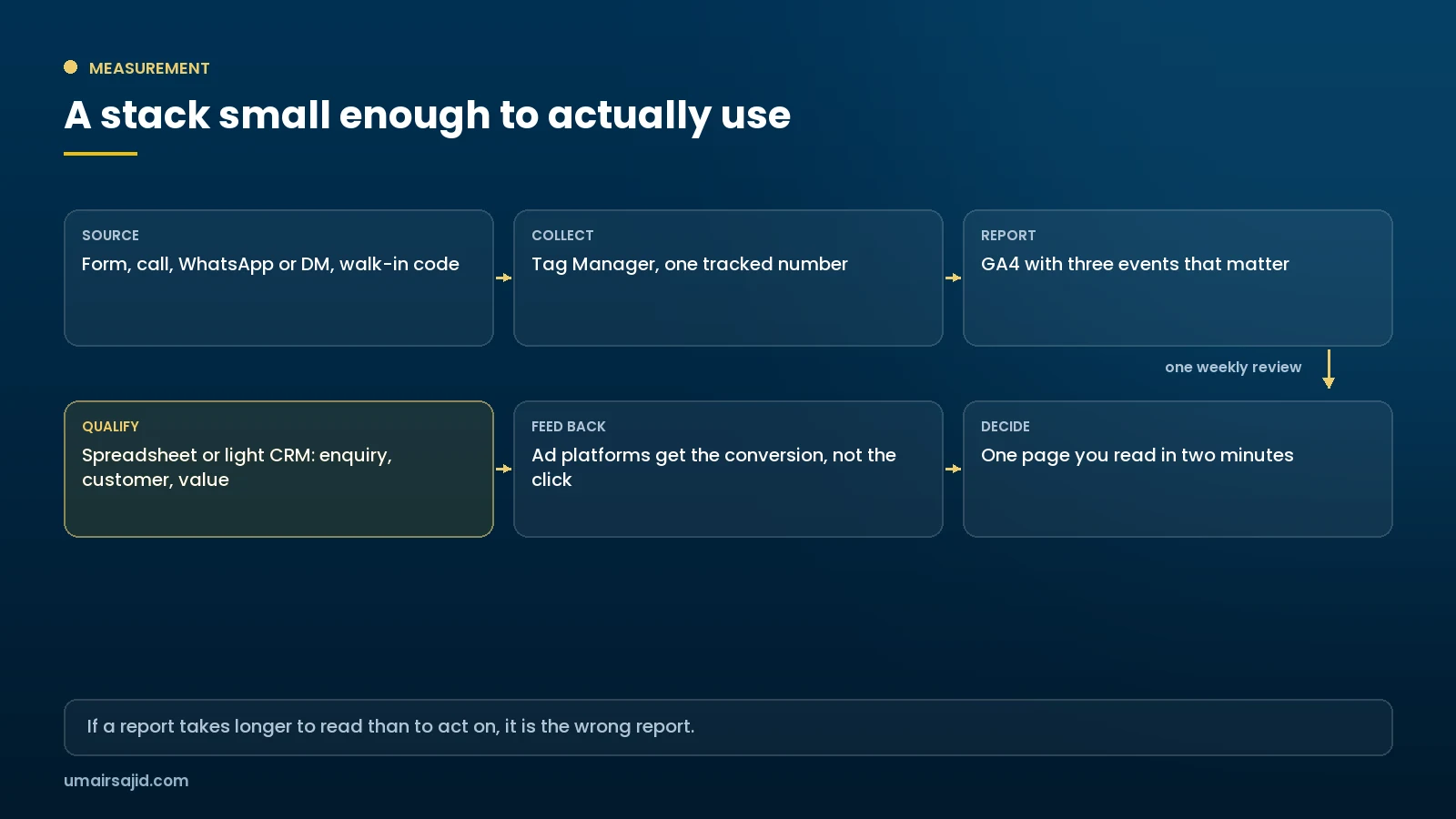
Three events, not thirty. In GA4 I want form submitted, phone tapped, message started. I have audited accounts with forty events where nobody could say how many customers arrived last month.
A spreadsheet or a light CRM. Every enquiry gets a row: date, source, what they wanted, quoted, won, value. A spreadsheet beats an expensive CRM nobody fills in. Move to a proper tool when the rows are too many to eyeball.
The two-minute dashboard. One page, updated weekly: spend, enquiries, cost per enquiry, customers, revenue, and this week against the same week last year. If a report takes longer to read than to act on, it is the wrong report.
Consent and honesty about attribution. Run a consent banner that works and keep customer data in systems you control. Then accept that last click lies. Someone sees your ad on Monday, searches your name on Thursday, and Google takes the credit. The corrections are cheap: the how-did-you-hear question, and pausing a channel now and then to see what happens.
Where AI and automation carry the load
AI is useful to a small business in a dull, practical way: it removes hours from the tasks the owner would otherwise skip.
Drafting, which the owner then edits. Captions, review replies, a first version of a service page, answers to the questions customers keep asking. A fortnight of captions comes out of one set of photographs in a sitting. The draft is the fast part, the edit is what keeps it yours. Publishing raw output is how every business in a category ends up sounding identical.
Follow-up, which is where the money hides. An instant reply to a new enquiry, a reminder to whoever must quote, a review request the day after delivery, a reactivation at six months. These tasks vanish in a busy week, and once automated they stop vanishing. The weekly six numbers pull themselves into one sheet on the same day.
What I never automate. The quote, the conversation, the apology when something goes wrong, and the reply to an unhappy review. Those are the business, not the marketing.
How the work actually runs
A plan nobody can execute is a document. The shape I use is deliberately light.
- A kickoff where access is granted, the goal and hours agreed, the stop list written.
- A weekly check of thirty minutes, same time, same six numbers.
- A monthly review that decides one thing to change and one thing to stop.
- A quarterly reset before your busy season.
Who does what: I take strategy, the site, search, ads, tracking and reporting. The owner takes the photographs, the voice notes and the replies, about twenty minutes a day. Whoever is on the counter owns reply speed, and that is not negotiable, because it sets the conversion rate of everything upstream.
On doing it yourself against hiring someone, my split is this. Most owners can run the profile, the reviews, the photographs and the posting themselves, and better than an outsider would. What is worth paying for is the work where a mistake is expensive or invisible: tracking setup, ad account structure, the technical health of the site, and the quarterly decision about where money goes next. That is roughly how I work with the smallest clients through freelance consulting.
Everything lives in one document of decisions and one dashboard, and you own the site, the accounts, the data and the plan, whether we keep working together or not.
The first 90 days
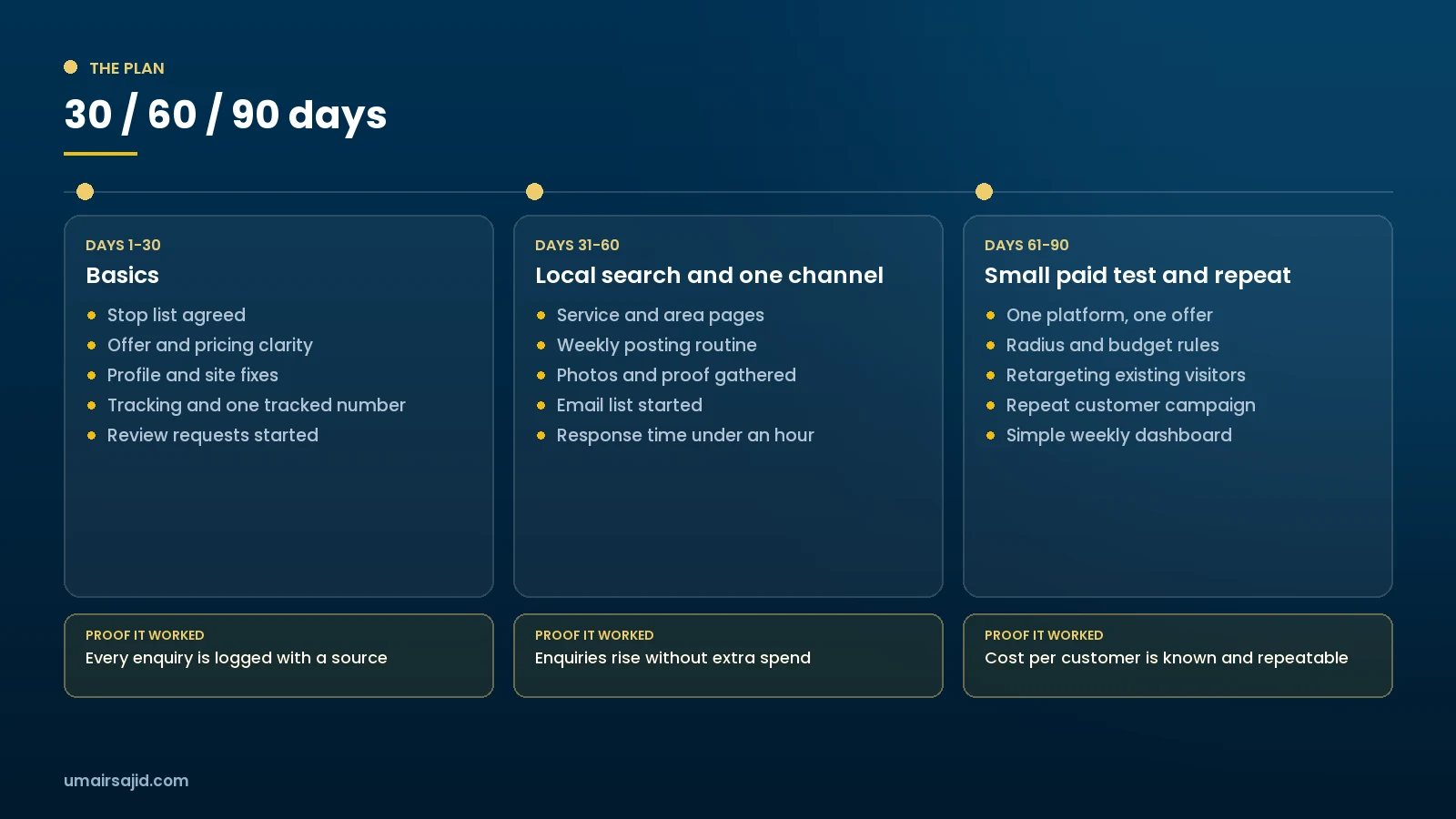
Days 1 to 30: basics and tracking. Access and audit. The stop list agreed and acted on. Call tracking and three GA4 events live. The Google Business Profile rebuilt. The offer rewritten in one sentence on the home page. The two pages that matter most rewritten, the form cut to four fields. Proof it worked: every enquiry this week has a source next to it.
Days 31 to 60: local search and one channel. The profile posting and collecting reviews steadily. The remaining pages fixed, speed and indexation sorted. One social platform running on a rhythm the owner holds. Reply speed measured and improved. Proof it worked: the profile produces more calls and direction requests than in month one.
Days 61 to 90: a small paid test and the repeat engine. One platform, one offer, a radius and a written stop rule. The customer list started and the first two follow-up messages live. Proof it worked: cost per enquiry is a number you can plan against, and repeat customers appear on the dashboard.
What this looks like after 90 days
An honest picture, because this market is full of people selling speed.
Fixes to the site and the form show up within days. The Google Business Profile usually moves in four to eight weeks, faster if it was badly set up. Paid gives a readable signal in two to three weeks and a trend you can trust by week six. Organic pages take three to six months, and anyone promising faster is guessing.
Two results for scale, both other people’s businesses. A local hospitality business doubled its weekend customers through local Facebook ads. A landscaping business I worked with reached three times its previous lead volume through a targeted social strategy. Those were their outcomes, in their markets, with their offers.
The same method, written out for specific industries, is here: landscaping companies, appliance repair businesses, remittance and money transfer apps and AI app companies. The sequence is identical in all four; only the channel mix and the proof change. You can see it applied to live accounts in the case studies.
The mistakes I stop first in small businesses
- Five channels at once. Attention is the scarce resource, not money. Two channels done properly beat five done occasionally.
- Boosting posts instead of running campaigns. The boost button buys engagement. Customers are a different objective in a different tool.
- No tracking at all. Without a source on each enquiry, every decision is a coin toss with a budget attached.
- Discount as the only offer. Discounts train people to wait for the next one and erode the margin that funds the marketing. Sell certainty or a bundle instead.
- Ignoring existing customers. The people who already paid you are the cheapest revenue you have, and they sit in an inbox nobody uses.
- Redesigning the site before fixing the offer. A new design over a vague promise is a prettier version of the problem.
- Answering enquiries tomorrow. The first business to reply usually wins the job, and fixing that costs nothing.
- Buying followers or reviews. It looks like progress for a fortnight and risks the only asset you cannot rebuild.
FAQ
How much should a small business spend on marketing?
Work back from your own numbers rather than copying a percentage. If you know the gross margin on an average customer, and roughly one in three enquiries becomes one, you can work out what you can afford per enquiry and multiply by the customers you need. Start below that figure and raise it only while the conversion rate holds.
Which platform should I start with?
The one that matches how people find what you sell. If they search when a problem appears, start with Google, the profile first and paid search second. If your product is discovered rather than searched for, start with the platform you can keep up with. The worst answer is the one your competitor uses.
Do I need a website, or is a Google Business Profile enough?
A profile alone can carry a very small local business, and plenty do fine on one. You still want a small site, because the profile is rented space and the site is the only asset you own outright. If you can only do one thing this month, do the profile.
Is SEO or advertising better for a local business?
They answer different questions. Ads buy enquiries this week and stop the day you stop paying. Local search compounds over months and keeps working in the quiet season. For most small businesses it is local search first, then a small paid test once the site converts.
How long before any of this works?
Site and form fixes show within days. The profile moves in four to eight weeks. Paid gives a readable signal inside a month. Reviews and organic content take three to six months. If someone says they can do organic faster, ask what they are selling.
Can I do this myself?
Most of it, yes. The profile, the reviews, the photographs and the posting are better done by you than by anyone you could hire, because you know the customers. What usually needs help is tracking setup, ad account structure and the quarterly call about where the money goes. For a second opinion first, book a free thirty-minute review.
What can I do with a very small monthly budget?
Spend it on one thing. Split across three platforms it buys noise, while the same amount behind one offer in a tight radius produces a readable result. Before that, spend two unpaid weeks on the profile, the reviews and the form. Those cost time rather than money, and they raise the return on every dollar after.
When is it worth hiring a consultant?
When your own hours cost more than help would, or when you have been busy for six months with nothing measurable to show for it. The other trigger is spending real money on ads without tracking, because that is where mistakes stop being cheap.
Where to start
Take the order, if nothing else. Own your basics, get found locally, then buy attention, measuring each stage before the next one starts. It is slower than launching ads on Monday, and it is why the business still gets enquiries in a quiet month.
Your first move costs nothing. Open a blank sheet, list the last twenty customers, and write where each one came from. If you cannot fill that column, you have found the first job.
Free 30-minute small business marketing review. I will look at your website, your Google Business Profile, your tracking and any ad accounts, then tell you the two things to fix first and the one thing to stop paying for. No pitch, and the notes are yours either way. Book the call.