







Quick answer
Fintech marketing for a remittance app comes down to one number almost nobody reports: funded first transfers. Installs, signups and verified users are checkpoints on the way there, and optimizing toward any of them buys people who never move a dollar. I build the plan in one order: make the money side believable, launch a single corridor properly, then buy users against a conversion the ad platforms can actually see.

This is the sequence my remittance marketing service runs, and it comes from working inside a remittance business rather than advising one from an agency desk. That view changes what you think the job is. Half of it is not marketing. It is fee clarity, KYC drop-off, payout speed and the gap between a signup and somebody who has sent money home. The other half is ordinary performance marketing, run under rules that will close your ad account.
Both halves belong to one person, or the two sides blame each other for a year.
Who this is for: founders and growth leads at money transfer apps, payment startups and licensed remittance businesses with a working product, some users, and no reliable way to buy more at a price they can carry.
Start with the goal, not the channel
Every remittance engagement opens with the same argument. The founder wants downloads, the cheapest number in this business and the least connected to revenue.
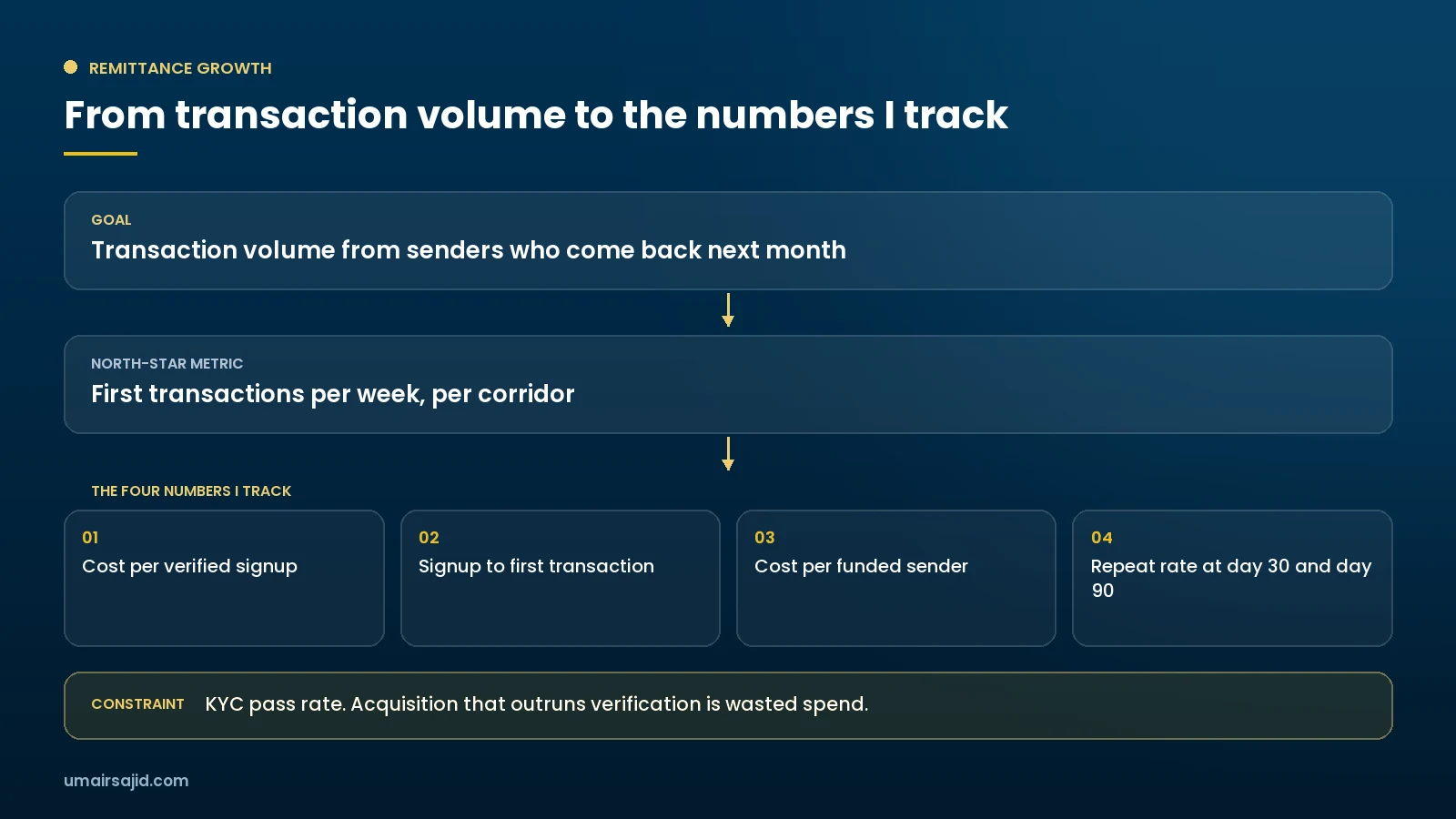
So I separate four states that get treated as one. An install is a tap in a store. A signup is an email address. A verified user has passed KYC. A funded first transfer is somebody who put real money in and sent it abroad. Only the last one earns anything, and only the last is worth optimizing toward.
That gives the north star: funded first transfers per week, per corridor. A thousand transfers on a route you lose money on is a worse week than three hundred on a route you do not.
Four numbers sit under it, reported weekly:
- Cost per verified signup. Verified, not registered. A registration that never clears KYC returns nothing.
- Signup to first transfer. The honest measure of your onboarding, your funding methods and your pricing.
- Cost per funded sender. All spend divided by people who completed a first transfer. The budget is judged on this.
- Day-30 and day-90 repeat. A remittance business is a subscription nobody calls a subscription.
A fifth number is not a marketing metric and still sets the ceiling: KYC pass rate. If seven in ten applicants abandon or fail verification, every dollar of spend is taxed at seventy percent before it reaches a transaction. I have watched teams triple a budget while that rate sat untouched, then wonder why cost per funded sender tripled.
Marketing that outruns verification is not growth. It is a support queue in a language nobody in your office speaks.
What I need to understand before I touch anything
The first two weeks produce no campaigns. They produce a picture of the business, because here the product facts decide the plan.
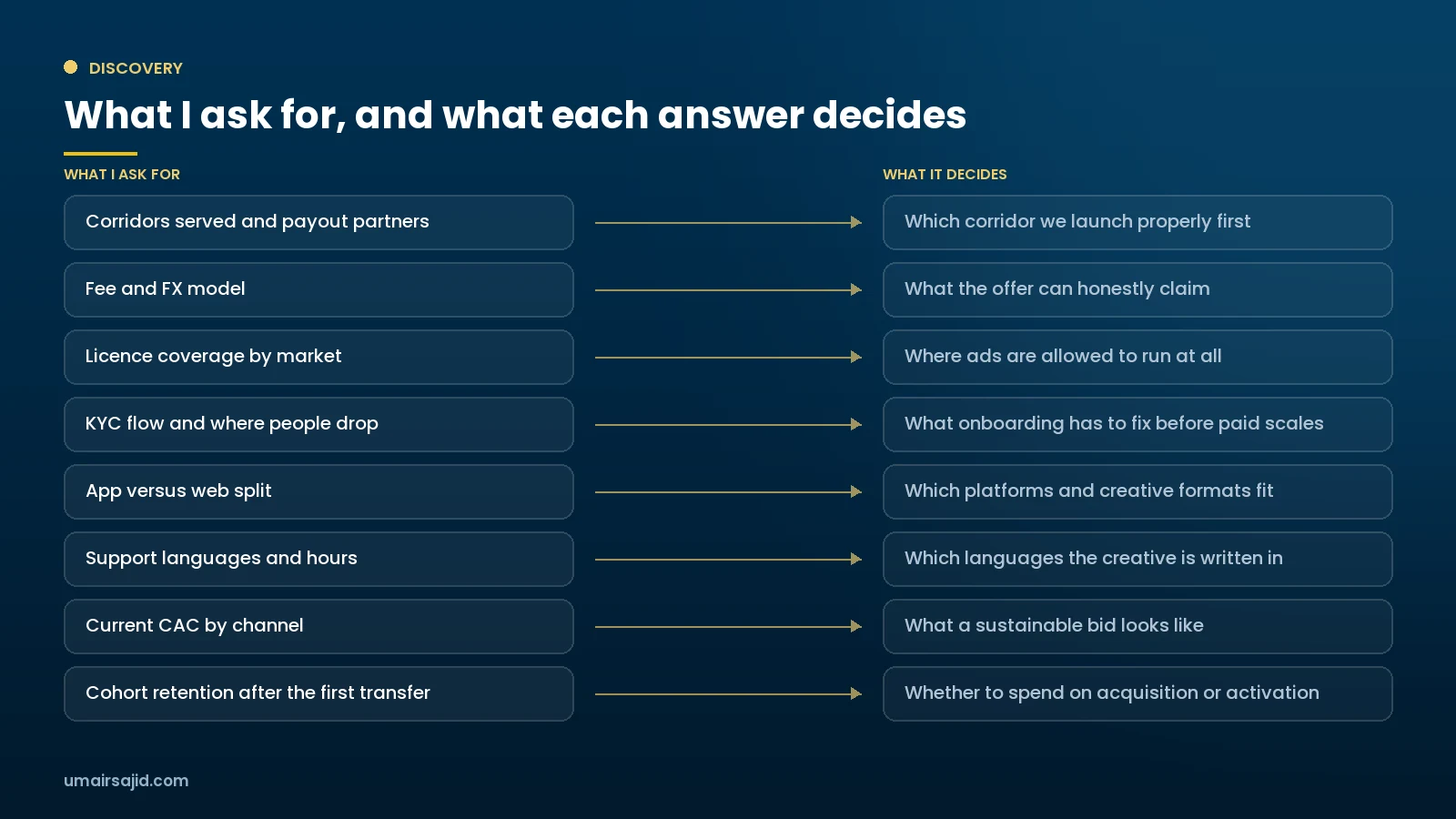
The questions, and why each one exists:
- Which corridors do you serve, and which makes money? Most companies list a dozen and earn almost everything on two.
- Who are your payout partners, and what do they cost? Partner plus acceptance cost is the floor that sets what you can pay for a sender.
- Do you earn on the fee, the FX spread, or both, and is the spread visible? This predicts conversion better than any page test.
- Which licences do you hold, and where do they let you operate? Coverage decides which countries can be targeted.
- App, web, or both, and where does the money move? Two funnels need two measurement setups, and mixing them produces nothing usable.
- Where do people abandon the KYC flow? Almost nobody has this by step, and it is the largest recoverable loss.
- What does a first transfer look like? Funding methods, limits, hold times, failed payments, receiver wait.
- What languages do senders speak, and what language is support in? If those differ, a translator would cut your cost per sender.
- What does a sender cost today, and per what event? Most teams quote cost per install and have never calculated cost per funded sender.
- What do cohorts do after the first transfer? Transfers per year, send amount, repeat rate. This sets what you can lose on acquisition.
- What are support tickets about? Free product research. The top five reasons are the objections in your ads.
- What access can I have? Measurement partner, store consoles, ad accounts, analytics, product database, support desk.
The last is a gate rather than a request. Without a view of the funnel from install to funded transfer, nothing I report later is worth reading.
Two things stop a paid campaign before it starts. The first is no server-side event for a funded first transfer, because the platforms then optimize toward the cheapest event they can see, which is an install. The second is an unmeasured KYC drop-off. Both are fixable in a fortnight, and both beat any campaign I could launch instead.
A third gate is nobody’s favorite conversation: ad account verification for financial services. Requirements differ by platform and country and get revised, so check the current policy in each platform’s ad policy center before you set a launch date.
Demand and competitor research in a market with barely any search demand
Here is a finding I would rather give you straight, because it changes everything downstream.
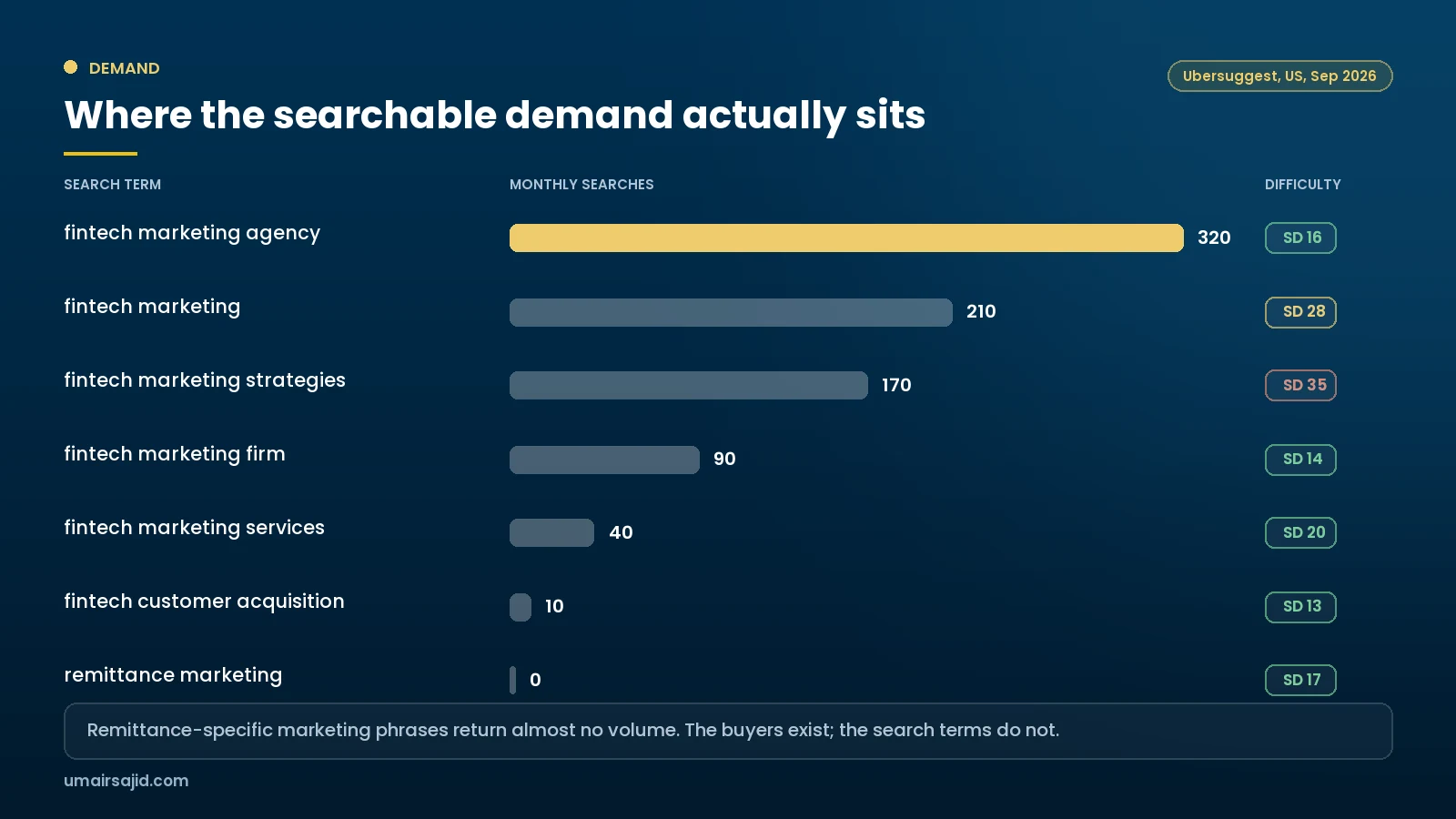
There is almost no search demand for remittance marketing. In the research for this post, `remittance marketing` returned zero monthly searches. `money transfer app marketing` returned no data at all. `remittance marketing agency` and `remittance marketing services`: zero. The nearest phrase with real volume is `fintech marketing` at roughly 210 searches a month, and the whole cluster combined sits under a thousand.
Three consequences follow, and they matter more than the numbers.
Category SEO is not your acquisition channel. If you are waiting for a blog to deliver senders through industry terms, you are waiting for traffic that is not there.
Your real demand is corridor and rate demand. Nobody searches for money transfer apps in the abstract. They search “send money to Nigeria”, “cheapest way to send money to the Philippines”, “USD to PKR rate today”, repeatedly, before anything moves.
The app stores are a search engine with their own demand curve, and for a consumer product they carry more buying intent than Google does. `remittance app` alone runs around 6,600 searches a month, at a difficulty score that shows how firmly the incumbents sit on it.
Reading the results page. Corridor terms belong to rate comparison sites and a few incumbents you will not outspend. The comparison sites are a channel, not an enemy: an accurate listing on them beats trying to outrank them.
Looking at the ads, not the websites. The Meta Ad Library and TikTok’s ad library show which competitor creatives are live, in which language and corridor, and for how long. An ad running three months is working. Last week’s is a test, not a signal.
Mapping the community. Senders cluster where no ad platform can target: community associations, places of worship, grocery and phone shops, employer groups, small creator accounts in the language. Mapping those produces the cheapest acquisition you will find.
The positioning gap. Every remittance brand says fast, safe and low fees. Almost none publishes the exact rate, the fee, the receive amount, the payout time by method, and what happens when a transfer is held. Specific beats superior, and here specific is rare.
The growth roadmap, and why one corridor beats five
The sequencing rule I do not bend: trust before corridor, corridor before capture, capture before scale.
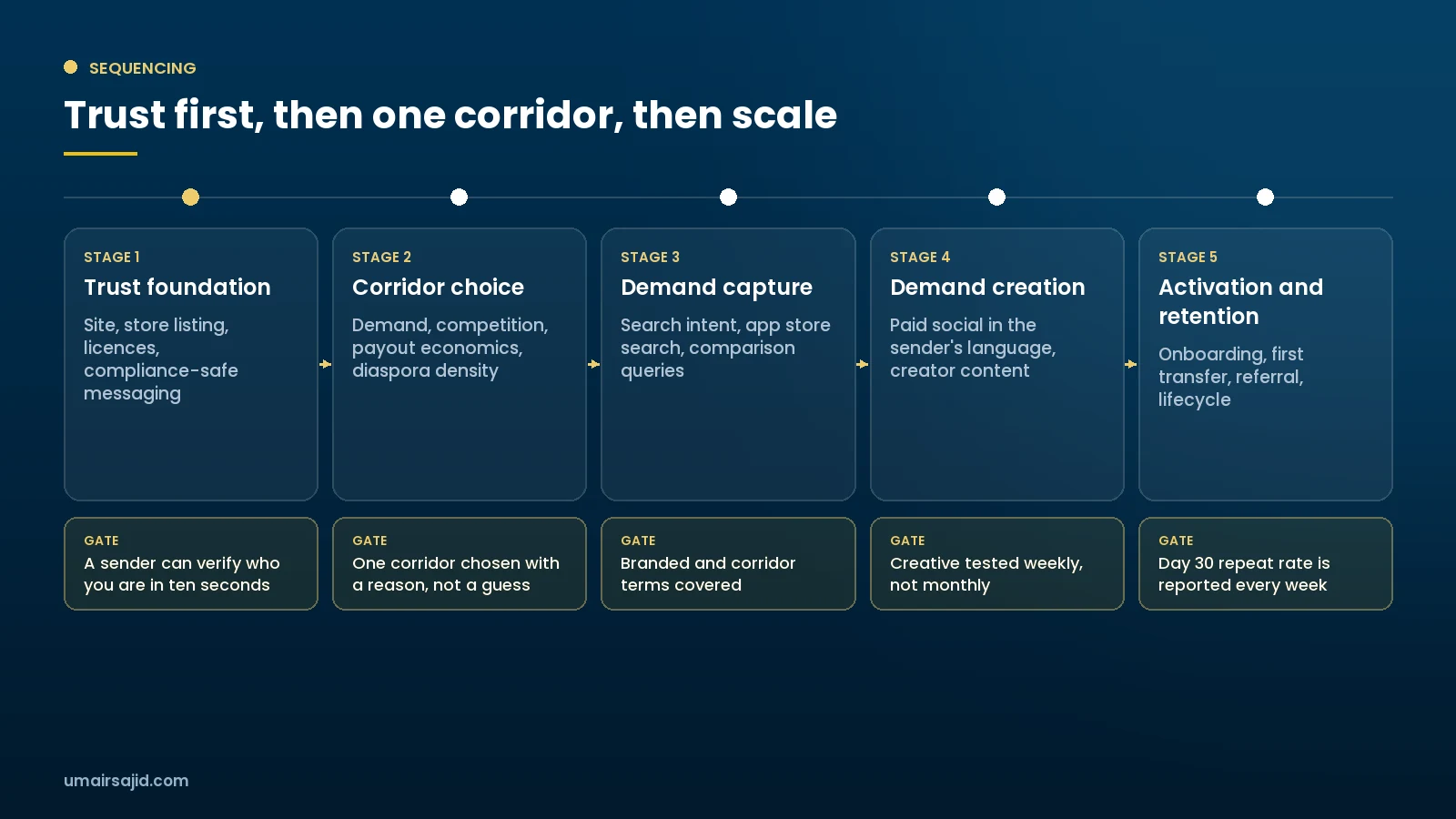
A remittance company’s first job is to be believed. Somebody is about to hand an unfamiliar app a month’s savings and ask it to reach their mother. Traffic aimed at a product that has not answered that is an expensive survey.
Then comes the corridor decision, where most fintech marketing strategy goes wrong. Launching five at once feels efficient and is not, because every corridor is a different product: different payout partners, speeds, regulation, demographics, language, competitors and reasons for sending. Five thin launches give you five half-localized creative sets and five funnels too small to read. One corridor done properly gives you a template and a number you trust.
Each stage has a gate, so progress is not a matter of opinion:
| Stage | What gets built | The gate before moving on |
|---|---|---|
| Trust foundation | Rate and fee transparency, licence and security pages, tracking, KYC instrumentation | Every funded transfer is attributed and the KYC funnel is visible by step |
| Corridor selection | Unit economics per corridor, partner capacity, demand and competitor read | One corridor chosen with the math written down |
| Capture | Corridor page, store listing, Search and store ads, localized creative | Cost per funded sender is known and stable |
| Creation | Paid social, creators, community, referral | The creative library refreshes and the referral loop is live |
| Activation and retention | Lifecycle for transfers two and three, rate alerts, reactivation | Day-30 repeat is a reported number, not an estimate |
One exception. If a corridor has a hard seasonal peak, such as the weeks before a major religious holiday, I pull it forward and build while running, as a trade made with the founder.
Owned media: what a remittance brand actually owns
Owned media is everything that would survive every ad account being disabled tomorrow: the site, the app, the store listing, the rate page, the help center and the sender list.

The page map comes before the design
Home, one page per priority corridor, a rate and fee page, a how-it-works page, trust pages for licences and security, a help center in each sender language, a referral page, the store listings. A small site done properly beats forty thin corridor variants.
Fee and FX transparency is a conversion lever, not a legal chore
This is the highest-return page on the site and the one most teams treat as an obligation. Senders check rates, often daily, sometimes across four apps. If your rate sits behind a signup wall, you are asking somebody to create an account to find out whether they want an account. Most will not.
So put a live calculator on the page: send amount, fee, rate, receive amount, payout time by method. Show the total the receiver gets, because that is what people compare. If your rate is not cheapest, say what it buys: speed, cash pickup coverage, support in their language.
Corridor landing pages that are not clones
A corridor page built by swapping a country name into a template is the pattern Google’s spam policies describe as scaled content abuse, and it risks the whole domain rather than one page. A real one names the payout methods and their speeds, the limits, the documents a sender needs, the holidays that delay payouts, and the current rate. If you cannot write a genuinely different page for a corridor, you are not ready to market it.
The onboarding and KYC flow is a marketing problem
Compliance owns what gets asked. Marketing owns whether people finish it, and that distinction is where growth disappears.
The drop-off points are predictable. Document capture fails on an old camera. The liveness step is unexplained, so it feels like a scam. Source-of-funds questions read like an accusation. Somebody abandons at step four with no way to resume.
The fixes are boring. Explain each request before making it, in one sentence, in their language. Show progress and say how long review takes. Allow a resume link. Put support at the step where people stall. Instrument every step, so the argument about where people leave is settled with a number.
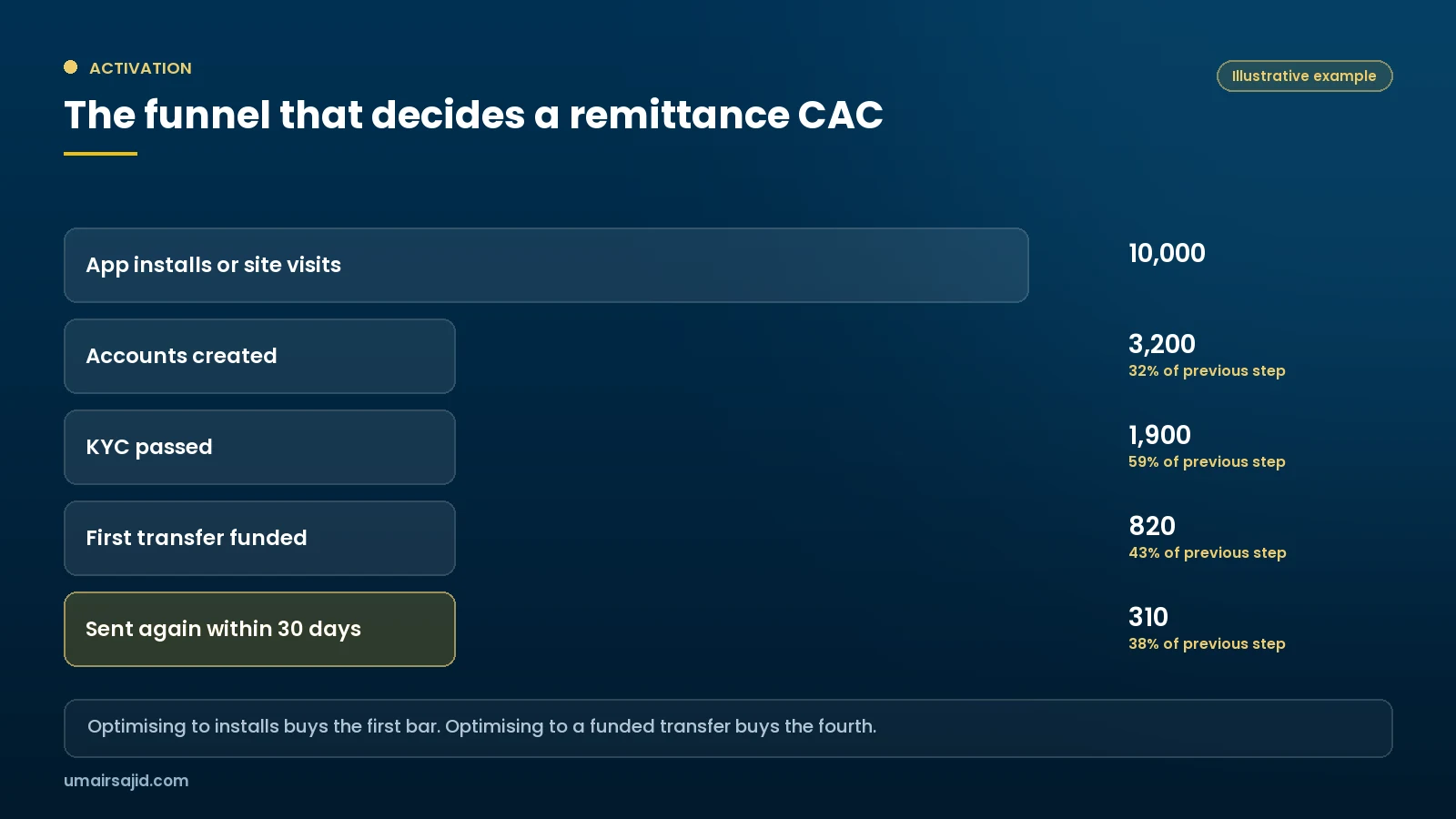
The funnel above is an illustrative example I drew, not a client’s data. The shape is the point: install to signup, signup to verified, verified to funded are three problems with three owners, and one blended rate hides which is costing you money.
On-page SEO, technical SEO and the trust pages
On-page work here is narrow and worth doing anyway: corridor and currency words in titles and H1s, the rate above the fold, FAQ schema, internal links to the rate page. Technically, deep links have to work, localized pages need correct language tags, and the site has to load on a mid-range phone on mobile data.
The trust pages carry more weight than any of it. Name the entity holding the licence and the regulator it answers to, explain how funds are safeguarded, and publish support hours in the sender’s language. That is the cheapest conversion work in remittance, and it is usually buried in a footer.
App store listing and ASO
For a consumer remittance product the store listing sells harder than the website. The title and subtitle carry the words senders type, which are corridor and currency words rather than fintech words. The first two screenshots have to answer rate, fee and payout speed, because most people never swipe. Localize the listing per storefront and sender language, not merely per country.
Ask for ratings after a delivered transfer, never on first open, and reply to reviews. Store rules for financial apps are specific about what a listing may claim, and they change, so check the current policy first.
Social and the content engine
Two platforms in the sender’s language beat five in English, and what performs is not brand content. It is rate explainers, corridor how-tos, receiver-side clips of a payout arriving, and creators who send money themselves.
The rule I give teams: film the parts people are nervous about. The verification step, the moment the receiver gets the notification, a transfer being held. Nervousness is the conversion barrier, so content that reduces it wins. When you want that run properly, social media marketing strategy covers it.
Lifecycle messaging for the second and third transfer
Your first transfer usually loses money. The second and third are the business, and this is the part built last that should be built early.
Six flows cover most of it. Abandoned KYC, with a resume link and an explanation of the step they stalled on. Abandoned first transfer, triggered at the funding step rather than at signup. Transfer confirmation with receiver status, the most opened message you will ever send and so the best place to ask for a referral. A second-transfer nudge timed to the sender’s pay cycle. Rate alerts. Dormancy reactivation for senders who missed a cycle.
Push and email everywhere, SMS where it pays. If the business also handles business transfers or recruits agents, that side runs as its own lead generation funnel, separate from the consumer numbers.
Earned media: the trust you cannot buy
Earned media here is not a PR line item. It is why somebody chooses an unfamiliar app over the shop their family has used for fifteen years.
Diaspora community partnerships. Community associations, grocery and phone shops, travel agents, employer groups and places of worship are where senders concentrate. These work when they are real and reciprocal, and fail when treated as a sponsorship slot. Expect months, and expect them to win on cost.
Creators in the sender’s language. Micro creators who live in the corridor beat large accounts who do not. Brief them tightly, because a creator who promises a rate has created a compliance problem with your name on it. Give them what they may say, what they may not, and freedom with the rest.
Referral mechanics between sender and receiver. The receiver is the next sender’s most credible recommendation, and the confirmation moment is when both are happiest. Pay on a funded transfer rather than a signup, make it two-sided, and cap it per account and per device.
Fraud and incentive abuse, before the offer scales. Every referral program that works gets farmed. The patterns repeat: one device carrying many accounts, one funding instrument across supposedly unrelated users, rings where sender and receiver are the same person. Write the caps and abuse rules before launch, have risk and finance sign them off, and never let marketing own the payout rules alone.
Ask for store reviews after a delivered transfer, and pitch the receiving country’s media rather than the sending country’s tech press. What I never do: buy reviews, buy links, or let a partner promise a rate.
Paid media: fintech customer acquisition without paying for installs
Now we buy users, against the right event, on a corridor we understand.

Platform selection, with reasons. Meta usually comes first, because diaspora audiences are reachable by language and affinity and the formats suit the story you need to tell. TikTok earns its place on corridors with a younger sending population, where somebody will produce creator-style video weekly; TikTok advertising is worth testing once that engine exists. Google Search captures corridor intent and defends your brand terms against competitors, who will bid on them. Apple Search Ads and Google App campaigns pick up store intent, and they waste money fastest when the conversion event is wrong.
Policy first, creative second. Financial services advertising carries extra requirements on every major platform: business verification, restricted categories, country rules, limits on what copy may claim. These differ by platform and market and get revised, so check the current policy in each platform’s own ad policy center before writing a line, and again when you add a corridor. The penalty is not a rejected ad. It is a disabled account.
Account structure. One corridor per campaign, not a campaign for “Europe”. Prospecting and retargeting separated, app and web separated. The point is that when something moves, you can say what moved.
Creative, and what changes beyond translation. Localized creative in the sender’s language is the biggest single lever here, and translation is the first ten percent of it. What else changes: the payout method shown, because a cash pickup corridor and a mobile wallet corridor are different products in the viewer’s mind. The send amount, because a typical transfer differs by corridor and a wrong number makes an ad feel foreign. The occasion, whether school fees, a medical bill or monthly support. The scene, the faces, the currency format, the reading direction, the claim itself. One English creative across six corridors is the most common waste here, always defended as a test.
Volume matters as much as quality: six to ten pieces per corridor per month, mostly unpolished, because polished fintech advertising reads like a bank. Facebook advertising and Google Ads management cover this when you want it run rather than explained.
The event you optimize toward. The funded first transfer, sent server-side, often enough to leave the learning phase. When a new corridor cannot yet produce that volume, I optimize to verified signup as an interim and hold the platform accountable on the downstream rate in my dashboard. What I do not do is optimize to installs and hope.
Budget logic. Budget is set per corridor against cost per funded sender and payback, not as a monthly total split by channel. Because a first transfer often loses money, the real ceiling on fintech customer acquisition cost is your repeat rate, not your margin on transfer one. Write the scaling and stopping rules before launch.
The measurement stack
If you cannot see which spend produced a funded transfer, everything above is guesswork with an invoice attached.
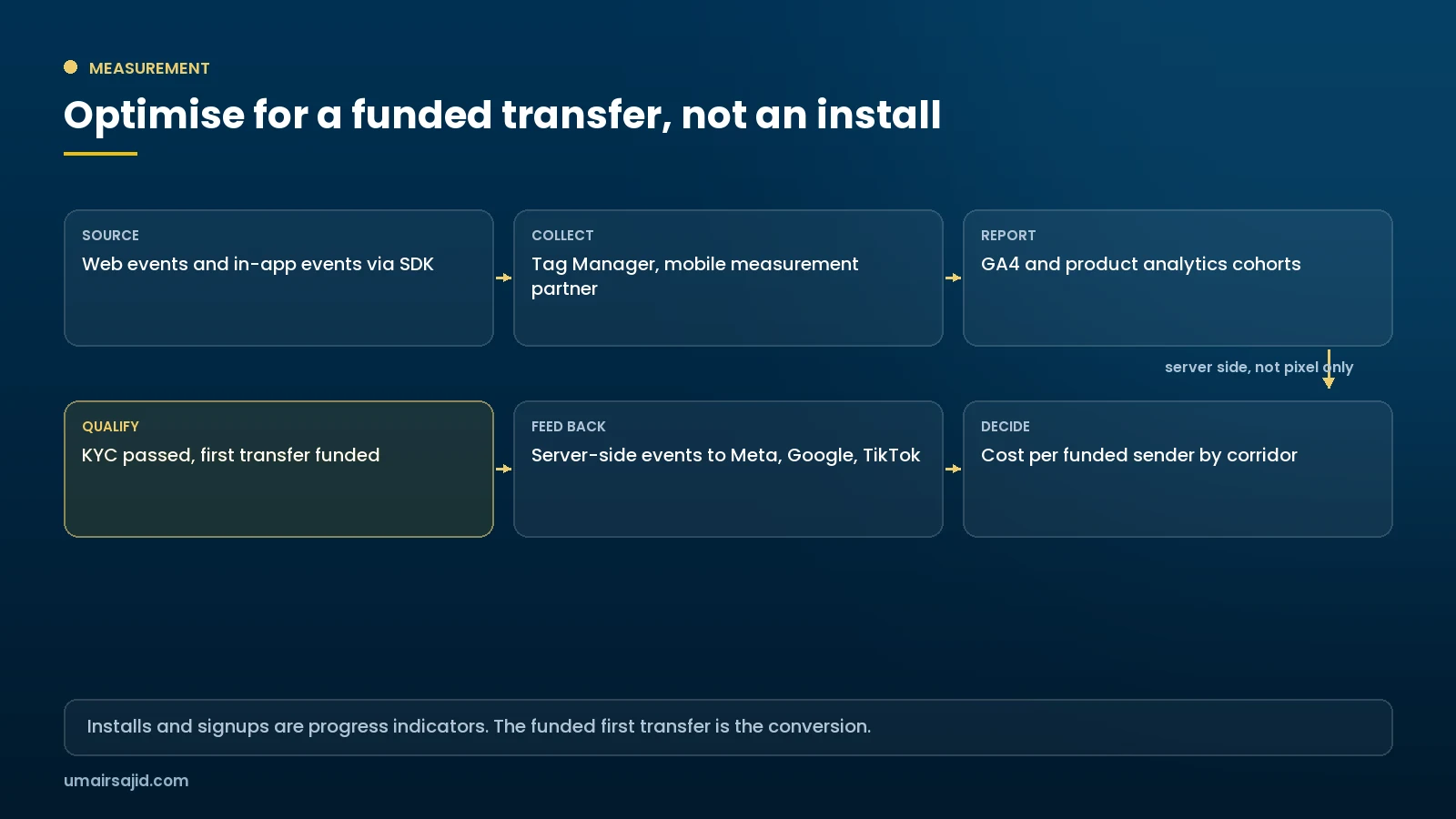
What counts as a conversion. Verified signup and funded first transfer. Not installs, not registrations. Two events, defined once, named identically everywhere.
The stack. A measurement partner for app attribution, a server-side tag container for web, the product database as the source of truth, a cohort dashboard, and conversion APIs sending the real events back to Meta, TikTok and Google.
Why pixel-only tracking understates a fintech funnel. The event that matters happens late. Somebody clicks at lunchtime, starts verification that evening, waits for a review, and funds a transfer two days later on a different device at midnight. A browser pixel cannot see that. It cannot see in-app events, it loses the user when the browser closes, and it is limited by extensions and privacy changes. Server-side events, sent from your backend with a shared event ID, are what make the funded transfer visible to the systems spending the money.
Consent mode gets configured properly, identifiers stay hashed, and a legal review covers what you send an ad platform about a customer.
The one report. Per corridor: spend, verified signups, cost per verified signup, funded first transfers, cost per funded sender, transfer volume, day-30 repeat. If it takes longer to read than to act on, it is wrong.
Attribution honesty. Last click badly undercounts community work, creator content and word of mouth, the channels that matter most here. Corridors are natural test cells: pause a channel on one, hold another steady, measure the difference. Fraud checks belong on the same page, because a sudden drop in cost per funded sender is sometimes creative and sometimes a referral ring.
Where AI and automation carry the load
AI earns its place here by removing hours from research and support so the human work gets attention.
Corridor research is the clearest win: clustering search terms across languages, reading competitor reviews at volume, turning support tickets into a theme list for creative.
Localization drafts come second, with a caveat. Machine translation produces fluent copy and confident errors, and here the errors are about money, payout methods and claims. Every localized asset gets a native speaker who knows the corridor. The draft saves an hour. The reviewer saves the account.
On the operations side I automate support triage, KYC step explainers, transfer status notifications, churn scoring and the weekly reporting pull.
What I do not automate: anything compliance signs off, ad copy approval, and communication about a held transfer. A held transfer is somebody’s rent. That conversation gets a person.
How the work actually runs
A plan nobody can execute is a document. The engagement has a shape:
- Kickoff, where access is granted, the corridor math is agreed, and the stop list is written down.
- A weekly call of thirty minutes, same time, same six numbers on screen.
- A monthly review of cost per funded sender and repeat rate, by corridor.
- A quarterly corridor review, where a corridor is scaled, fixed or closed.
Who does what: I own strategy, the site, the store listing, paid media, tracking, lifecycle and reporting. Compliance owns copy sign-off, a gate rather than a suggestion, so it goes in the calendar with a deadline. Product owns fixes to the KYC flow, which is why the drop-off data has to be undeniable before I ask. Support owns language coverage and hands me the objection list.
Everything lives in one board, one decisions log and one dashboard, and at the end you own the accounts, the data and the plan.
The first 90 days
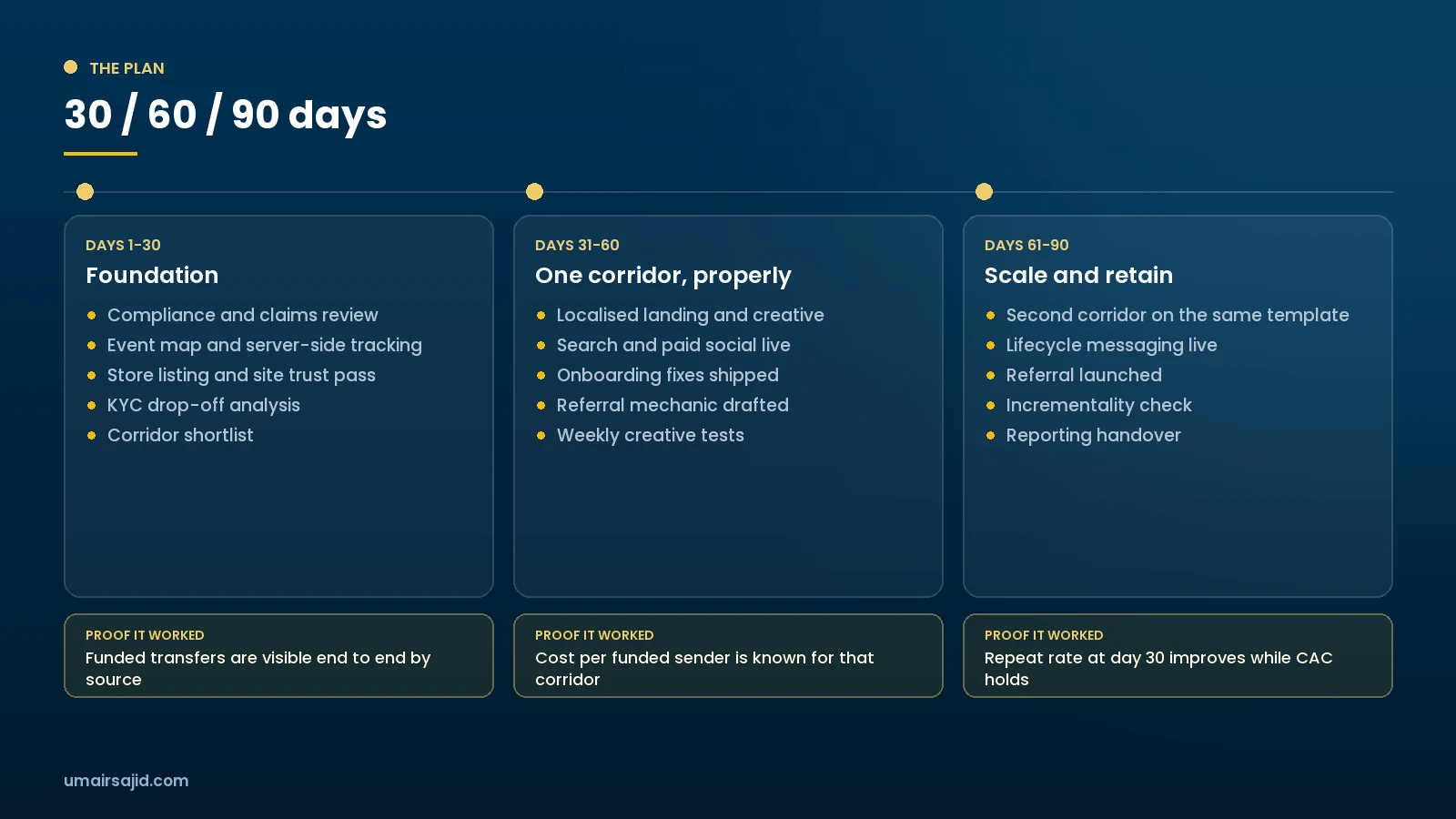
Days 1 to 30: foundation and visibility. Access and audit. Server-side events live for verified signup and funded first transfer, with deduplication. The KYC funnel instrumented step by step. Ad accounts verified for financial services against the current policy. The rate and fee page rebuilt with a live calculator. Corridor unit economics written down so the choice is arithmetic rather than instinct. Proof it worked: every funded first transfer appears in the dashboard with a source and a corridor.
Days 31 to 60: one corridor, launched properly. The corridor page written for real. Store listing localized for that corridor’s senders. Six to ten creative pieces in the sender’s language. Meta and Search live, optimizing to a real event. Lifecycle flows for abandoned KYC and first transfer. Community and creator conversations started, which take longer than media buying. Proof it worked: cost per funded sender is stable enough to plan against.
Days 61 to 90: scale and the repeat loop. Scale what converts, cut what does not. Referral launched with caps and abuse rules signed off by risk. Second and third transfer flows live. Rate alerts running. A first geo holdout. Corridor two prepared, not launched. Proof it worked: day-30 repeat holds or rises while cost per funded sender falls.
What this looks like after ninety days
An honest picture, because remittance growth decks are usually fiction.
Paid channels give a readable click and signup signal within two to three weeks, but funded-transfer data takes longer, because the event sits downstream of verification. Fixes to the KYC flow show up in days, and they are the fastest wins in the plan. Store optimization moves over four to eight weeks. Corridor pages take three to six months and will still never be your largest channel, which is what the research at the top of this post said.
For context on the paid side: a money-transfer app I worked with cut cost per click by 40 percent and lifted transaction volume by 70 percent after its Facebook campaigns were restructured around the right conversion event, and a payments product raised conversions by 50 percent while cutting cost per acquisition by 30 percent through paid search and landing-page work. Those were their results, on their corridors. Yours will depend on your unit economics and your KYC pass rate.
I have written the same playbook for landscaping companies, appliance repair businesses, AI app companies and small businesses, and the framework applied to live accounts sits in the case studies.
The mistakes I stop first in remittance marketing
- Optimizing for installs. An install is a tap. Feed the platforms a funded transfer and the same budget buys a different kind of user.
- One English creative for every corridor. It underperforms on all of them, and the underperformance gets blamed on the platform.
- Launching five corridors at once. Five thin launches produce no readable data and no template. One corridor done properly produces both.
- Treating KYC drop-off as compliance’s problem. It is the largest fixable loss between spend and revenue, and it sits in the marketing funnel either way.
- Hiding the rate and the fee until after signup. A wall at the comparison step costs you the people doing their homework, who are the ones worth having.
- Discount-only acquisition. A free first transfer buys a first transfer. Without a reason to come back, you rented a transaction at a loss.
- No repeat-sender program. The model is repeat. Acquisition without lifecycle is filling a bucket with a hole in it.
- A referral offer with no abuse rules. Write the caps, device checks and payout conditions before launch. The people who farm these offers move faster than finance.
FAQ
How do you market a money transfer app?
Start with product facts rather than channels: visible fees and rates, a verification flow people can finish, and one corridor where the unit economics work. Then buy users against a funded first transfer, with creative in the sender’s language, and build lifecycle messaging for transfers two and three. Money transfer app marketing usually fails because spend arrives before the funnel is measurable.
Which corridor should you launch first?
The one where three things line up: partner cost leaves a workable margin, your licence covers it, and you have existing senders to learn from. Volume matters least, because a large corridor you lose money on drains the budget fastest.
What do Meta and Google allow for financial services advertising?
Both run extra requirements for financial products: business verification, category restrictions and country rules about what copy may claim. The specifics differ by platform and market and change, so check the current policy in each platform’s own ad policy center. Plan for verification to take time.
Should the KPI be installs or the first transfer?
The first funded transfer. App user acquisition for remittance products goes wrong when install volume becomes the scoreboard, because installs are easy to buy and say nothing about whether money moved. Track them as a diagnostic, and pay for funded senders.
How do you lower fintech customer acquisition cost?
Four levers, in order of payback: fix the KYC drop-off, send funded-transfer events server-side, localize creative per corridor, and build lifecycle loops so the second transfer is not bought twice. Cutting bids is the last lever, not the first.
Does app store optimization matter for a remittance app?
Yes, more than most teams expect, because store search carries corridor intent and the listing sells to people who never see your website. Title, subtitle, the first two screenshots and your rating carry the weight.
How long before a channel is reliable?
Paid social and search give a usable signal on clicks and signups in two to three weeks, and a trustworthy cost per funded sender in six to eight, because the conversion sits downstream of verification. Store work moves in four to eight. Anyone quoting faster on organic is guessing.
Do you need a fintech marketing agency, or can an in-house team run this?
Plenty of in-house teams run content, lifecycle and community well once the structure exists. The parts that need outside help are measurement, the paid account structure and the corridor economics, because those three decide whether everything else pays for itself. A free thirty-minute review gives you the priority list.
Where to start
If you take one thing from this, take the order. Believability before corridors, one corridor before five, a measured funnel before real spend. It is slower than launching ads on Monday, and it is why cost per funded sender is still falling in month six.
The first move costs nothing. Pull last month’s installs, signups, verified users and funded first transfers by corridor, and look at the drop between each pair. If you cannot produce those numbers, start there.
Free 30-minute remittance growth review. I will look at your funnel from install to funded transfer, your tracking, your store listing and your ad accounts, and name the two things to fix first and the one thing to stop paying for. No pitch, and the notes are yours either way. Book the call.